

The case
The letters Andrew Helgelien received from La Porte, Indiana, were warm, practical and insistent. A widow with a good farm, they said, was looking for a hard-working Scandinavian man to share it; he should sell up, bring his money and tell no one. Helgelien, a bachelor farmer from South Dakota, arrived in January 1908 with his savings. Within days he had vanished. When his brother Asle wrote asking after him, the widow replied that Andrew had gone away, perhaps to Norway.
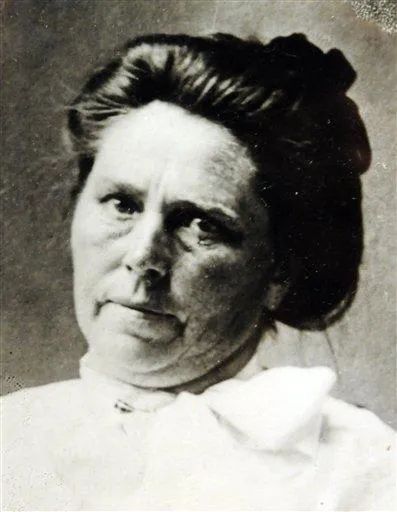
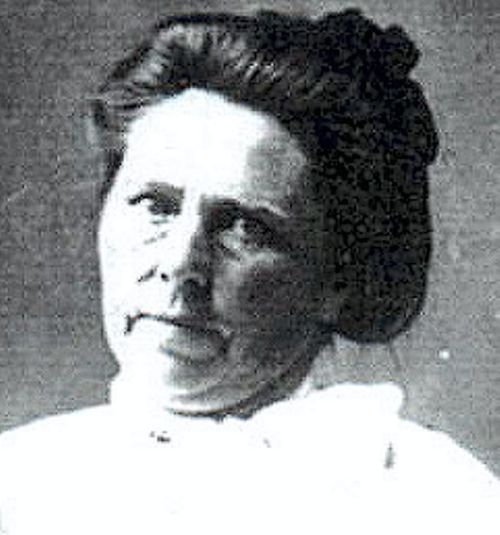
The widow was Belle Gunness, born Brynhild Paulsdatter Størset in Selbu, Norway, in 1859. She had emigrated in 1881, joined a sister in Chicago and married Mads Sørensen in 1884. Their life together was punctuated by fires and insurance payments: a candy store and a house burned, two infant children died, and on July 30, 1900, the one day on which two life policies on Sørensen overlapped, he died suddenly at home. Belle collected on both and bought a farm on the edge of La Porte. In 1902 she married Peter Gunness; within a week his infant daughter had died in Belle's care, and that December Peter himself died of a head injury that she blamed on a falling meat grinder. A coroner's jury was suspicious, but nothing came of it.
From about 1905 Belle advertised in Chicago newspapers for a husband. Men answered from Wisconsin, Minnesota and the Dakotas. Several came to the farm with money, and their families never heard from them again. Belle explained the departures easily; she kept their trunks and coats. Her foster daughter Jennie Olson also disappeared in 1906, said to have gone to school in California.
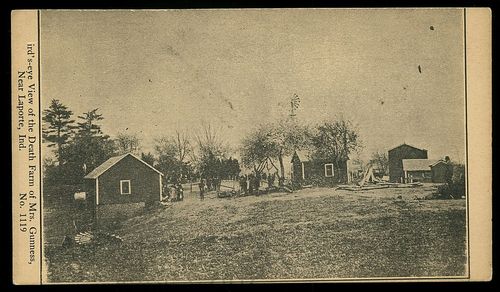
In the early hours of April 28, 1908, the farmhouse burned to the ground. In the cellar searchers found the bodies of Belle's three children, Myrtle, Lucy and Philip, and of an adult woman without a head, who was taken to be Belle. Suspicion fell at once on Ray Lamphere, a former hired hand and sometime lover with whom she had quarreled bitterly and whom she had publicly accused of threatening her.
Then Asle Helgelien came looking for his brother. With a former farmhand he pointed searchers to patches of soft ground in the hog lot. In early May they dug up Andrew Helgelien's remains, and within days the remains of about a dozen more people, including Jennie Olson. Most of the men were never identified. The kindly widow of the first newspaper reports became, almost overnight, the center of one of the largest murder stories in the country.
Ray Lamphere was charged with murder and arson. At his trial in November 1908 the jury acquitted him of murder but convicted him of arson, and he was sent to the Indiana State Prison, where he died of tuberculosis about a year later. Before his death he reportedly told a minister that Belle had killed the men for their money and that she had escaped the fire after planting another woman's body in the cellar. Whether Belle Gunness died that night or walked away has never been settled.
Who lost out
Most of the people who died on the Gunness farm were men who wanted what her advertisements promised: a home, a wife and a share in a working farm. Andrew Helgelien brought his savings from South Dakota; Henry Gurholt was a Wisconsin farmhand who wrote home that he liked the place and asked his family to send seed potatoes; John Moe of Minnesota withdrew his savings to make the move. Many others were never named, because the remains could not be matched to anyone or because no one came to ask.
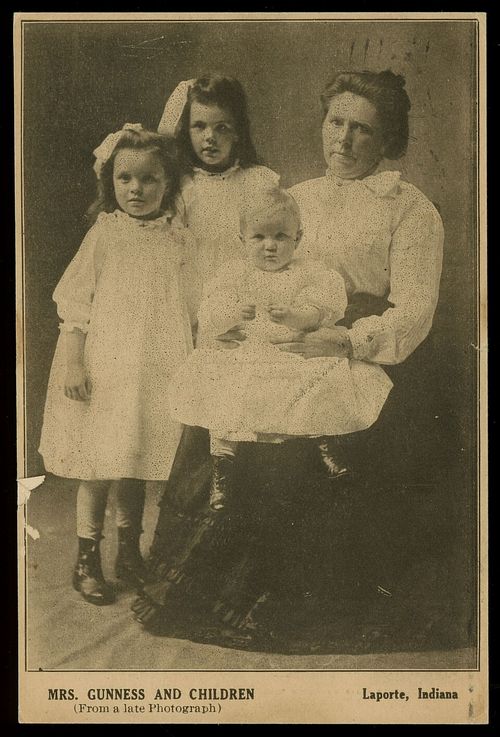
The children are the most painful part of the record. Jennie Olson was Belle's foster daughter, a teenager who had lived with her for years. Myrtle and Lucy Sørensen were Belle's daughters by her first marriage, and Philip Gunness, the youngest, was her son with Peter Gunness. They died in the fire at about eleven, nine and five years old.
Timeline
Brynhild Paulsdatter Størset is born in Selbu, Norway.
She emigrates to the United States and settles in Chicago as Belle.
She marries Mads Sørensen in Chicago.
Sørensen dies on the day two life insurance policies overlap; Belle collects on both and buys a farm at La Porte.
She marries Peter Gunness, whose infant daughter dies in her care a week later.
Peter Gunness dies of a head injury; a coroner's jury reaches no charge.
Belle's foster daughter Jennie Olson disappears.
Andrew Helgelien arrives at the farm from South Dakota and disappears.
The farmhouse burns; the bodies of three children and a headless woman are found in the cellar.
Excavation of the hog lot uncovers the remains of Andrew Helgelien and about a dozen other people.
Ray Lamphere is acquitted of murder but convicted of arson.
Lamphere dies in the Indiana State Prison.
People in the case
-
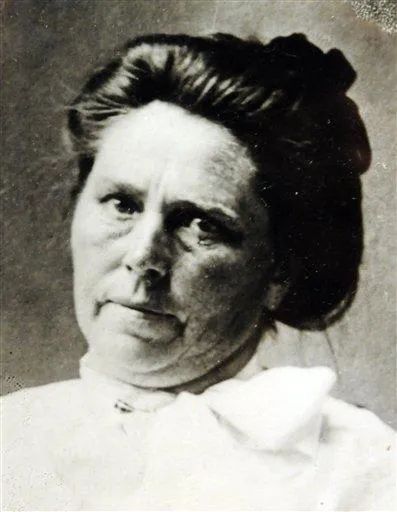
Belle Gunness Perpetrator
11 November 1859 – ?
Born Brynhild Paulsdatter Størset in Selbu, Norway; never tried. Legally presumed to have died in the fire of April 28, 1908, but her fate is unknown.
-
Ray Lamphere Accused
? – 1909
Belle's former hired man; acquitted of murder but convicted of arson in November 1908; died in prison.
-
Andrew Helgelien Victim
? – January 1908
South Dakota farmer who answered Belle's advertisement; his remains were the first identified in the hog lot.
-
Asle Helgelien Witness
Andrew's brother, whose search for him led to the discovery of the graves.
-
Jennie Olson Victim
? – 1906
Belle's foster daughter, said in 1906 to have gone to school in California; her remains were found on the farm.
-
Peter Gunness Victim
? – December 1902
Belle's second husband, killed by a head injury eight months after the wedding; officially an accident.
-
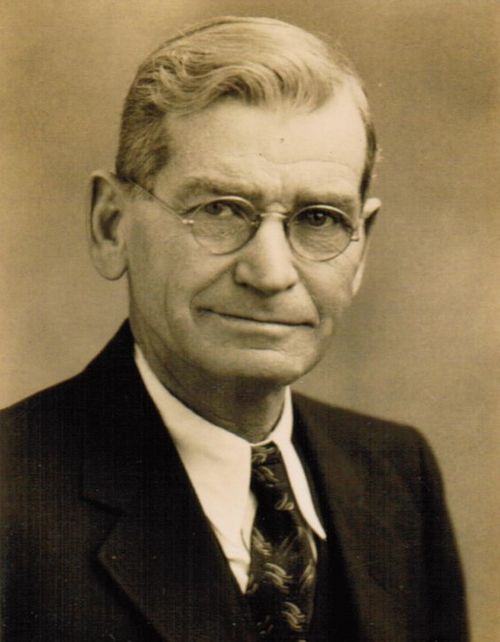
Edward Bechly Also involved
3 March 1874 – 31 August 1945
Journalist who sought and published a later Lamphere confession.
Where it happened
- La Porte, Indiana. The Gunness farm lay on the northern edge of town; the house was destroyed by the 1908 fire.
- Indiana State Prison, Michigan City. Where Ray Lamphere served his sentence and died.
- Selbu, Norway. Belle Gunness's birthplace.
Outcome
Never caught Never tried
Belle Gunness was never charged; the authorities treated the headless body in the cellar as hers, partly on the strength of dental work found in the ashes. Ray Lamphere was tried for murder and arson in November 1908, acquitted of murder and convicted of arson, and died in prison. No one else was charged.
What the record settles, and what it doesn't
Established
- Belle Gunness's farmhouse at La Porte burned on April 28, 1908, killing her three children, Myrtle, Lucy and Philip.
- In May 1908 the remains of Andrew Helgelien and about a dozen other people were found buried on the farm.
- Belle had placed advertisements seeking a husband and corresponded with men who then traveled to the farm and disappeared.
- Her first husband died on the day two life insurance policies on him overlapped, and her second husband died eight months after their wedding.
- Ray Lamphere was acquitted of murder but convicted of arson in November 1908.
- The identity of the headless woman found in the cellar has never been confirmed.
Disputed
- Whether Belle Gunness died in the fire: the coroner accepted the headless body and a dental bridge found in the ashes as hers, while a local doctor and many others argued the body was too small, and reported sightings continued for decades.
- How many people she killed: estimates range from about fourteen to more than forty, since many remains were never identified.
- Whether her husbands and young children who died before 1908 were murdered, which is widely believed but was never proven.
- Ray Lamphere's role: his reported confessions accused Belle and described her escape, but they were made privately and published only after his death, and he may have helped her or been her dupe.
- Whether a woman arrested in Los Angeles in 1931, Esther Carlson, who died awaiting trial for poisoning, was Belle; the claim has never been proven.
In the newspapers of the day
Clippings from American newspapers digitised by the Library of Congress. The excerpt under each is the library's machine-read text, uncorrected; read the original page for the full report.
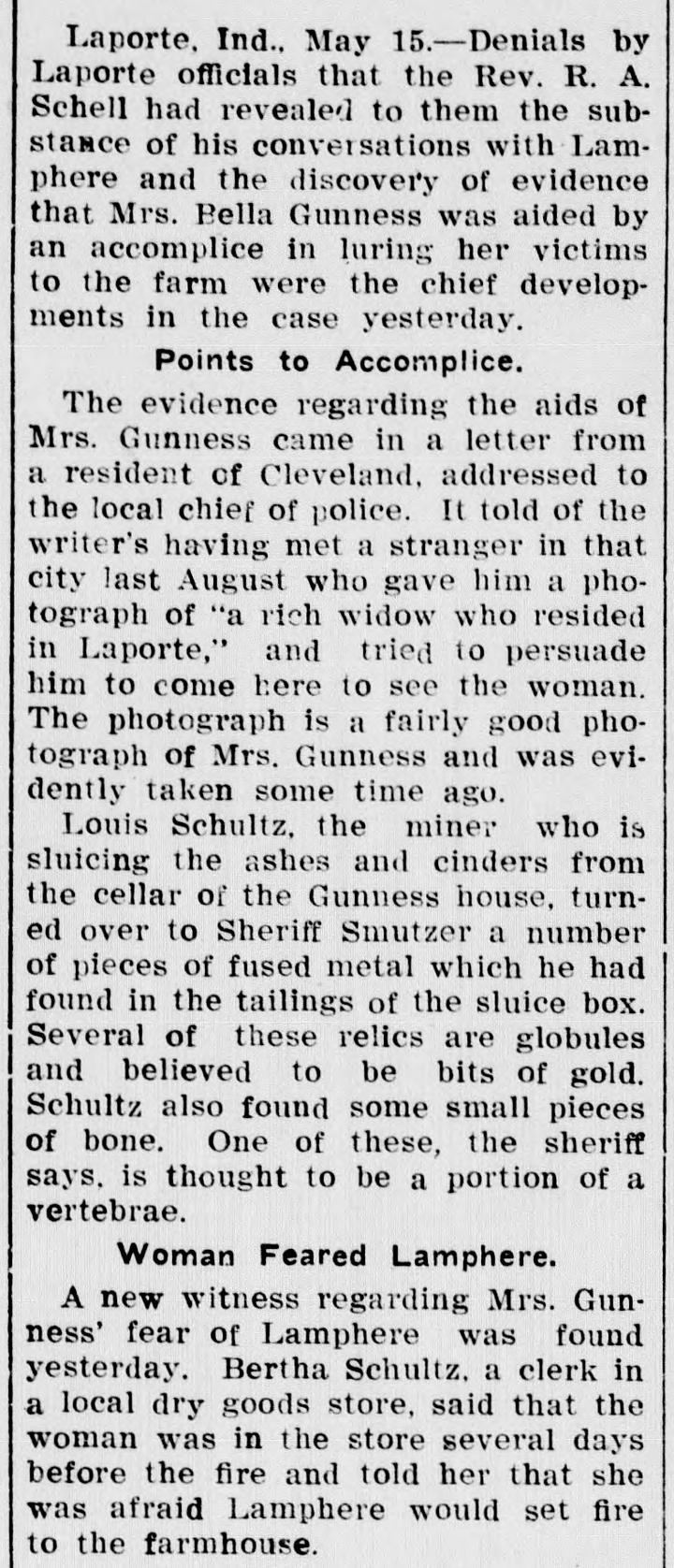
The wibaux pioneer (Wibaux, Mont.)
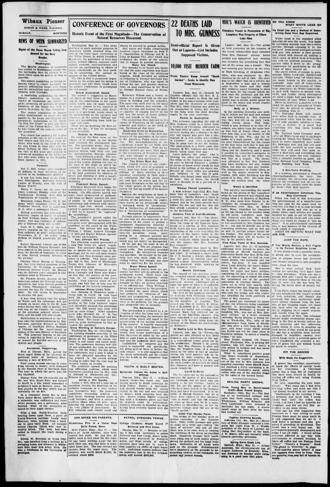
, page 2 · The fire and the bodies in the hog lot
I.aporte. Ind.. May 15.—Denials by Laporte officials that the Rev. R. A. Schell had revealed to them the sub- stance of his conveisations with Lam- phere and the discovery of evidence that Mrs. Pella Gunness was aided by an accomplice in luring her victims to the farm were the chief develop- ments in tlie case yesterday. Points to Accomplice. The evidence regarding the aids of Mrs. Gunness came in a letter from a resident cf Cleveland, addressed to the local chief of police. It told of the writer's having met a stranger in that city last August who gave him a pho- tograph of "a rich widow who resided in Laporte," and tried to persuade him to come here to see the woman. The photograph is a fairly good pho- tograph of Mrs. Gunness and was evi- dently taken some time ago. Louis Schultz, the miner who is sluicing the ashes and cinders from the cellar of tho Gunness house, turn- ed over to Sheriff Smutzer a number of pieces of fused metal which he had found in the tailings of the sluice box. Several of these relics are globules and believed to be bits of gold. Schultz also found some small pieces of bone. One of these, tlie sheriff says, is thought to be a portion of a vertebrae. Woman Feared Lamphere. A new witness regarding Mrs. Gun- ness' fear of Lamphere was found yesterday. Bertha Schultz, a clerk in a local dry goods store, said that the woman was in the store several days before the fire and told her that she was afraid Lamphere would set fire to the farmhouse. Jawbone That of Arch-Murderess. Laporte, Ind., May 17.—"The identi- fication of the piece of jawbone taken from the ruins of the Gunness farm- house as a portion of Mrs. Gunness …
Evening star (Washington, D.C.)
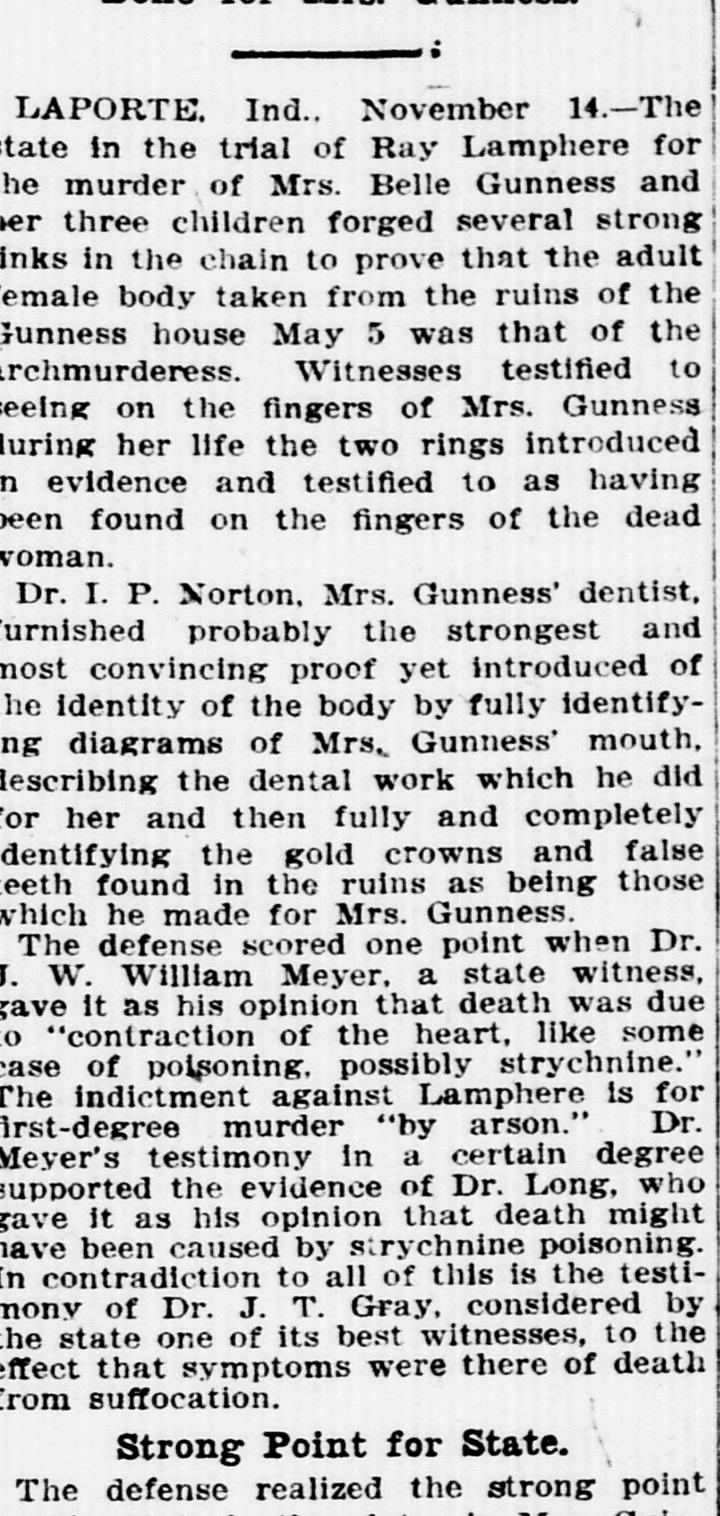
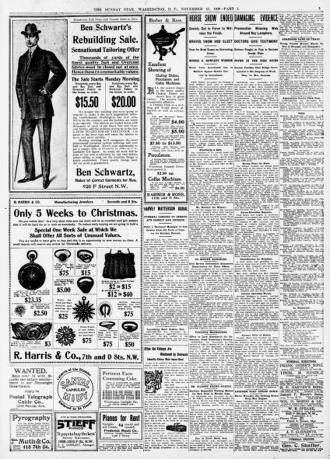
, page 5 · Ray Lamphere's trial
I hAPORTE. Ind.. November 14.?The ate In the trial of Ray Lamphere for e murder of Mrs. Belle Gunness and r three children forged several strong iks in the chain to prove that the adult male body taken from the ruins of the .inness house May 5 was that of the chmurderess. Witnesses testified to elng on the fingers of Mrs. Gunness iring her life the two rings introduced evidence and testified to as having en found on …
New-york tribune (New York [N.Y.])
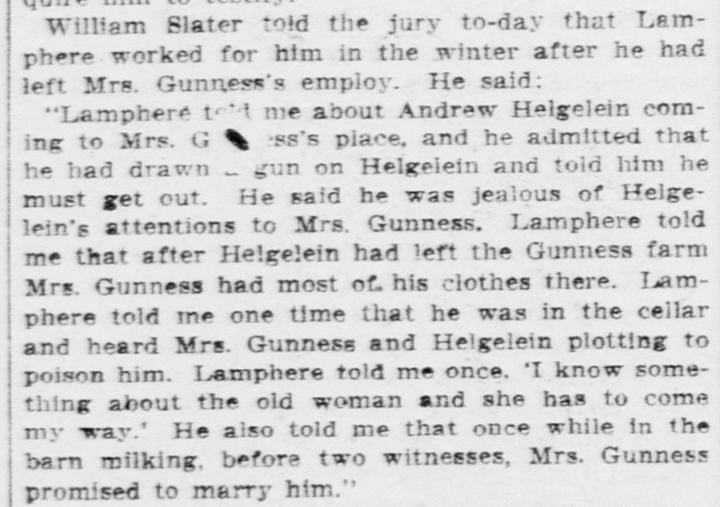
, page 5 · Ray Lamphere's trial
William Slater toid the jury to-day that Lam- phere worked for him in the winter after he had jeft Mrs. Gunness's employ. He said: “Lamphere t-°1 me about Andrew Heigelein com- ing to Mrs. G § ‘'ss’s place, and he admitted that he had drawn . gun on Helgeiein and toid him he must get cut. He said he was jealous of Helge- lein’s attentions tc Mrs. Gunness. ILamphere told me that after Helgelein had left the Gunness …
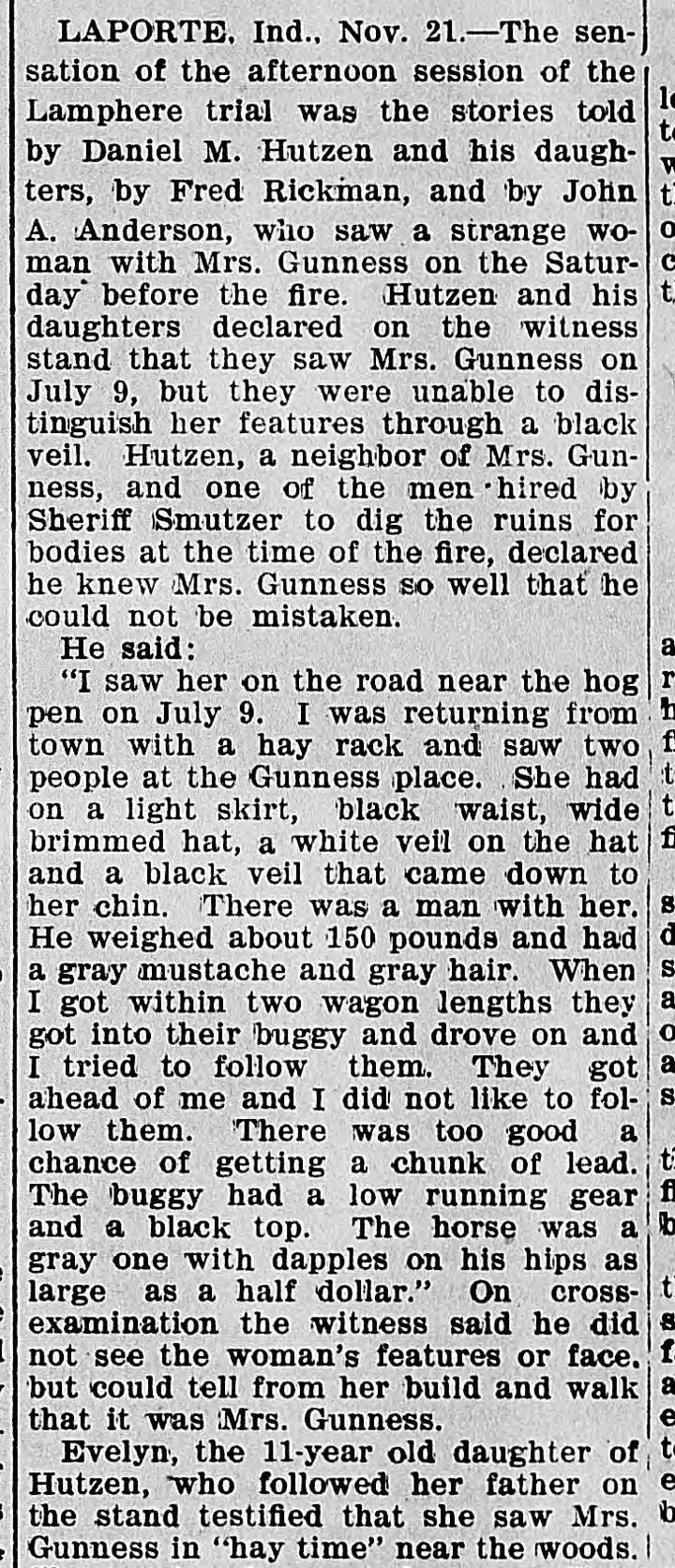
The billings gazette (Billings, Mont.)
, page 3 · Ray Lamphere's trial
Lamphere trial was the stories told by Daniel M. Hutzen and his daugh- ters, by Fred Rickinan, and by John A. Anderson, who saw a strange wo- man with Mrs. Gunness on the Satur- day' before the fire. ,Hutzen and his daughters declared on the witness stand that they saw Mrs. Gunness on July 9, but they were unable to dis- tinguish her features through a black veil. Hutzen, a neighbor of Mrs. Gun- ness, and one of the men-hired 'by Sheriff Smutzer to dig the ruins for …
Source: Chronicling America: Historic American Newspapers, Library of Congress. Public domain.
Pictures




Afterwards
The farm became a macabre attraction in the summer of 1908, with crowds, postcards and souvenir hunters, and the story ran in newspapers across the country. Lamphere's death in prison removed the one person who might have answered the central question. Over the years reported sightings of Belle came from Chicago, Mississippi, California and elsewhere, and a theory that she lived on in Los Angeles under another name has never gone away.
The case is remembered as one of the earliest well-documented examples of a woman who killed repeatedly for money, and her lonely-hearts method gave a phrase to later crimes. In 2008 researchers exhumed the headless body in the hope of comparing its DNA with saliva from letters Belle had sent, but the samples were too degraded to settle the matter. The question of her fate remains open.
Questions readers ask
Did Belle Gunness die in the fire?
Nobody knows. The authorities ruled that a headless woman's body found in the ruins was hers, but a doctor who knew her said the body was too small, and DNA testing in 2008 was inconclusive. She may have planted the body and escaped.
How many people did Belle Gunness kill?
The remains of about a dozen people were found on her farm in 1908, besides her three children who died in the fire. Estimates of her total victims, including suspicious earlier deaths, range from around fourteen to more than forty.
Who was Ray Lamphere?
Belle's former hired man and lover. He was charged with setting the 1908 fire, acquitted of murder and convicted of arson, and died in prison. Statements attributed to him said Belle had killed the men and escaped.
Sources and further reading
- Belle Gunness (Wikipedia)
- Chronicling America: Gunness coverage, April-June 1908
- Wikidata Q269709 (life dates checked here)
Written by Sinister Crimes from the sources above; see our editorial standards. Last checked 1 November 2026.