

The case
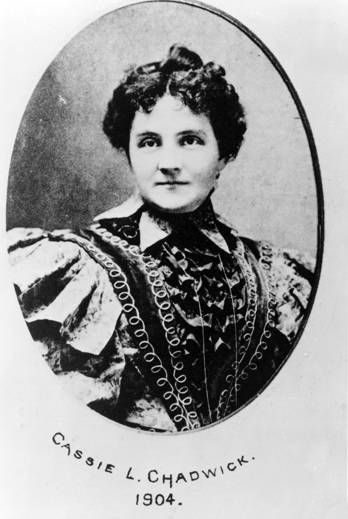
In late November 1904 a Massachusetts banker named Herbert Newton went to court in Cleveland to recover a loan of about $190,000. His debtor was Cassie Chadwick, wife of a respected physician, mistress of a house on Euclid Avenue, then known as Millionaires' Row, and, by persistent and carefully placed rumour, the illegitimate daughter of Andrew Carnegie. Within weeks the rumour had collapsed, a small-town national bank had shut its doors, and the press had discovered that Mrs Chadwick had a criminal record stretching back a quarter of a century under a string of other names.
She was born Elizabeth Bigley in 1857 in what was then Canada West, one of eight children of a railway worker. Her career in forgery began in her teens. In 1879 she was tried at Woodstock, Ontario, for passing forged notes, and was acquitted after her lawyers argued she was insane. She moved to Cleveland, where she told fortunes as Madame Lydia DeVere, and in 1882 married a doctor, Wallace Springsteen, who threw her out within days when creditors appeared at his door. Around 1889 she was convicted in Toledo of forgery and sent to the Ohio Penitentiary; she was paroled in 1893.
Back in Cleveland, now calling herself Mrs Cassie Hoover, she met Dr Leroy Chadwick, a widower of good family, and married him in 1897. The Carnegie story seems to have been launched soon afterwards. According to the most common account, on a trip to New York she had an acquaintance of her husband, a lawyer, drive her to Carnegie's Fifth Avenue mansion and wait outside. She went in, apparently spoke only to the housekeeper, and came out with a story and a document: a promissory note bearing Carnegie's name. Swearing him to secrecy, she confided that she was the steel magnate's natural daughter, that he had given her notes worth millions out of guilt, and that she stood to inherit a fortune. The secret, as she intended, did not stay secret.
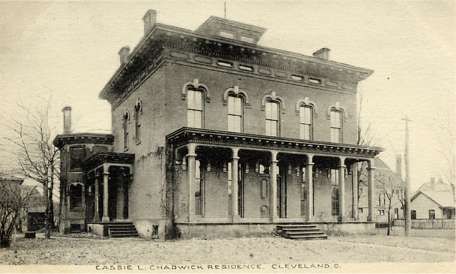
The idea's strength was that it could not easily be checked. No banker wanted to ask the richest man in America whether he had a hidden child, and the notes appeared to promise repayment in full. For several years Chadwick borrowed from banks and private lenders in Ohio and beyond, often at high interest, offering forged or worthless securities as backing. She spent lavishly on jewellery, clothes, furniture and gifts, and became a figure of fascination, if not acceptance, on Euclid Avenue.
The heaviest exposure was at the Citizens' National Bank of Oberlin, whose president, Charles Beckwith, and cashier, A. B. Spear, had advanced her large sums, some of them by certifying her cheques when she had no funds to cover them. When Newton called in his loan and other creditors followed, the bank could not survive the run, and it closed. Carnegie said through his representatives that he did not know her and had signed no such notes. Chadwick was arrested in New York in December 1904 and brought back to Cleveland. Her husband had left for Europe.
Federal prosecutors charged her with conspiring with the Oberlin bank officers to violate the national banking laws. Her trial in the United States District Court at Cleveland opened on 6 March 1905, drew crowds and reporters from across the country, and ended with her conviction on seven counts. On 27 March Judge Robert W. Tayler sentenced her to ten years in the Ohio Penitentiary. Beckwith died before he could be tried; Spear pleaded guilty and received seven years.
Her appeal failed in November 1905, and she entered the penitentiary at Columbus at the start of 1906. Her health declined quickly. She died in the prison on 10 October 1907, her fiftieth birthday, and was buried in Woodstock, Ontario, the town where her first forgery trial had been held.
Who lost out
The heaviest losses fell on the depositors of the Citizens' National Bank of Oberlin, a small-town Ohio bank whose officers had lent Chadwick far beyond its means; when it failed in late 1904, ordinary account holders in Oberlin, including people associated with the town's college, saw their savings frozen or lost. Private lenders such as the Brookline banker Herbert Newton and several larger banks also lost heavily, though some were reluctant to admit how much they had advanced at high interest on the strength of a rumour.
Timeline
Elizabeth Bigley is born in Canada West.
She is tried at Woodstock, Ontario, for forgery and acquitted on grounds of insanity.
As Lydia DeVere she marries Dr Wallace Springsteen in Cleveland; the marriage lasts twelve days.
She is convicted of forgery in Toledo and sent to the Ohio Penitentiary.
She is paroled and returns to Cleveland.
She marries Dr Leroy Chadwick and moves to Euclid Avenue.
Herbert Newton sues to recover his loan, and other creditors follow.
Chadwick is arrested in New York; the Citizens' National Bank of Oberlin closes.
Her federal trial opens in Cleveland.
Judge Robert W. Tayler sentences her to ten years in the Ohio Penitentiary.
The federal appeals court upholds her conviction.
She dies in the Ohio Penitentiary on her fiftieth birthday.
People in the case
-
Cassie Chadwick Perpetrator
10 October 1857 – 10 October 1907
Born Elizabeth Bigley in Canada West; also known as Lydia DeVere and Cassie Hoover among other names. Convicted in 1905 and died in prison.
-
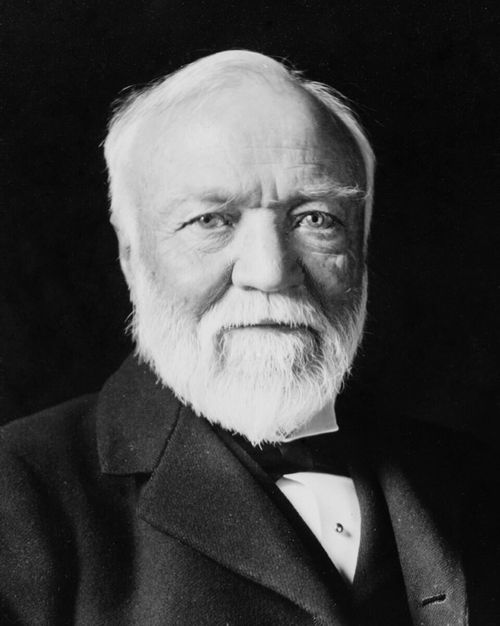
Andrew Carnegie Also involved
25 November 1835 – 11 August 1919
Steel magnate whose name Chadwick used; he denied knowing her or signing her notes.
-
Leroy S. Chadwick Also involved
Cleveland physician who married her in 1897; he went abroad when the scandal broke and was not charged.
-
Charles T. Beckwith Accomplice
President of the Citizens' National Bank of Oberlin; indicted with Chadwick but died before trial.
-
A. B. Spear Accomplice
Cashier of the Oberlin bank; pleaded guilty and was sentenced to seven years.
-
Herbert B. Newton Witness
Brookline, Massachusetts, banker whose lawsuit over his loan set off the collapse.
-
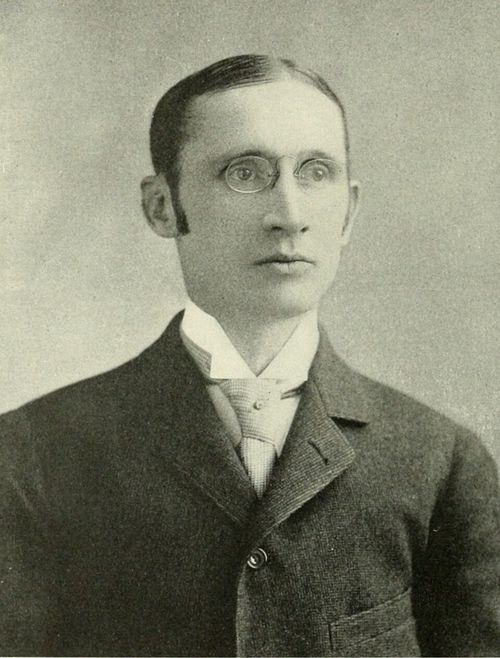
Robert W. Tayler Judge
20 November 1852 – 26 November 1910
Federal district judge who presided at her trial and sentenced her to ten years.
Where it happened
- Euclid Avenue, Cleveland. 'Millionaires' Row'; the Chadwick house stood near East 82nd Street (coordinates approximate).
- Oberlin, Ohio. Home of the Citizens' National Bank, which failed after lending to her.
- Ohio Penitentiary, Columbus. Where she served her sentence and died in 1907.
- Woodstock, Ontario. Scene of her first forgery trial in 1879 and her burial place.
Outcome
Convicted Convicted
Chadwick was tried in the United States District Court at Cleveland from 6 March 1905 for conspiring with officers of the Citizens' National Bank of Oberlin to violate national banking laws. The jury convicted her on seven counts, and on 27 March 1905 she was sentenced to ten years in the Ohio Penitentiary. The Sixth Circuit Court of Appeals affirmed the conviction in November 1905; she died in prison in October 1907.
What the record settles, and what it doesn't
Established
- Cassie Chadwick was born Elizabeth Bigley in Canada in 1857 and used many names during her career.
- She had been tried for forgery in Ontario in 1879 and convicted of forgery in Ohio around 1889.
- She obtained large loans by letting it be believed that she was Andrew Carnegie's illegitimate daughter and heir, backed by forged notes in his name.
- Carnegie denied any connection with her.
- The Citizens' National Bank of Oberlin failed as a result of its loans to her.
- A federal jury convicted her in March 1905, and she was sentenced to ten years; she died in prison on 10 October 1907.
Disputed
- The total she obtained: figures from about $1 million to $2 million or more appear, and the real amount was never established because some lenders concealed their loans.
- How the Carnegie story began: the visit to Carnegie's house with a lawyer is the standard account, but it rests on later reporting rather than court evidence.
- Her place of birth, given variously as Eastwood or near Woodstock, and the exact year of her Toledo conviction.
- How much Leroy Chadwick knew of his wife's past and dealings; he was never charged.
- Some popular accounts say she was sentenced to fourteen years; contemporary reports of the sentencing give ten.
In the newspapers of the day
Clippings from American newspapers digitised by the Library of Congress. The excerpt under each is the library's machine-read text, uncorrected; read the original page for the full report.
Evening star (Washington, D.C.)
, page 1 · The Carnegie notes unravel
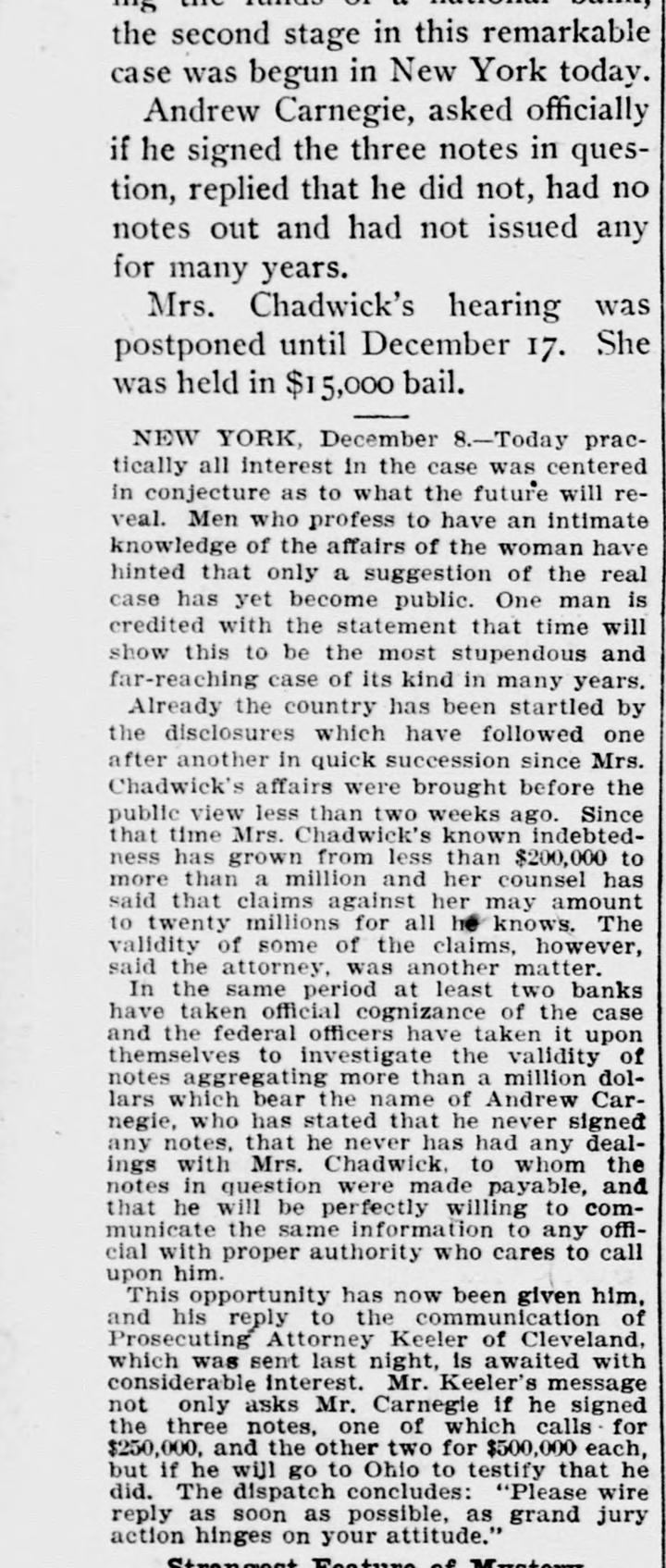
Andrew Carnegie, asked officially if he signed the three notes in ques- tion, replied that he did not, had no notes out and had not issued any for many years. Mrs. Chadwick's hearing was postponed until December 17. She was held in $15,00o bail. NEW YORK, December 8.-Today prac- tically all interest in the case was centered in conjecture as to what the future will re- veal. Men who profess to have an intimate …
The montgomery advertiser (Montgomery, Ala.)
, page 1 · The Carnegie notes unravel
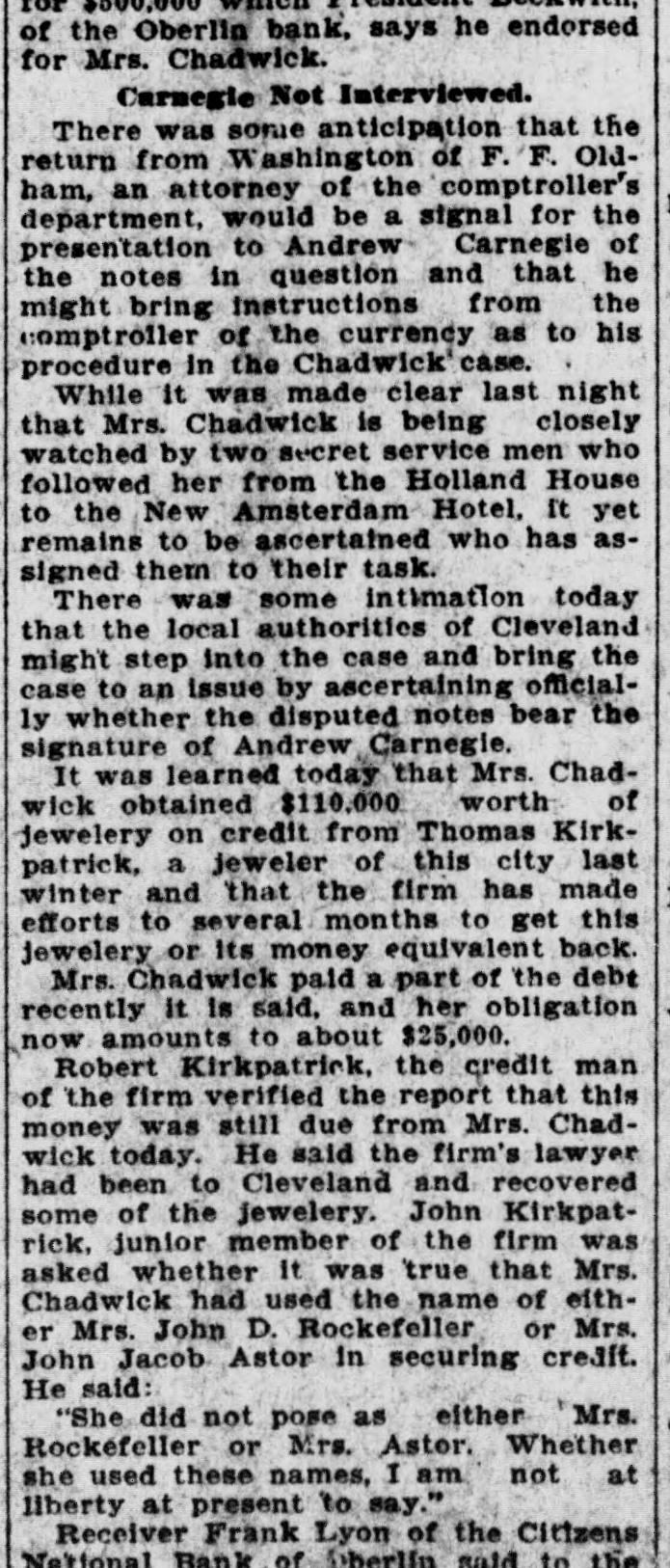
Carnegie Net Interviewed. There was some anticipation that the return from Washington of F. F. Old- ham. an attorney of the comptroller's department, would be a signal for the presentation to Andrew Carnegie of the notes In question and that he might bring Instructions from the comptroller of the currency as to his procedure In the Chadwick’ case. While It was made clear last night that Mrs. Chadwick Is being …
The news & observer (Raleigh, N.C.)
, page 2 · The Carnegie notes unravel
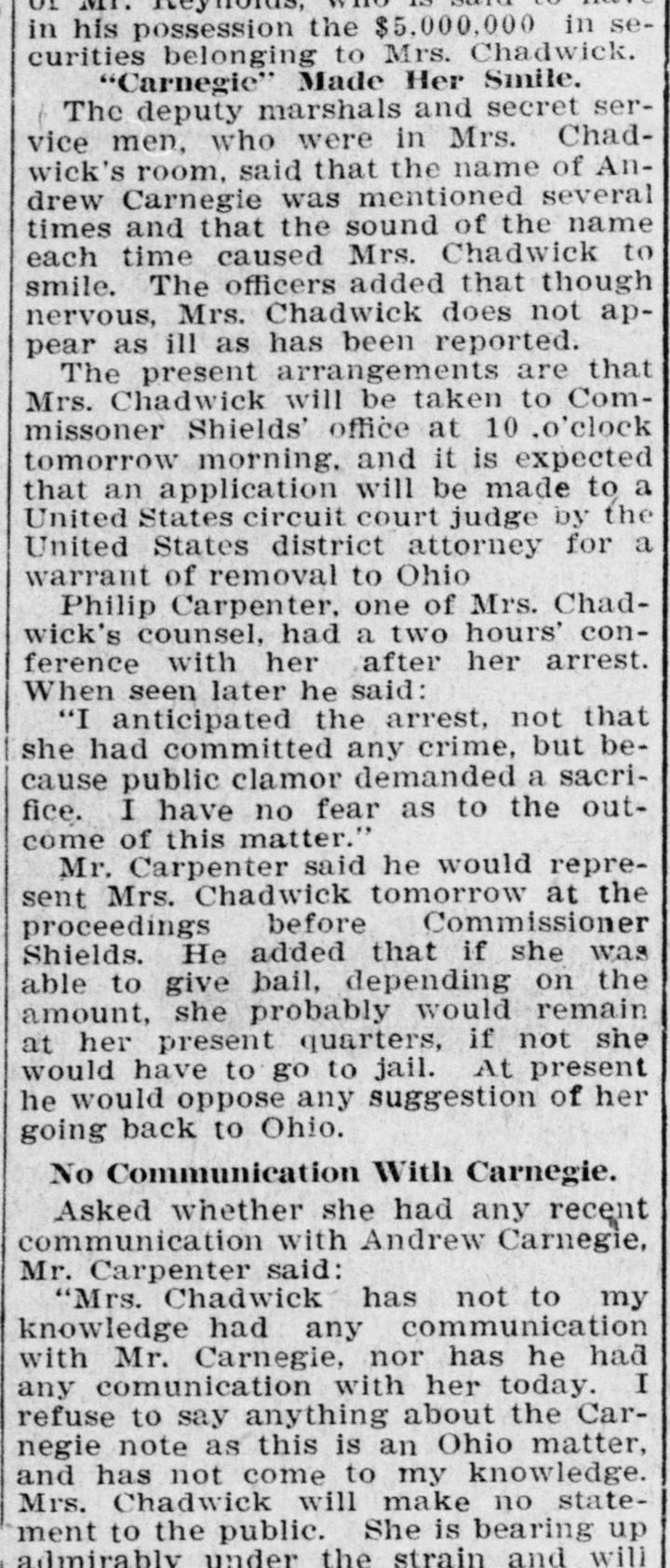
“Carnegie” Made Her Smile. The deputy marshals and secret ser- vice men, who were in Mrs. Chad- wick’s room, said that the name of An- drew Carnegie was mentioned several times and that the sound of the name each time caused Mrs. Chadwick to smile. Tiie officers added that though nervous, Mrs. Chadwick does not ap- pear as ill as has been reported. The present arrangements are that Mrs. Chadwick will be taken to …
Omaha daily bee (Omaha [Neb.])
, page 2 · The trial in Cleveland
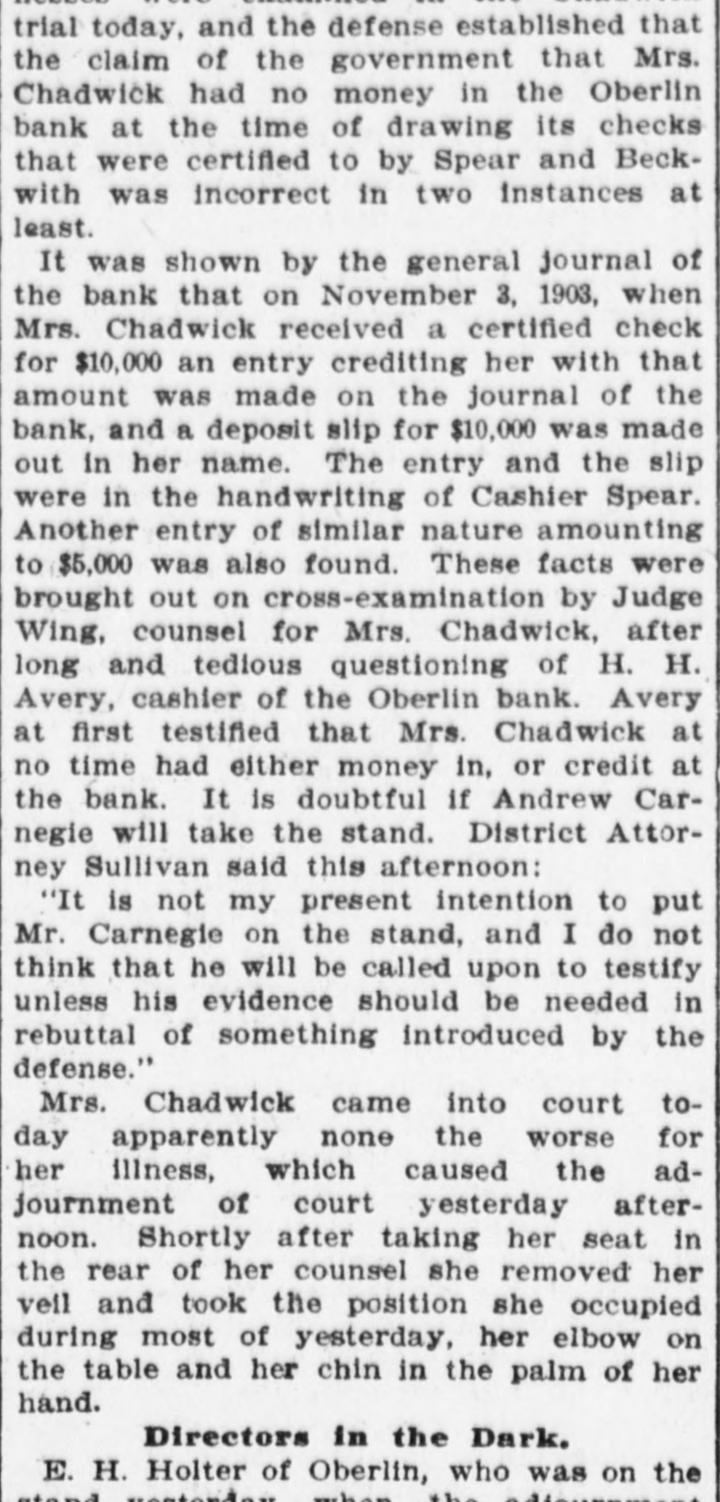
Chadwick had no money In the Oberlin bank at the time of drawing Its checks that were certified to by Speur and Beck- wlth was Incorrect In two Instances at least. It was shown by the general Journal of the bank that on November 2, 1903, when Mrs. Chadwick received a certified check for 210,000 an entry crediting her with that amount was made on the Journal of the bank, and a deposit slip for 210,000 wss made out In …
Evening times-republican (Marshalltown, Iowa)
, page 5 · The trial in Cleveland
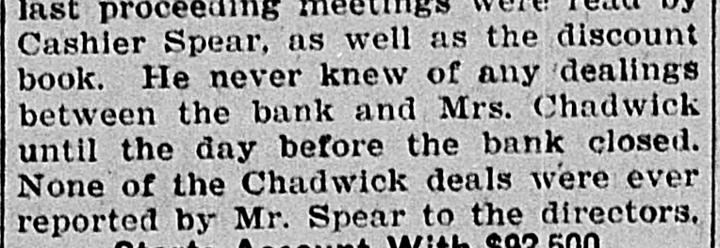
between the bank and Mrs. Chadwick until the day berore the bank closed. None of the Chadwick deals were ever reported by Mr. Spear to the directors.
Fort mill times (Fort Mill, S.C.)
, page 1 · The trial in Cleveland
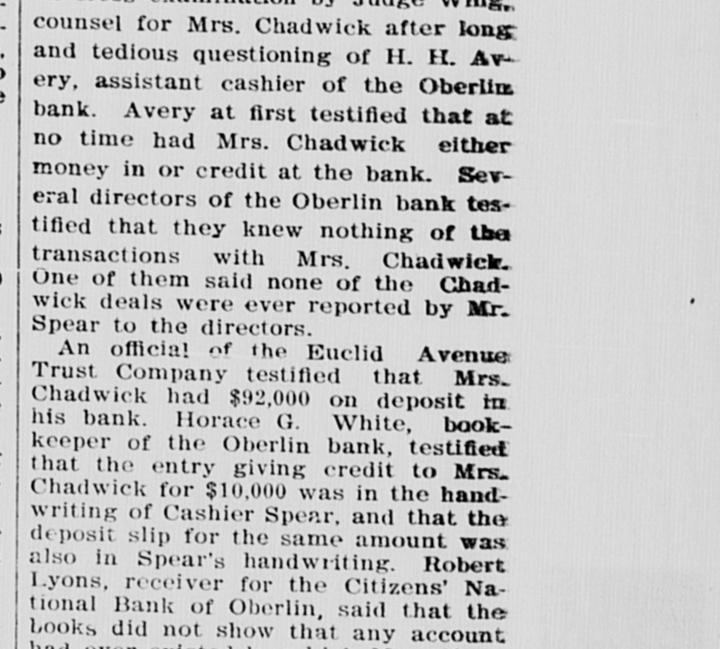
assistant cashier of the Oberlin. bank. Avery at first testified that at no time had Mrs. Chadwick either money in or credit at the bank. Several directors of the Oberlin bank testified that they knew nothing of tba transactions with Mrs. Chadwick. One of them said none of the Chadwick deals were ever reported by Mr. Spear to the directors. An official the Euclid Avenue Trust Company testified that Mrs. Chadwick had …
The morning tribune (Providence, R.I.)
, page 1 · Death in prison
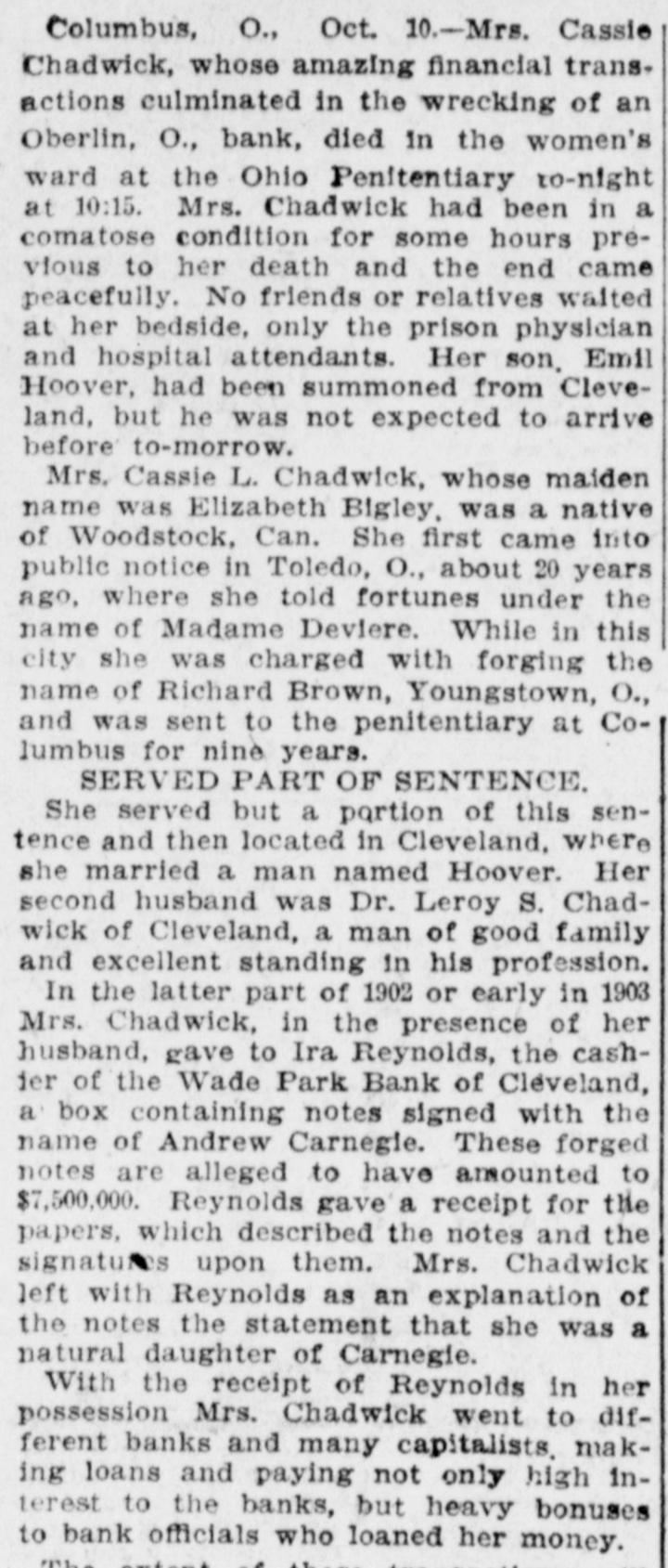
Columbus, 0., Oct. 10.—Mr*. Cassie Chadwick, whose amazing financial trans* actions culminated In the wrecking of an Oberlin, 0., bank, died In the women’s ward at the Ohio Penitentiary 10-nfght at 10:15. Mrs. Chadwick had been In a comatose condition for some hours pre- vious to her death and the end came peacefully. No friends or relatives waited at her bedside, only the prison physician and hospital attendants. …
The semi-weekly messenger (Wilmington, N.C.)
, page 3 · Death in prison
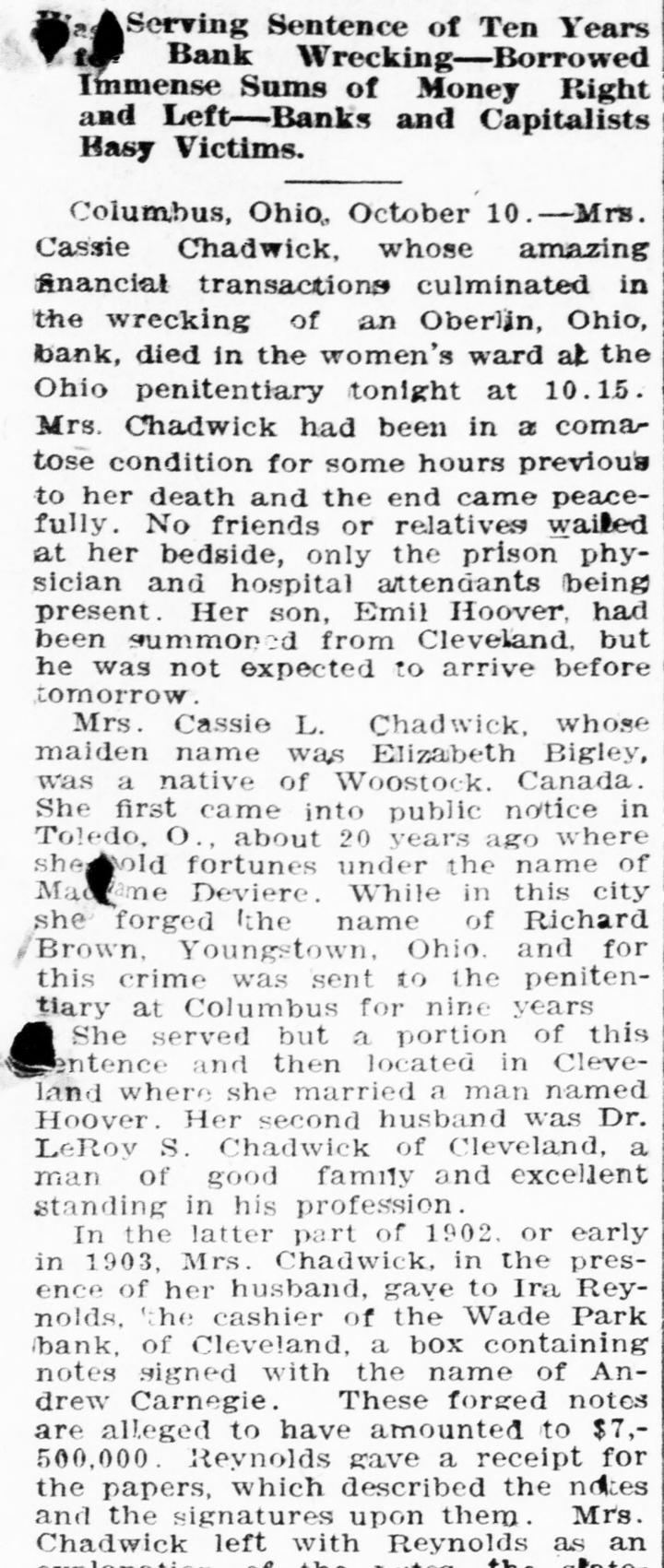
6?AScrTillK Sentence of Ten Years XtLf Bank Wrecking Borrowed Itnmense Stuns of Money Bight aad Left Banks and Capitalists Has? Victims. Columbus, Ohio October 10. lira. Cassie Chadwick, whose amazing financial transactions culminated in the wrecking of an Oberljn, Ohio, bank, died in the women's ward at the Ohio penitentiary tonlgrht at 10.15. Mrs. Chadwick had been in a coma- tose condition for some hours previous …
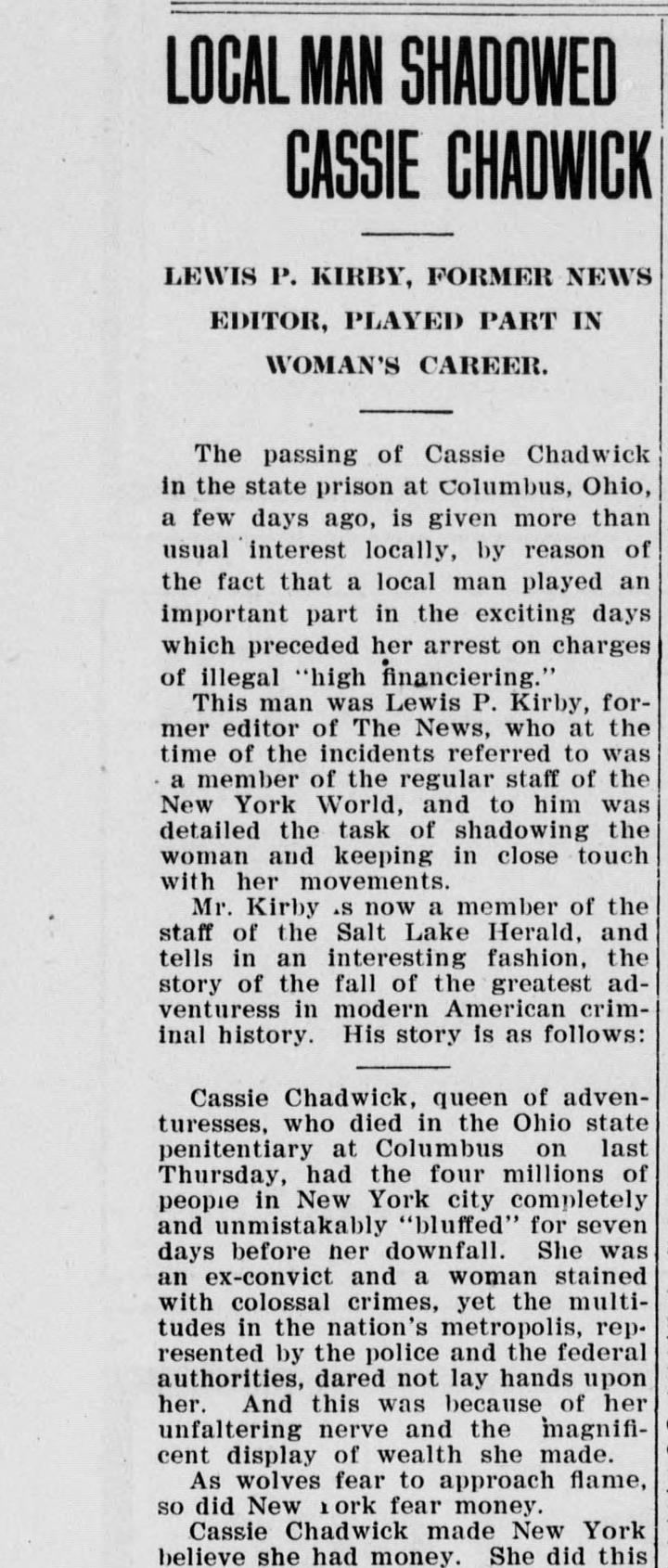
LOCAL MAN SHADOWED CASSIE CHADWICK LEWIS I*. KIRBY, FORMER NEWS EDITOR, FLAYED PART IN WOMAN’S CAREER. The passing of Cassie Chadwick in the state prison at Columbus, Ohio, a few days ago, is given more than usual interest locally, by reason of the fact that a local man played an important part in the exciting days which preceded her arrest on charges of Illegal "high financiering.” This man was Lewis P. Kirby, for- mer editor of The News, who at the time of the incidents referred to was a member of the regular staff of the New York World, and to him was detailed the task of shadowing the woman and keeping in close touch with her movements. Mr. Kirby ,s now a member of the staff of the Salt Lake Herald, and tells in an interesting fashion, the Rtory of the fall of the greatest ad- venturess in modern American crim- inal history. His story Is as follows: Cassie Chadwick, queen of adven- turesses, who died in the Ohio state penitentiary at Columbus on last Thursday, had the four millions of people in New York city completely and unmistakably “bluffed” for seven days before ner downfall. She was an ex-convict and a woman stained with colossal crimes, yet the multi- tudes in the nation’s metropolis, rep- resented by the police and the federal authorities, dared not lay hands upon her. And this was because of her unfaltering nerve and the magnifi- cent display of wealth she made. As wolves fear to approach flame, so did New lork fear money. Cassie Chadwick made New York believe she had money. She did this for seven days, and it was not until New York ceased to believe that the wonderful woman criminal was drag- ged from her luxurious libtel and finally sent back to Ohio and the prison where she died. On arriving in New' York in 1904, Mrs. Chadwick went to the Holland house, an ultra-aristocratic hostelry, where she lived in great splendor. She was believed to bo the wife of a Cleveland multi-millionaire and many exclusive doors were opened to her. Although she had known the in- side of a prison even then, she bore herself with a grace and assurance that few women could have excelled. Her Holland house suite swarmed with the bluest of the blue …
Source: Chronicling America: Historic American Newspapers, Library of Congress. Public domain.
Pictures


Afterwards
The case was a national sensation and a lesson in how far credit could stretch on a name. Banking reformers cited it, cartoonists lampooned the bankers who had lent without asking questions, and Cleveland's Euclid Avenue gained a tourist curiosity in the Chadwick house, which was demolished in the early 1920s to make way for a synagogue. Chadwick's story has since been retold in books, a 1985 Canadian television film, Love and Larceny, and an episode of the period drama Murdoch Mysteries.
Questions readers ask
Was Cassie Chadwick related to Andrew Carnegie?
No. She only implied that she was his illegitimate daughter, and Carnegie denied knowing her or signing any notes in her favour.
How much money did Cassie Chadwick steal?
Estimates range from about $1 million to $2 million in 1900s dollars. The exact figure was never settled because some lenders hid their loans.
What was Cassie Chadwick convicted of?
Conspiring with officers of the Citizens' National Bank of Oberlin to violate federal banking laws. She was sentenced to ten years and died in prison in 1907.
What was Cassie Chadwick's real name?
Elizabeth Bigley. She also used names including Lydia DeVere, Marie LaRose and Cassie Hoover.
Sources and further reading
- Cassie Chadwick (Wikipedia)
- Chadwick v. United States, 141 F. 225 (6th Cir. 1905)
- Mrs. Chadwick Sentenced (Kingston Daily Freeman, 28 March 1905)
- Wikidata Q1048357 (life dates checked here)
Written by Sinister Crimes from the sources above; see our editorial standards. Last checked 1 November 2026.