
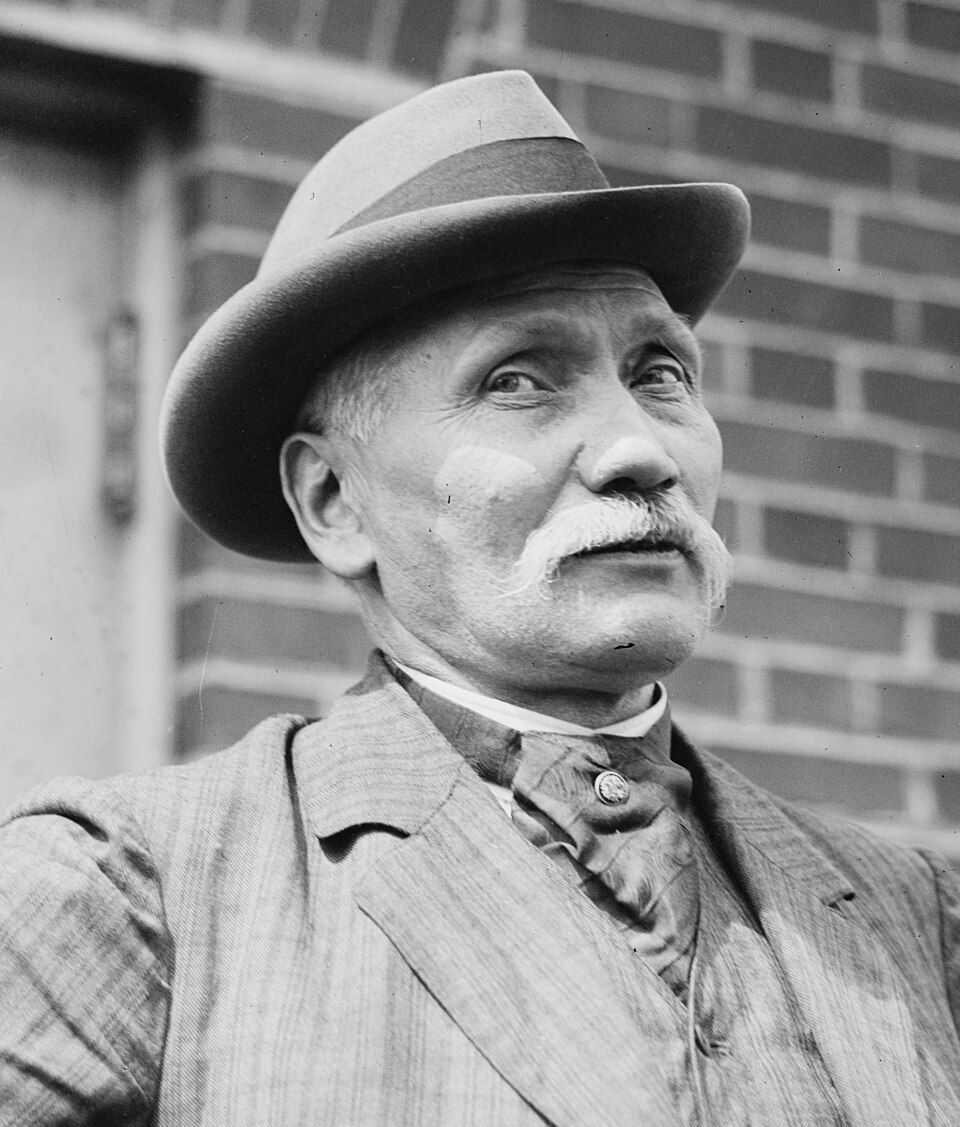

The case
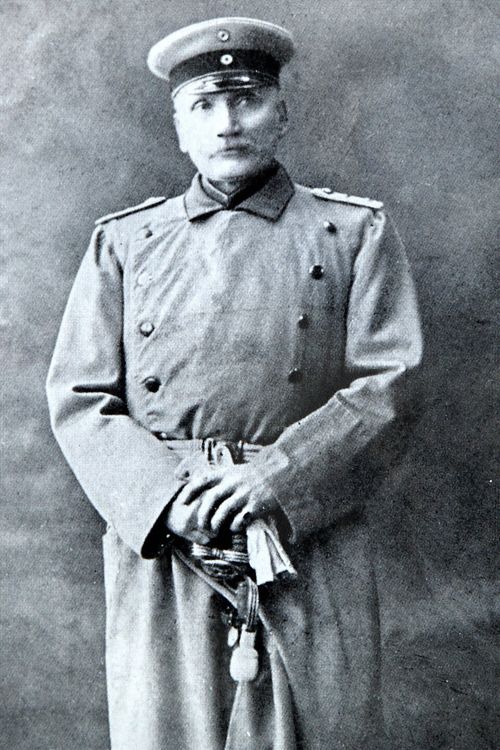
Around midday on 16 October 1906, a grey-moustached captain of the Prussian Foot Guards stopped a small detachment of guardsmen marching through north-west Berlin and told them they were now under his command, on orders from the highest authority. He picked up a few more men from a nearby rifle range and sent the sergeant back to barracks to report. Nobody asked for paperwork. The uniform was enough.
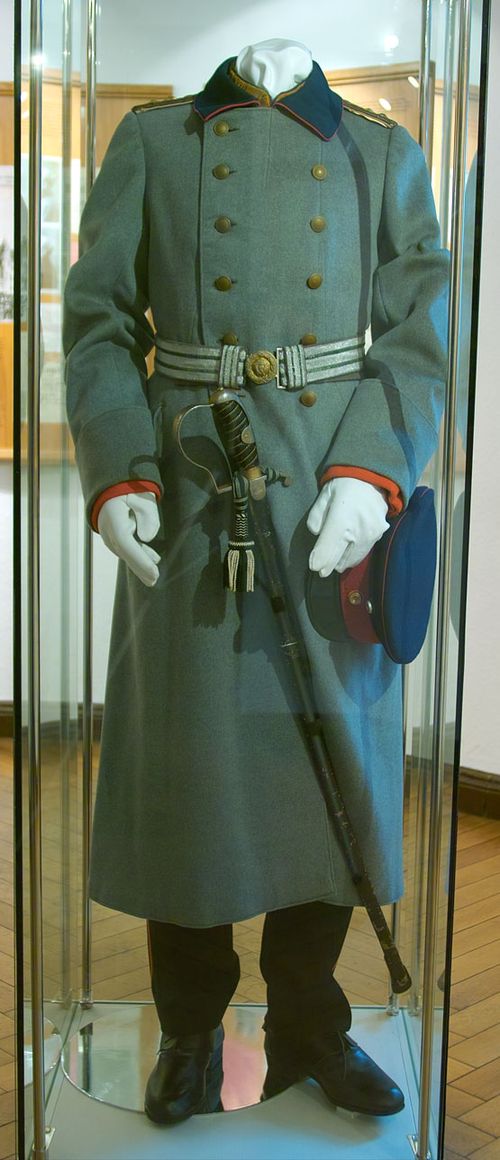
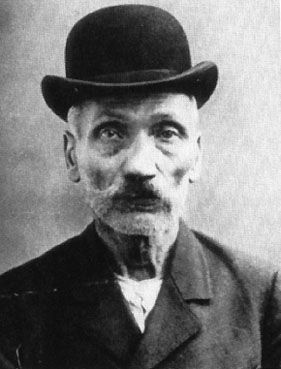
The captain was Wilhelm Voigt, a 57-year-old shoemaker from Tilsit in East Prussia who had spent much of his adult life in prison for theft, forgery and burglary. He had been released in February 1906 after a fifteen-year sentence for a botched break-in at a court cashier's office. Since then he had found honest work, first in Wismar and then near Berlin, only for the police to expel him from each place as an undesirable ex-convict. In August he was ordered out of the Berlin area altogether and stayed on illegally. Over the following weeks he bought the pieces of a guards captain's uniform from different second-hand dealers.
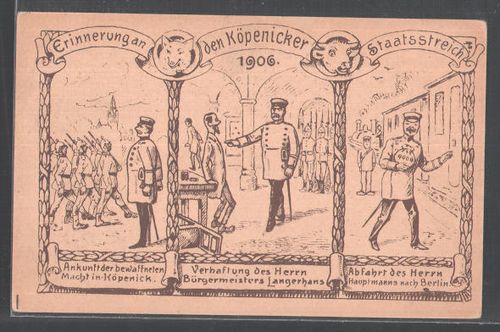
He took his soldiers by suburban train to Köpenick, then a separate town south-east of Berlin, bought them a beer on the way and gave each a mark for lunch. At the town hall he posted guards on every exit and told the local police to keep order outside, which they did, holding back the curious crowd. He announced to the mayor, Georg Langerhans, that he was under arrest in the name of the Kaiser. When Langerhans asked to see a warrant, Voigt pointed to his soldiers' bayonets.
He then had the treasurer count out the cash in the town's strongbox, roughly four thousand marks by the most common figure, and signed a receipt for it with the name of the director of his last prison. The mayor and the treasurer were put in carriages and sent under guard to the Neue Wache in central Berlin for questioning. Voigt ordered his men to hold the building for another half hour, walked back to the station, had a beer, and took the train to Berlin. There he changed into civilian clothes and disappeared.
Germany laughed. Newspapers called it the most brazen trick of the age, and abroad, especially in Britain, the story became a parable of a nation that would obey anything in uniform. The joke did not last long for Voigt. A former cellmate to whom he had once described the plan went to the police in hope of the reward, and on 26 October Voigt was arrested in Berlin over breakfast.
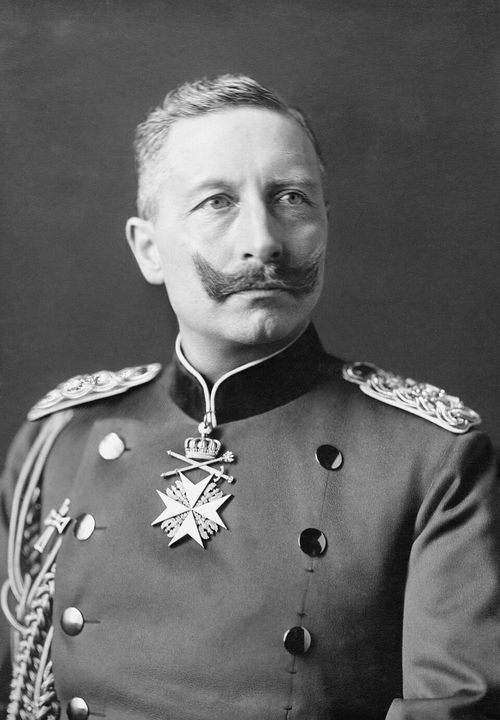
On 1 December 1906 a Berlin court convicted him of unlawfully wearing a uniform, false imprisonment, fraud and forgery, and sentenced him to four years. The judges were unusually sympathetic, noting in mitigation that he had tried hard to make an honest living after his release and had been pushed back into crime by the police system that kept moving him on. They rejected his claim that he had really been looking for a passport. Petitions for clemency poured in, and on 16 August 1908 Kaiser Wilhelm II pardoned him. He walked out of Tegel prison a celebrity.
Who lost out
No one was injured. The town of Köpenick lost the contents of its treasury, and its mayor, Georg Langerhans, a 36-year-old lawyer who had done much to modernise the town's streets, power and water supply, was arrested in his own office and driven to Berlin as a prisoner before the hoax came out. Ashamed, he offered his resignation three days later, but the town council asked him to stay, and in 1915 it re-elected him unanimously. He died in 1918.
Timeline
Wilhelm Voigt is born in Tilsit, East Prussia.
Voigt is released after serving a fifteen-year sentence for attempted burglary.
Police ban Voigt from living in the Berlin area as an ex-convict; he stays on unregistered.
In a captain's uniform, Voigt commandeers a squad of guardsmen, occupies Köpenick town hall, arrests the mayor and takes the town's cash.
Voigt is arrested in Berlin after a former cellmate tips off the police.
A Berlin court sentences him to four years in prison.
Pardoned by Kaiser Wilhelm II, Voigt is released early from Tegel prison.
Voigt publishes an account of his exploit, How I Became the Captain of Köpenick.
After touring with his act, Voigt receives Luxembourg papers and settles in Luxembourg.
Voigt dies in Luxembourg City.
People in the case
-
Wilhelm Voigt Perpetrator
13 February 1849 – 3 January 1922
Shoemaker and repeat offender from Tilsit who impersonated a Guards captain; sentenced to four years and pardoned after about twenty months.
-
Georg Langerhans Victim
23 September 1870 – 8 March 1918
Mayor of Köpenick from 1904, arrested by Voigt in his office and sent under guard to Berlin; he briefly resigned in embarrassment but returned to office within days.
-
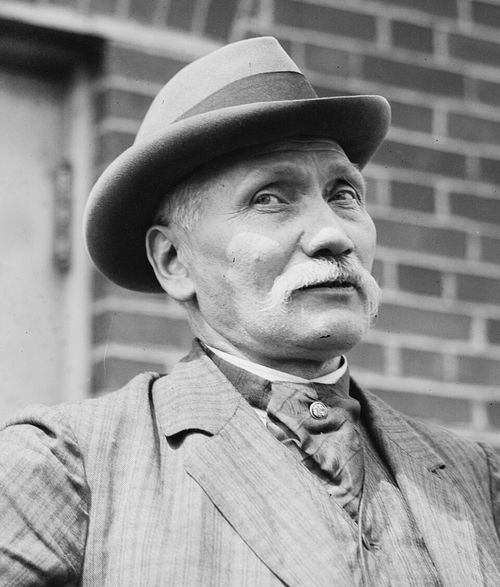
Wilhelm II Also involved
27 January 1859 – 4 June 1941
German Emperor who pardoned Voigt in August 1908.
Where it happened
- Köpenick town hall (Rathaus Köpenick). The town hall Voigt occupied; a statue of him now stands at its entrance.
- Tegel prison. Berlin prison from which Voigt was released after his pardon in 1908.
Outcome
Convicted Convicted
On 1 December 1906 the Landgericht II in Berlin convicted Voigt of unlawfully wearing a uniform, offences against public order, false imprisonment, fraud and serious forgery, and sentenced him to four years. Kaiser Wilhelm II pardoned him, and he was released on 16 August 1908 after serving about twenty months.
What the record settles, and what it doesn't
Established
- On 16 October 1906 Wilhelm Voigt, disguised as a captain of the Prussian Guards, took command of a group of soldiers and occupied Köpenick town hall.
- He arrested the mayor, Georg Langerhans, and the town treasurer and had them taken under guard to Berlin.
- He confiscated the cash in the town treasury and signed a receipt using the name of a former prison director.
- He was arrested on 26 October 1906 after a former cellmate informed the police.
- A Berlin court sentenced him to four years on 1 December 1906, and Kaiser Wilhelm II pardoned him on 16 August 1908.
- Voigt had a long criminal record and had been repeatedly expelled from places where he found work because of police rules on ex-convicts.
Disputed
- How much he took: English-language sources usually give 4,002 marks and 37 pfennigs, while German accounts drawing on the court record give about 3,557 marks.
- How many soldiers he commandeered: accounts range from about ten to eleven men, depending on how the two groups he collected are counted.
- What he was after: Voigt always said he wanted a passport so he could leave the country and live legally; the court found this unbelievable, since passports were not issued at the town hall, and his biographer suggests he expected a much larger sum in the safe.
- The Kaiser's reaction: he is often quoted as laughing and praising the discipline of his people, but that remark is not reliably documented; a press report that he called Voigt a clever fellow is considered better attested.
- His American tour: English sources say he entered the United States via Canada in 1910 and toured successfully; German accounts note that this is not firmly documented.
In the newspapers of the day
Clippings from American newspapers digitised by the Library of Congress. The excerpt under each is the library's machine-read text, uncorrected; read the original page for the full report.
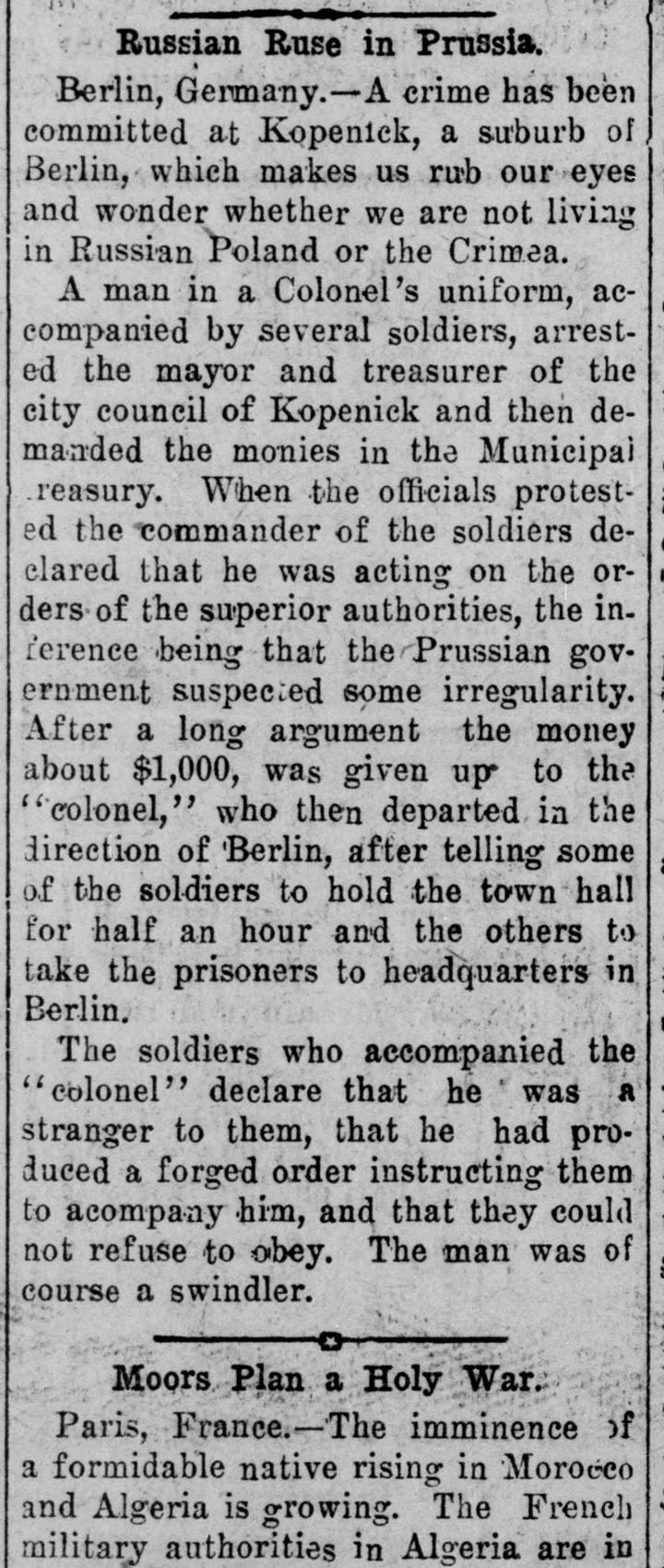
The brandon news (Brandon, Miss.)
, page 6 · The fake captain and his arrest
Russian Ruse in Prussia. Berlin, Germany.—A crime has been committed at Kopenick, a suburb of, Berlin, which makes us rub our eyes and wonder whether we are not living in Russian Poland or the Crimea. A man in a Colonel’s uniform, ac- companied by several soldiers, arrest- ed the mayor and treasurer of the city council of Kopenick and then de- manded the monies in the Municipal reasury. When the officials protest- …
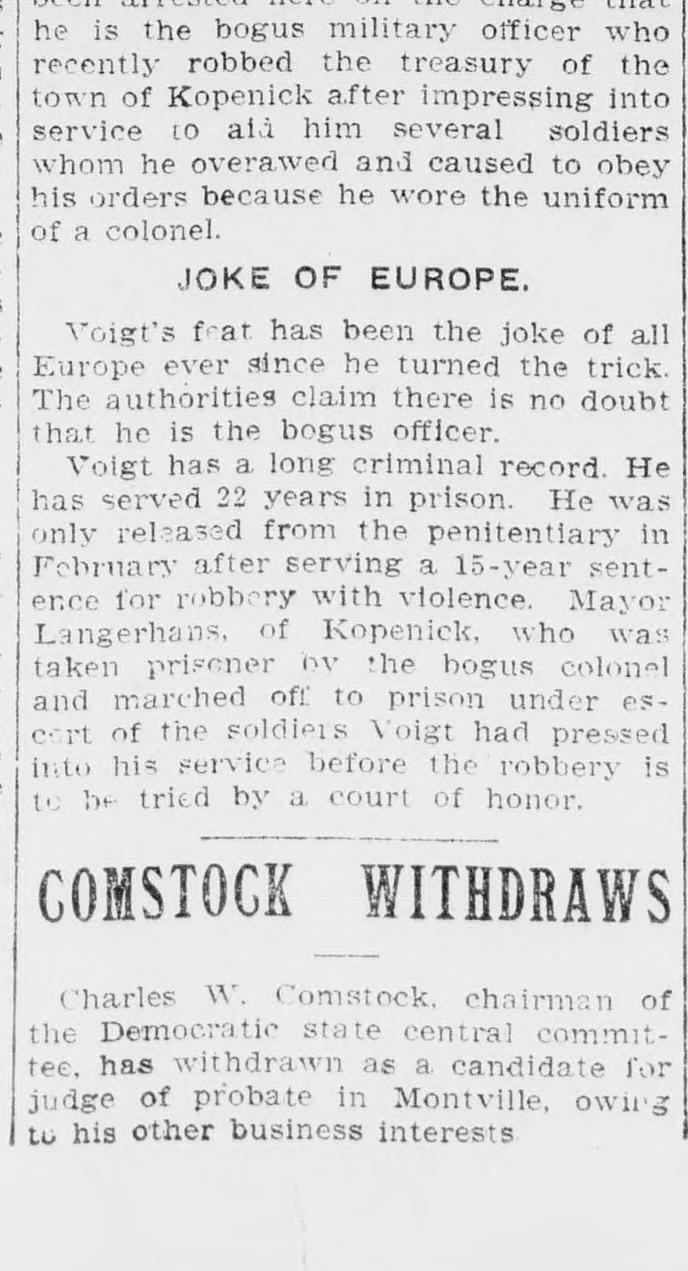
The new haven union (New Haven, Conn.)
, page 1 · The fake captain and his arrest
town of Kopenick after impressing into service to aid him several soldiers whom he overawed and caused to obey his orders because he wore the uniform of a colonel. 1 JOKE OF EUROPE. j Voigt's f-ar has boon the joke of a.ll ! Europe ever since he turned the trick. ! The authorities claim there is no doubt I that he is the bogus officer. I Voigt has a long criminal record. He j has served 22 years in prison. He was ■ …
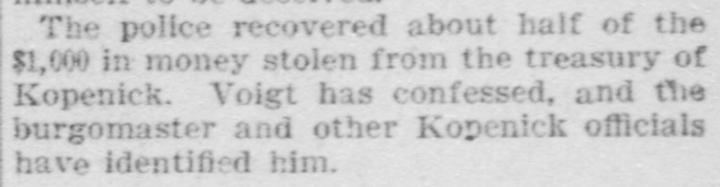
The washington herald (Washington, D.C.)
, page 3 · The fake captain and his arrest
The police recovered about half of the $1,000 in money stolen from the treasury of Kopenick. Voigt has confessed, and the burgomaster and other Kopenick officials have identified him.
The washington times (Washington [D.C.])
, page 4 · The trial in Berlin
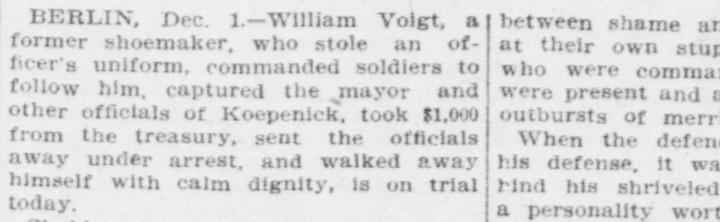
BERLIN, Dec. 1.—William Voigt, a former shoemaker, who stole an of- ficer's uniform, commanded soldiers to follow him, captured the Jnayor and other officials of Koepenick, took $1,000 from the treasury, sent the officials away under arrest, and walked away himself with calm dignity, is on trial today, | |
The richmond palladium (Richmond, Ind.)
, page 10 · The trial in Berlin
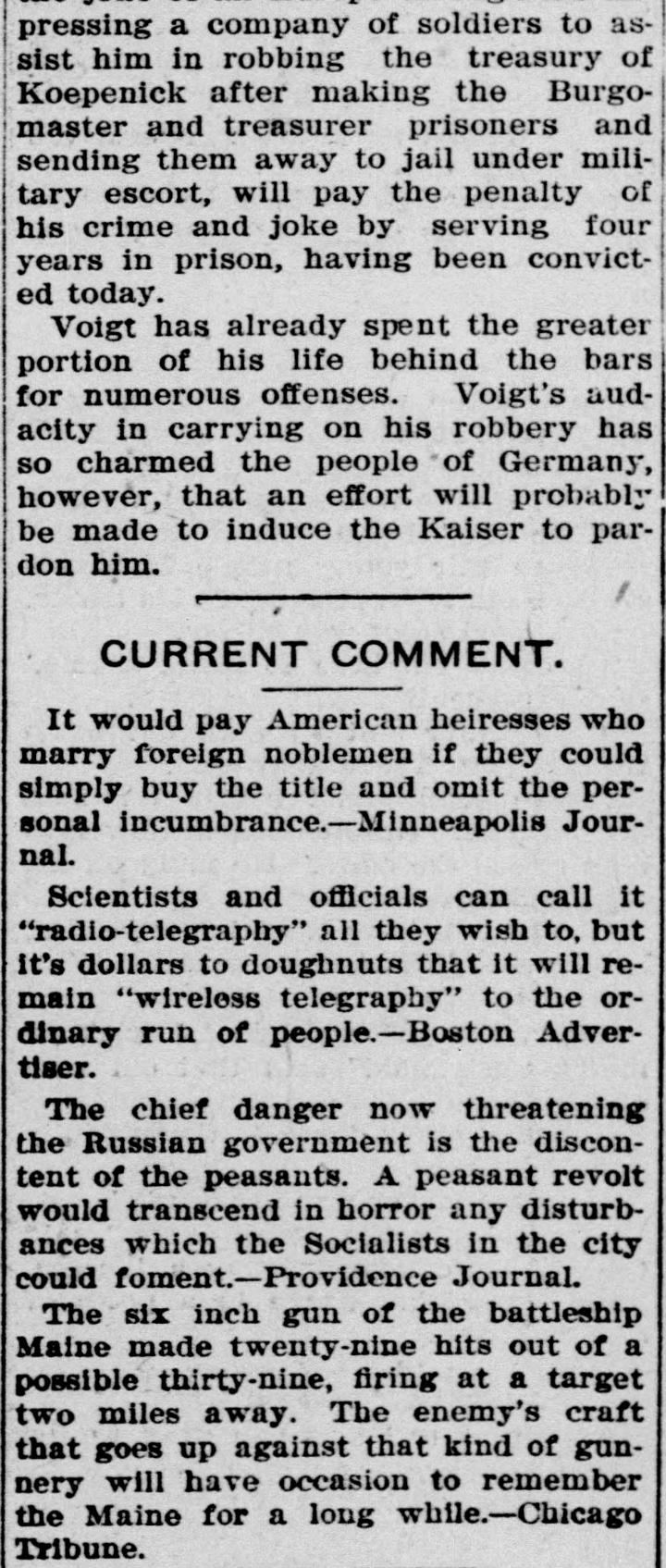
Koepenick after making the Burgo- master and treasurer prisoners and sending them away to jail under mili- tary escort, will pay the penalty of his crime and joke by serving four years in prison, having been convict- ed today. Voigt has already spent the greater portion of his life behind the bars for numerous offenses. Voigt's aud acity in carrying on his robbery has so charmed the people 'of Germany, however, that …
The daily morning journal and courier (New Haven, Conn.)
, page 2 · The trial in Berlin
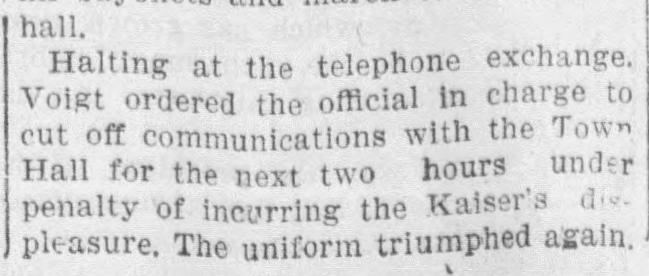
Voigt ordered the official In charge to cut off communications with the Town Hall for the next two hours undsr penalty of Incurring the Kaiser's d--pleasure. The uniform triumphed again.
Source: Chronicling America: Historic American Newspapers, Library of Congress. Public domain.
Pictures





Afterwards
Voigt cashed in on his fame. Within days of his release a waxwork of him went on show in Berlin, and he toured variety halls and fairgrounds in Germany and Austria-Hungary signing photographs in uniform until the authorities stepped in. He published a memoir in 1909, is said to have toured North America in 1910, and then settled in Luxembourg, where he worked as a waiter and shoemaker and was reportedly helped by a pension from a wealthy Berlin widow. Inflation after the First World War wiped out his savings, and he died in Luxembourg City in January 1922.
The German language gained a word, Köpenickiade, for a hoax that exploits blind respect for authority. Carl Zuckmayer's 1931 play The Captain of Köpenick turned Voigt into a symbol of the little man crushed by Prussian bureaucracy, and it has been filmed repeatedly. A bronze statue of the captain stands on the steps of the town hall he occupied, and his uniform is displayed inside.
Questions readers ask
Who was the Captain of Köpenick?
Wilhelm Voigt, a shoemaker and ex-convict who in October 1906 dressed as a Prussian Guards captain, took command of real soldiers, arrested the mayor of Köpenick and seized the town's cash.
Was the Captain of Köpenick punished?
Yes. He was sentenced to four years in prison in December 1906, but Kaiser Wilhelm II pardoned him and he was released in August 1908.
What is a Köpenickiade?
A German word, taken from Voigt's exploit, for a hoax that succeeds because people obey the outward signs of authority, such as a uniform, without question.
Sources and further reading
- Wilhelm Voigt (Wikipedia)
- Hauptmann von Köpenick (German Wikipedia)
- Wikidata Q62071 (life dates checked here)
Written by Sinister Crimes from the sources above; see our editorial standards. Last checked 1 November 2026.