
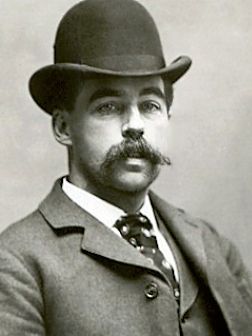

The case
The crime that hanged H. H. Holmes began as an insurance fraud. In the summer of 1894 he and his long-time associate Benjamin Pitezel, a carpenter with a record of petty crime, agreed to cheat the Fidelity Mutual insurance company out of $10,000. Pitezel would set up in Philadelphia as an inventor called B. F. Perry, a body would be found that could pass for his, and the money would be split. Early in September 1894 a badly burned man was found dead in the Callowhill Street office. It was Pitezel himself. Holmes collected the payout.
Holmes had been born Herman Webster Mudgett in Gilmanton, New Hampshire, in 1861. He trained in medicine at the University of Michigan, where by his own later admission he first used cadavers to defraud insurers, and moved to Chicago in 1886 under his new name. In the Englewood district he took over a drugstore and built a three-story block across the street at 63rd and Wallace, with shops below and rooms above that he advertised as a hotel for visitors to the 1893 World's Columbian Exposition. He paid almost no one: builders, suppliers and furniture dealers all chased him for debts. He married three women without divorcing any of them.
What he did after Pitezel's death is the best-documented part of his career and the worst. Persuading Pitezel's widow, Carrie, that her husband was alive and in hiding, Holmes took three of her children, Alice, Nellie and Howard, on a meandering journey through Ohio, Indiana, Michigan and Ontario that autumn, while moving Carrie and his own third wife along separate routes nearby. None of the three ever saw their mother again.
Pinkerton agents tracked Holmes to Boston, where he was arrested on November 17, 1894, first held on an old Texas horse-theft warrant and then sent to Philadelphia on the fraud. In June 1895 the Philadelphia detective Frank Geyer set out to find the missing children. Working from hotel registers, rental agents and letters the children had written but Holmes had never posted, he found the remains of Alice and Nellie in July beneath a rented house on St. Vincent Street in Toronto, and in August traced Howard's remains to a cottage Holmes had rented in Irvington, outside Indianapolis.
Holmes was tried in Philadelphia for Benjamin Pitezel's murder only. The trial opened on October 28, 1895; he briefly conducted his own defense, and the judge kept out evidence about the children. On November 2 the jury convicted him of first-degree murder. While awaiting execution he sold a long confession to the Hearst press, claiming 27 murders. Several of his named victims were later found to be alive, and others cannot be shown to have existed. He was hanged at Moyamensing Prison on May 7, 1896.
Separating the documented killings from the legend is the main task for anyone studying Holmes. Beyond Pitezel and three of his children, the record links him persuasively to Julia Conner and her daughter Pearl, who vanished from his building at the end of 1891; to his secretary Emeline Cigrand, who disappeared in December 1892; and to Minnie Williams and her younger sister Nannie, whose Texas property he took over in 1893. Other disappearances remain possible but unproven.
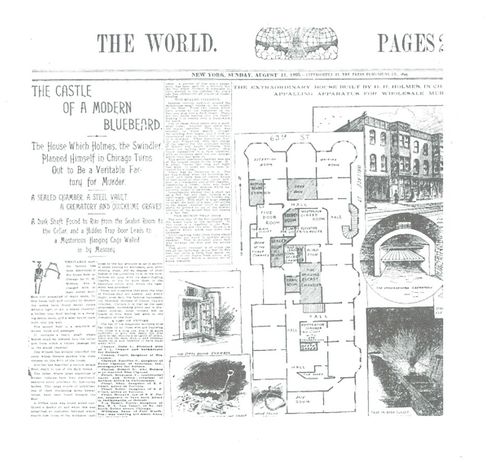
The rest grew in the newspapers of 1895. Reporters described the 63rd Street building as a "murder castle" with gas chambers, trapdoors, chutes and a basement crematorium where Exposition visitors met their end. The investigation found hidden rooms, which Holmes appears to have used to hide furniture bought on credit, and some human remains and personal effects, but no evidence of mass murder of fairgoers. Figures of 100, 133 or 200 victims have no documentary basis. The real total, as far as it can be established, is nine confirmed murders, with a few more probable.
Who lost out
Benjamin Freelon Pitezel was a carpenter and would-be inventor who drifted between jobs and had a minor criminal record. He became Holmes's partner in schemes from about 1890 and trusted him enough to stake his family's future on the 1894 fraud. He left a wife, Carrie, and five children. Alice, the eldest, kept writing to her mother and grandparents throughout the autumn of 1894; Holmes kept the letters, and they became the trail that led investigators to her. Nellie and Howard, the younger two taken from the family, were still young children; the surviving letters describe a homesick journey from one boarding house to the next.
The Chicago victims were people who came into Holmes's orbit through work or love. Julia Smythe Conner came to the building with her husband, who ran the drugstore's jewelry counter; when the marriage broke up she stayed on with her young daughter Pearl. Emeline Cigrand, from Indiana, came to Chicago as a stenographer and was last seen in December 1892. Minnie Williams, a former actress with property in Fort Worth, and her younger sister Nannie disappeared in 1893 after Holmes had taken charge of their affairs.
Timeline
Herman Webster Mudgett, later H. H. Holmes, is born in Gilmanton, New Hampshire.
Now calling himself Henry Howard Holmes, he arrives in Chicago and goes to work at an Englewood drugstore.
Julia Conner and her daughter Pearl disappear from Holmes's building on 63rd Street.
Emeline Cigrand, Holmes's stenographer, is last seen.
Nannie Williams writes that she will travel with Holmes; neither she nor her sister Minnie is seen again.
Jailed briefly in St. Louis, Holmes discusses an insurance swindle with the train robber Marion Hedgepeth.
Benjamin Pitezel is killed in Philadelphia, and Holmes collects the $10,000 insurance on him.
Holmes kills Howard Pitezel near Indianapolis and Alice and Nellie Pitezel in Toronto.
Holmes is arrested in Boston after being followed by Pinkerton agents.
Detective Frank Geyer finds the remains of Alice and Nellie Pitezel beneath a rented house in Toronto.
The 63rd Street building is damaged by fire, and Geyer traces Howard Pitezel's remains to Irvington, Indiana.
A Philadelphia jury convicts Holmes of the first-degree murder of Benjamin Pitezel.
Hearst newspapers publish Holmes's confession to 27 murders, several of them demonstrably false.
Holmes is hanged at Moyamensing Prison in Philadelphia.
People in the case
-
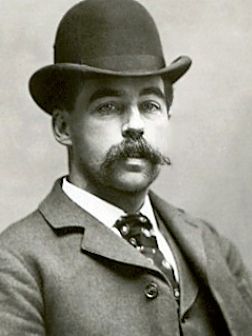
H. H. Holmes Perpetrator
16 May 1861 – 7 May 1896
Born Herman Webster Mudgett; swindler and bigamist convicted of murdering Benjamin Pitezel and hanged.
-
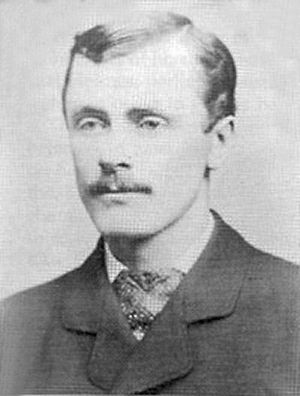
Benjamin Pitezel Victim
? – September 1894
Holmes's accomplice in fraud, killed in Philadelphia in early September 1894; born c. 1856.
-
Alice Pitezel Victim
? – October 1894
Eldest Pitezel child in Holmes's care; found in Toronto in July 1895.
-
Nellie Pitezel Victim
? – October 1894
Alice's younger sister; found with her in Toronto.
-
Howard Pitezel Victim
? – October 1894
The youngest of the three; his remains were traced to Irvington, Indiana, in August 1895.
-
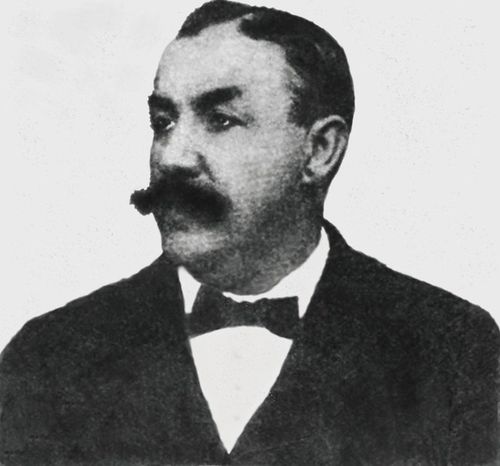
Frank Geyer Investigator
28 July 1853 – 4 October 1918
Philadelphia detective who traced Holmes's route and found the children; published an account of the case in 1896.
-
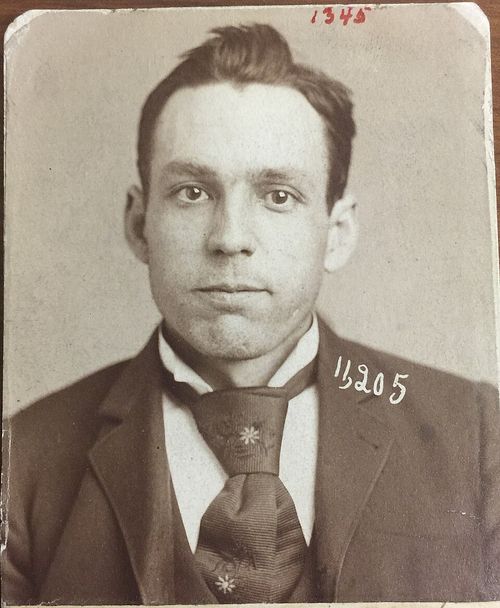
Marion Hedgepeth Witness
14 April 1856 – 31 December 1909
Train robber who met Holmes in a St. Louis jail in 1894 and later informed on the insurance scheme.
-
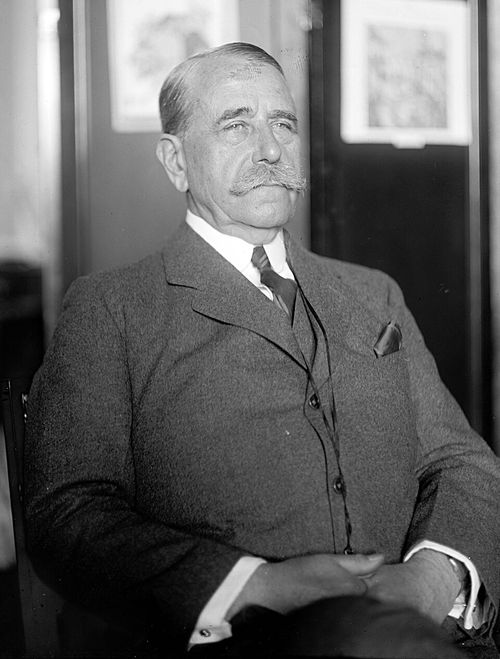
George S. Graham Prosecutor
13 September 1850 – 4 July 1931
Philadelphia district attorney who prosecuted Holmes.
Where it happened
- Site of Holmes's building, 63rd and Wallace, Englewood, Chicago. The so-called castle; rebuilt after an 1895 fire and demolished in 1938. A post office now stands on the site (approximate position).
- Moyamensing Prison, Philadelphia. Where Holmes was held and hanged in 1896; the prison was demolished in the 1960s.
- St. Vincent Street, Toronto. Approximate site of the rented house where Alice and Nellie Pitezel were found; the street no longer exists.
- Irvington, Indianapolis. Then a suburb of Indianapolis, where Holmes rented a cottage in October 1894.
Outcome
Executed Executed
Holmes was charged in Philadelphia with the murder of Benjamin Pitezel, the case with the strongest evidence. A jury convicted him of first-degree murder on November 2, 1895, and he was sentenced to death; appeals failed. He was hanged at Moyamensing Prison on May 7, 1896. He was never tried for any other killing.
What the record settles, and what it doesn't
Established
- H. H. Holmes was the alias of Herman Webster Mudgett, a qualified physician turned swindler, forger and bigamist.
- He killed Benjamin Pitezel in Philadelphia in September 1894 and collected insurance money on his death.
- He took three of Pitezel's children into his care and killed them in Indiana and Ontario in October 1894; their remains were found by Detective Frank Geyer in 1895.
- He was convicted of Pitezel's murder on November 2, 1895, and hanged on May 7, 1896.
- His 1896 confession to 27 murders was sold to the Hearst press and included people later found alive.
- Historians generally count nine confirmed victims: the four Pitezels, Julia and Pearl Conner, Emeline Cigrand and Minnie and Nannie Williams.
Disputed
- The total number of victims: the documented figure is about nine, Holmes claimed 27, and popular accounts since the mid-twentieth century have repeated 100 to 200 without evidence.
- The nature of the 63rd Street building: the 1895 press described a purpose-built murder castle, while the surviving records point to a shoddily built commercial block whose oddities came from cost-cutting and fraud.
- Whether Holmes killed visitors to the 1893 World's Fair: no fairgoer has been shown to have died in his building.
- Several further disappearances linked to Holmes, including Emily Van Tassel and others, remain possible but unproven.
- Whether Holmes, as a man who killed largely to cover fraud, fits modern definitions of a serial killer; some historians argue that the label owes more to later retellings than to the record.
- The exact ages of the Pitezel children, which contemporary and later sources give differently.
Pictures




Afterwards
The building on 63rd Street was damaged by fire in August 1895, apparently set deliberately, but was repaired and stood until 1938; a post office occupies the site. Marion Hedgepeth, whose tip about the insurance scheme helped bring Holmes down, was pardoned and later shot dead by a Chicago police officer during a robbery in 1909. Frank Geyer's 1896 book on the case sold widely. Holmes asked to be buried under concrete to keep his body from dissection, and he was; his grave at Holy Cross Cemetery in Yeadon, Pennsylvania, was opened in 2017 to settle rumors that he had escaped the gallows, and the remains were identified as his.
Holmes was half forgotten for decades before mid-century magazine writers revived the murder castle. Popular histories and documentaries since then have treated him as "America's first serial killer", and the 200-victim figure became received wisdom. Researchers working from court papers, insurance records and contemporary newspapers have pushed back hard, showing how much of the castle story began in the competitive yellow journalism of 1895. The documented case is narrower and, for the Pitezel family, worse: a fraud that turned into the deliberate killing of a man and three of his children.
Questions readers ask
How many people did H. H. Holmes kill?
Nine murders are generally considered confirmed, including Benjamin Pitezel and three of his children. Holmes himself confessed to 27, but some of those people turned out to be alive. Figures of 200 or more have no evidence behind them.
Was the H. H. Holmes murder castle real?
The building was real, a three-story block of shops and rooms at 63rd and Wallace in Chicago. The trapdoors, gas chambers and maze of death rooms described in 1895 newspapers were largely invented; the odd layout and hidden rooms are better explained by Holmes's habit of cheating builders and creditors.
What was H. H. Holmes convicted of?
Only one murder: that of his accomplice Benjamin Pitezel in Philadelphia in 1894. He was convicted on November 2, 1895, and hanged on May 7, 1896.
What was H. H. Holmes's real name?
Herman Webster Mudgett. He was born in Gilmanton, New Hampshire, in 1861 and adopted the name Henry Howard Holmes before moving to Chicago in 1886.
Sources and further reading
- H. H. Holmes (Wikipedia)
- Frank Geyer (Wikipedia)
- Frank P. Geyer, The Holmes-Pitezel Case (1896), Internet Archive
- Chronicling America: trial coverage, November 1895
- Wikidata Q360680 (life dates checked here)
Written by Sinister Crimes from the sources above; see our editorial standards. Last checked 1 November 2026.