
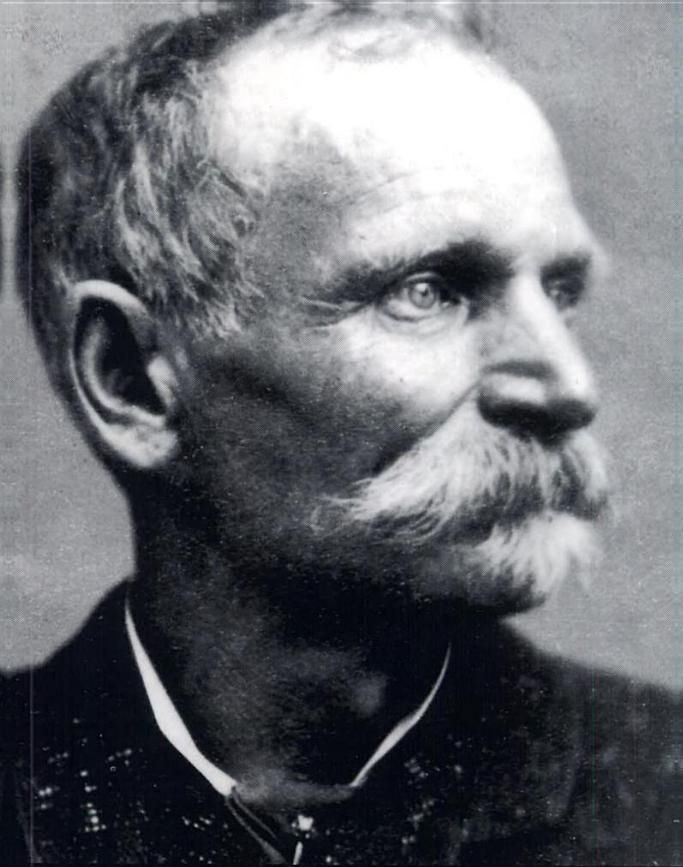

The case
The robber who stopped John Shine's stage on the road from Sonora to Milton on 26 July 1875 wore a long linen duster, had a flour sack over his head with eyeholes cut in it, and carried a shotgun. He asked Shine, politely, to throw down the box, and called over his shoulder to his men in the brush to give the driver a volley if he resisted. Shine handed over the Wells Fargo strongbox. When the robber had gone he looked at the rifles trained on him from the bushes and found they were sticks.
Over the next eight years the same man robbed Wells Fargo stages at least 28 times, across the mining counties of the Sierra foothills, the Mendocino and Sonoma coast and north along the road to Oregon. He worked alone and on foot, apparently because he was afraid of horses, and could cover long distances through rough country. He was unfailingly polite to drivers, kept his profanity for his poetry, and by every account never fired his gun. At two robberies, in 1877 and 1878, he left short verses signed Black Bart, and the newspapers did the rest.
He was Charles E. Boles, born in Norfolk, England, around 1829 and raised on a farm in Jefferson County, New York. He had gone to California in the Gold Rush, married in 1854 and settled with his wife and four children in Illinois. In the Civil War he served in the 116th Illinois Infantry, was badly wounded at Vicksburg, marched with Sherman to the sea and came home a brevet lieutenant. In 1867 he went west again to prospect in Idaho and Montana. A letter to his wife in 1871 mentions a bitter run-in with Wells Fargo agents and a vow to get even. After that his letters stopped.
The company's chief detective, James B. Hume, spent years on the case. Black Bart's robberies brought in modest sums, sometimes very little, but they were persistent and embarrassing to a company whose business was safe carriage. Descriptions slowly accumulated: greying hair, two missing front teeth, deep-set eyes, slender hands, a gentleman's manners.
His last robbery, on 3 November 1883, was at Funk Hill near Copperopolis, the place where he had started. The strongbox had been bolted to the floor of the coach, and while he struggled with it the driver, Reason McConnell, borrowed a rifle from a young passenger named Jimmy Rolleri who had got off to hunt along the creek. Shots were fired, and Black Bart was hit in the hand. He escaped with the gold but dropped several belongings, among them a handkerchief with a laundry mark, F.X.O.7.
Hume and the San Francisco detective Harry Morse took the mark round the city's laundries, about ninety of them, until it led to Ferguson and Bigg's California Laundry on Bush Street and to a well-dressed lodger who called himself C. E. Bolton, a mining man often away on business. Arrested in mid-November, he denied everything, then admitted to some robberies, apparently believing the older ones were beyond the statute of limitations. Wells Fargo pressed charges only for the Funk Hill robbery. Boles pleaded guilty and was sentenced to six years in San Quentin.
He was released early for good conduct in January 1888, deaf in one ear and failing in sight. Asked by reporters if he would rob again, he said he was through with crime; asked if he would write more poetry, he laughed and asked if they had not heard him say he was through with crime. A few weeks later he checked into a hotel in Visalia and was never seen again.
Timeline
Charles Boles enlists in the 116th Illinois Infantry.
Boles writes to his wife from the mining country about a quarrel with Wells Fargo agents; his letters soon stop.
First robbery: the Sonora to Milton stage is held up near Copperopolis by a lone masked man.
At a robbery of the Point Arena to Duncans Mills stage he leaves his first verse signed Black Bart.
He leaves a second verse after robbing the Quincy to Oroville stage.
He robs a stage in Jackson County, Oregon, the farthest north he is known to have worked.
Last robbery, at Funk Hill; he is wounded in the hand and drops a handkerchief with a laundry mark.
Detectives arrest Boles in San Francisco after tracing the laundry mark.
He pleads guilty to the Funk Hill robbery and is sentenced to six years in San Quentin.
He is released early for good behaviour.
Last known sighting, at a hotel in Visalia, California.
People in the case
-
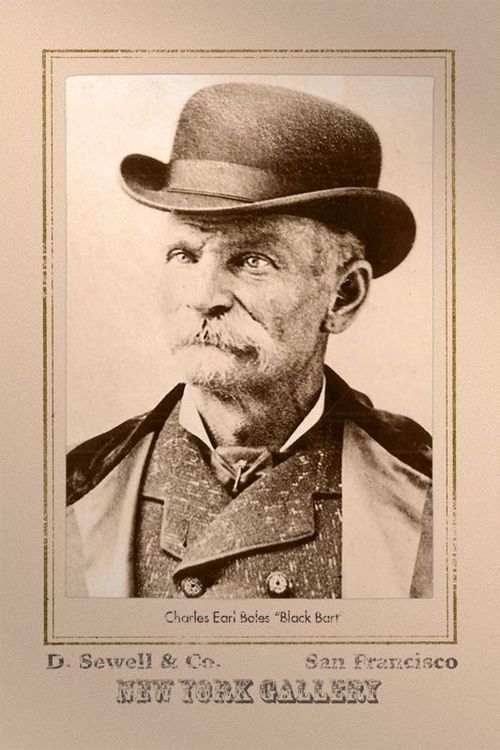
Charles E. Boles (Black Bart) Perpetrator
1829 – ?
English-born Civil War veteran and prospector who robbed Wells Fargo stages from 1875 to 1883. Birth year approximate; last seen in February 1888 and date of death unknown.
-
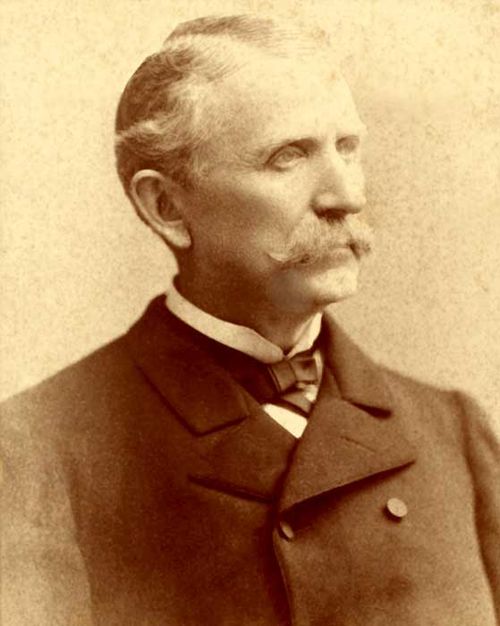
James B. Hume Investigator
1827 – 1904
Wells Fargo's chief of detectives, who pursued Black Bart for years.
-
Harry N. Morse Investigator
22 February 1835 – 11 January 1912
Former Alameda County sheriff and private detective who traced the laundry mark.
-
Reason McConnell Witness
Driver of the stage robbed at Funk Hill in November 1883; fired at the robber.
-
Jimmy Rolleri Witness
Nineteen-year-old son of the Reynolds Ferry owner, whose rifle was used against the robber at Funk Hill.
-
John Shine Witness
Driver of the stage in Black Bart's first robbery in July 1875.
Where it happened
- Copperopolis, California. Funk Hill, scene of his first and last robberies, lies southeast of the town.
- San Andreas, California. Seat of Calaveras County, where Funk Hill lies; an inn there is named for him.
- San Quentin prison. Where he served four years of a six-year sentence.
- Visalia, California. Where he was last seen in February 1888.
Outcome
Convicted Pleaded guilty
Wells Fargo prosecuted only the final robbery, at Funk Hill on 3 November 1883. Boles pleaded guilty in November 1883 and was sentenced to six years in San Quentin. He was released for good behaviour in January 1888 after about four years and two months, and disappeared a few weeks later.
What the record settles, and what it doesn't
Established
- Black Bart was Charles E. Boles, an English-born Civil War veteran who used the alias C. E. Bolton in San Francisco.
- He robbed Wells Fargo stagecoaches in northern California and southern Oregon at least 28 times between 1875 and 1883.
- He worked alone and on foot, wore a flour-sack mask and duster, and is not known to have fired his shotgun in any robbery.
- He left verses at only two robberies, in August 1877 and July 1878.
- A laundry mark, F.X.O.7, on a handkerchief dropped at Funk Hill led detectives to his San Francisco lodging.
- He pleaded guilty to the Funk Hill robbery and served about four years of a six-year sentence in San Quentin.
- After his release he was last seen in February 1888 and his fate is unknown.
Disputed
- What happened to Boles after February 1888 is unknown. Local tradition places him in Marysville or buried at Knights Landing, and one Wells Fargo detective said in 1897 that he believed Boles had gone to Japan; none of this is documented.
- His year of birth is uncertain, with sources varying around 1829.
- How many robberies he committed is uncertain; 28 is the usual count, and some robberies once credited to him, including one in November 1888 with a copycat verse, were not his.
- Whether his grudge against Wells Fargo, mentioned in his 1871 letter, explains his choice of targets is a reasonable inference rather than a proven fact.
- Where the name came from is not certain: he told a detective it simply came to him while writing the first poem, though a villain called Black Bart had appeared in a serial story in the Sacramento Union in the early 1870s.
In the newspapers of the day
Clippings from American newspapers digitised by the Library of Congress. The excerpt under each is the library's machine-read text, uncorrected; read the original page for the full report.
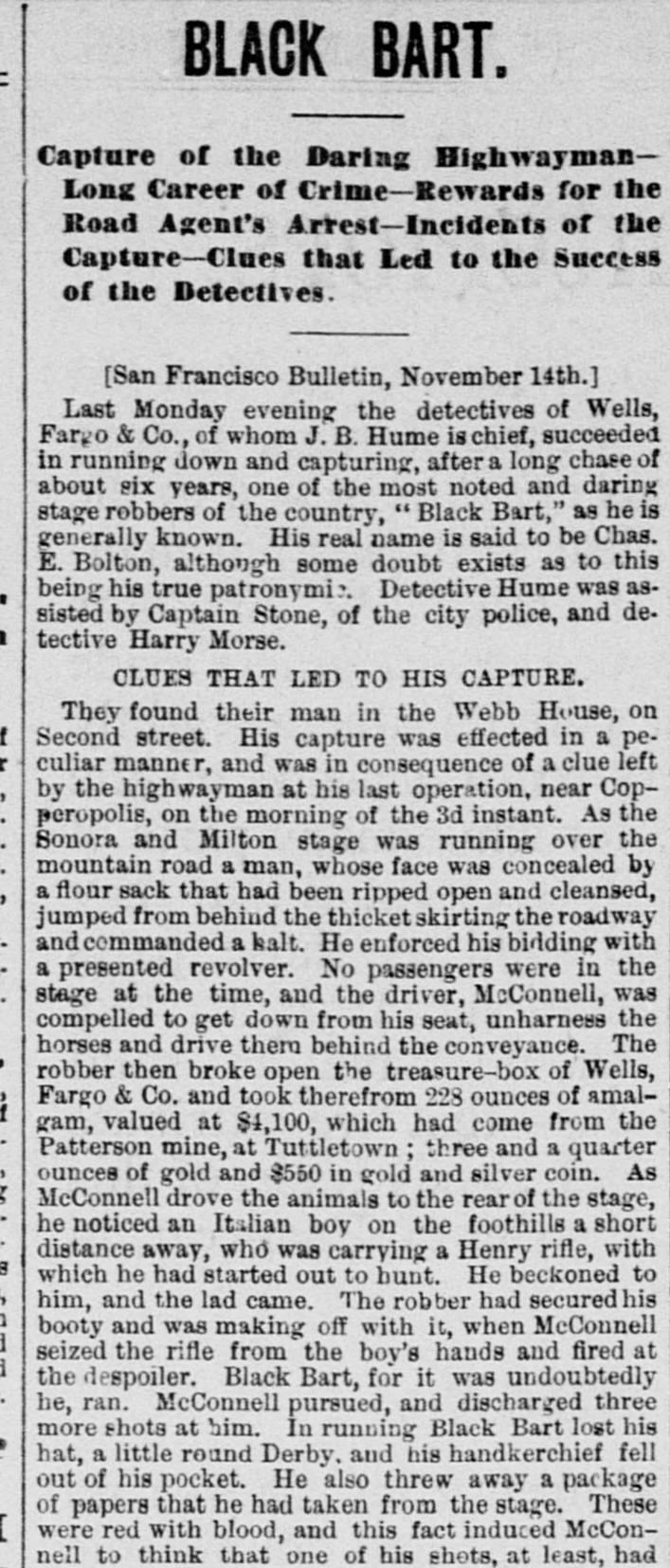
Sacramento daily record-union (Sacramento [Calif.])
, page 4 · The arrest of Black Bart
BLACK BART. ■- | Capture of the D-trlns Highwayman— Lone Career of Crime— Rewards for the Road Agent's Arrest— lncidents of the Capture— Clues tbat Led to the success of Ihe Detectives. [San Francisco Bulletin, November lltb.] Last Monday evening the detectives of Wells, Far. & Co., of whom J. B. Hume is chief, succeeded in running down and capturing, after a long chase of about six years, one of the most noted and darina* stage robbers of the country, " Black Bart," as he is generally known. His real name is said to be Cbas. E. Bolton, although some doubt exists as to this being his true patronymi *. Detective Hume was as- sisted by Captain Stone, of the city police, and de- tective Harry Morse. CLUES THAT LED TO HIS CAPTURE. Tbey found their man in the Webb House, on Second street. His capture was effected in a pe- culiar manner, and was in consequence of a clue left by the highwayman at bis last operation, near Cop- peropolis, on the morning of the 3d instant. As the Sonora and Hilton stage was running over the mountain road a man, whose face was concealed by a flour sack that had beeu ripped open and cleansed, jumped from behind the thicket skirting the roadway and commanded a halt. He enforced bis bidding with a presented revolver. No passengers were in the stage at the time, aud the driver, M-Connell, was compelled to get down from his seat, unharness the horses and drive them behind the conveyance. The robber then broke open the treasure-box of Wells, Fargo & Co. and took therefrom 2*23 ounces of amal- gam, valued at 81,100, which had come from the Patterson mine, at Tuttletown ; three and a quarter ounces of gold and *550 in gold and silver coin. As McConnell drove the animals to the rear of the stage, he noticed an Italian boy on the foothills a short distance away, who was carrying a Henry rifle, with which he had started out to bunt. He beckoned to him, and the lad came. The robber had secured his booty and was making off with it, when McCounell seized the rifle from the boy's hands and fired at the di spoiler. Black Bart, for it was undoubtedly be, ran. McConnell pursued, and discharged three more thots at bim. In running Black Bart lost his hat, a little round Derby, and his handkerchief fell out of his pocket. He also threw away a package of papers that he had taken from the stage. These were red with …
Omaha daily bee (Omaha [Neb.])
, page 2 · The arrest of Black Bart
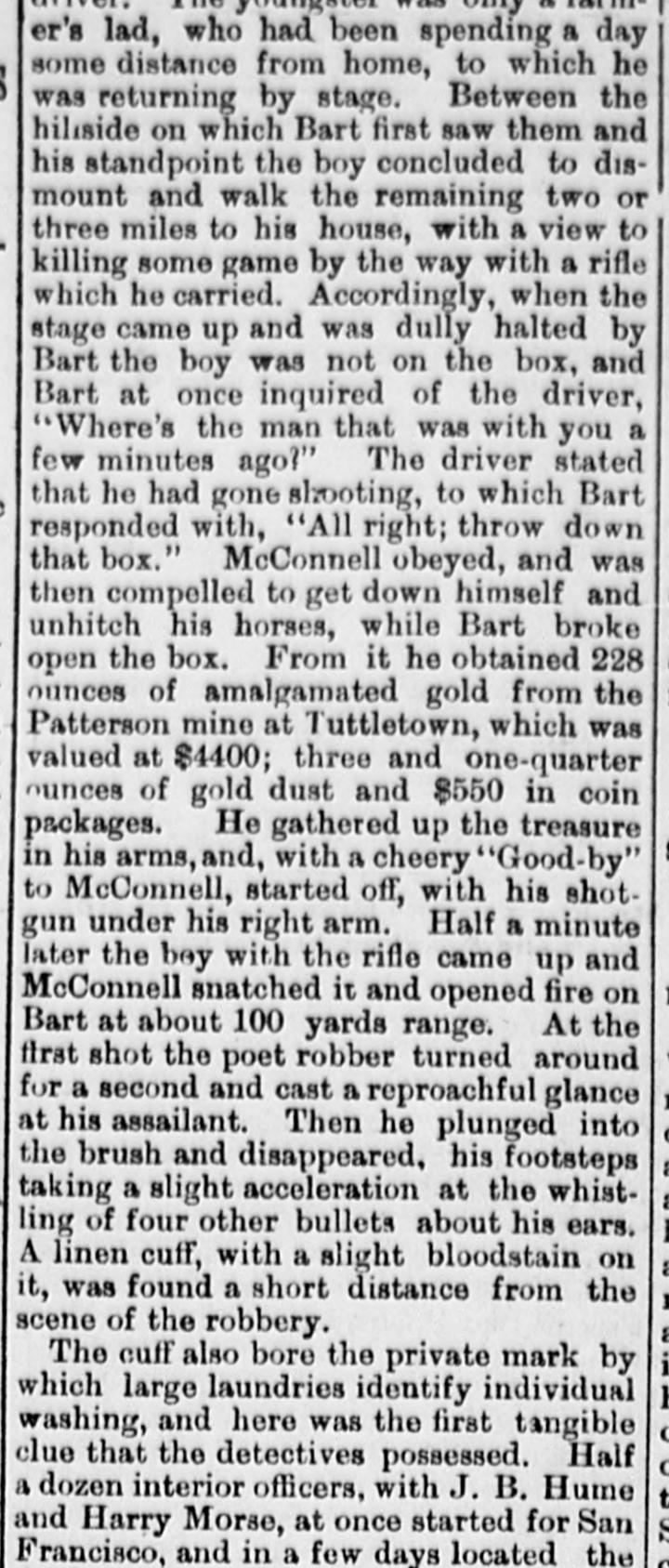
w as returning by stage. Between the hihsido on which Bart first saw thorn and h is e1'tudpoint Ute bay concluded to dls. mount and walk the remaining two or three miles to iris batten , with n view to killing some soma by the way with n aloe which he cnrriod. AcconlinqIq , whoa rho st age cvno up and was dully halted by Bart rho bo was not on ta box cud I3nrt at once inquired of tine driver , " ' man ti 1Vhera's rho that svna with you few tninuica n o } " The driver anicd that ho had on abotin to which Dart. roennacd with "All right ; throw dawn flint box. " McConnell uba ea , and was than camsoiled to [ lut down himself and unhitch iris horses , while hart. broke spun the box. From it ho obiainod 228 nnncaa of mmalgnamtod gold from the I'nttornon mine at Tuttlotown , which was vnluad at $1100 ; Urrca mad one-quarter runcos of gold dust and $ GGO to coin pncknges. Ito gathered up rho treasure ! tt his arms and with a cheer "Good b " bJ fllcCuunull started off with his shat. guts under Lis tight auto , half n miuuto Inter iho boy with the ri0o cfttno up and M cConnell snatched it and opened tire on Bart at about. 100 yards range. At the fir st shat tire poet robber turned around fur n secmtd and cast n topronchful glance lit his tsasailmtt. Then ha plunged into the brush and dieappoarea , has footstopa taking a slight nccolorntion at rho whist- liujl of four attar ballots about his oars , A boon cuff , with a altj'ht …
New york dispatch (New York [N.Y.])
, page 1 · The arrest of Black Bart
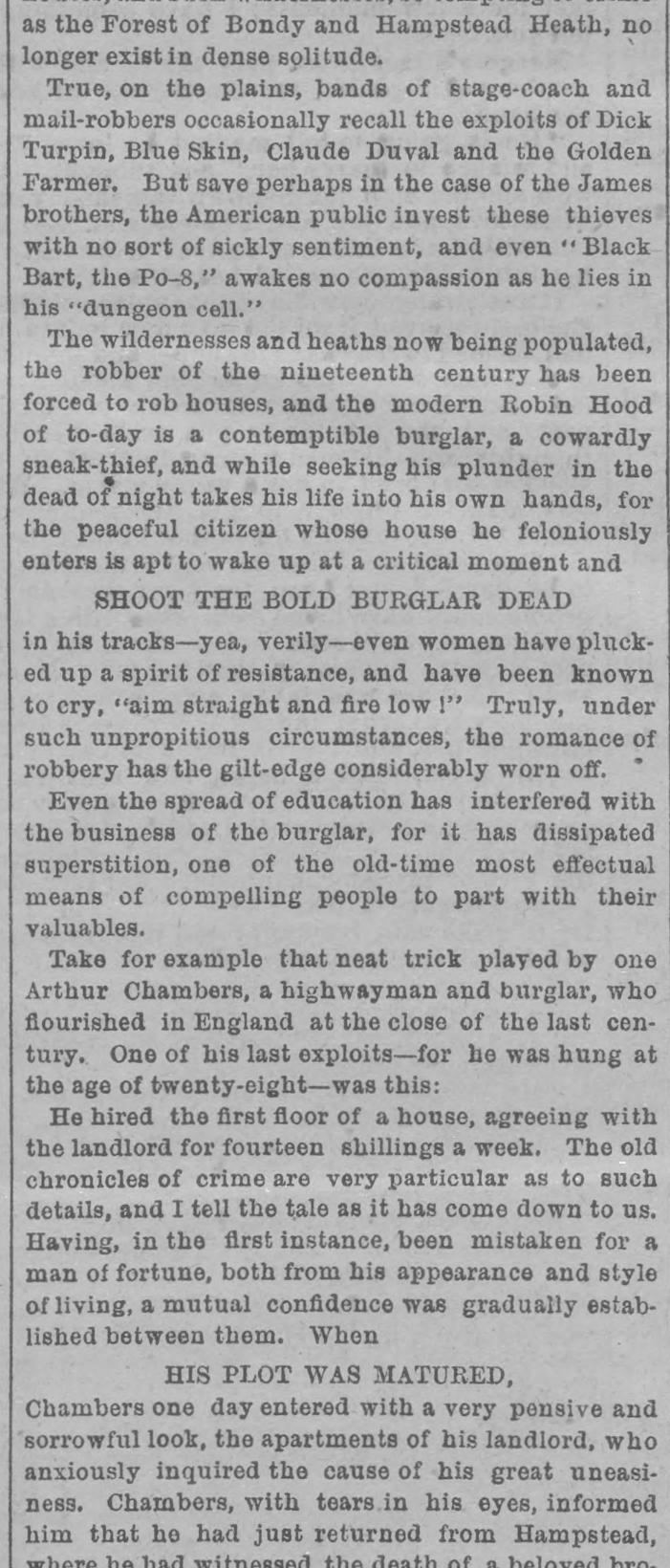
True, on the plains, bands of stage-coach and mail-robbers occasionally recall the exploits of Dick Turpin, Blue Skin, Claude Duval and the Golden Farmer. But save perhaps in the case of the James brothers, the American public invest these thieves with no sort of sickly sentiment, and even “ Black Bart, the Po-8,” awakes no compassion as he lies in his “dungeon cell.” The wildernesses and heaths now being populated, …
Waterbury evening democrat (Waterbury, Conn.)
, page 1 · Release from San Quentin
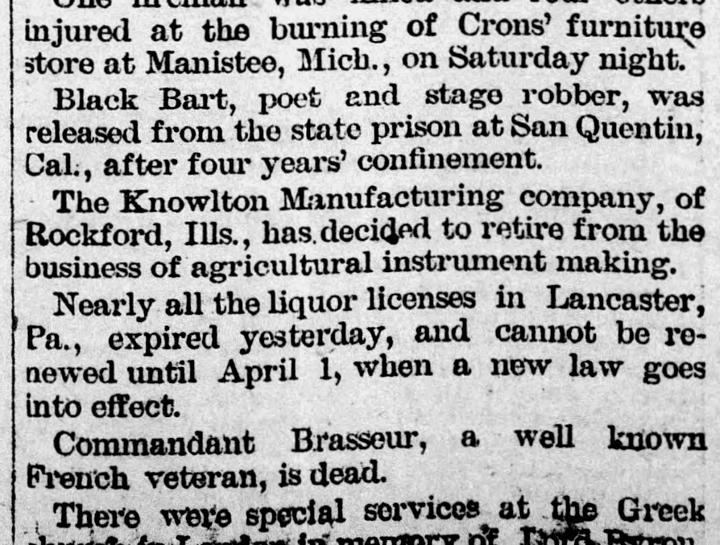
Black Bart, poet and stage robber, was released from tho state prison at ban Quentin, CaL, after four years' contmemenc. The Knowlton Manufacturing company, of Rockford, Ills., has. decided to retire from the business of agricultural instrument maiang. Nearly all the liquor licenses in Lancaster j Pa., expired yesteroay, ana cannot oe re newed until April 1 when a new law goes into effect. Commandant Brasseur, a …
The monmouth inquirer (Freehold, N.J.)
, page 4 · Release from San Quentin
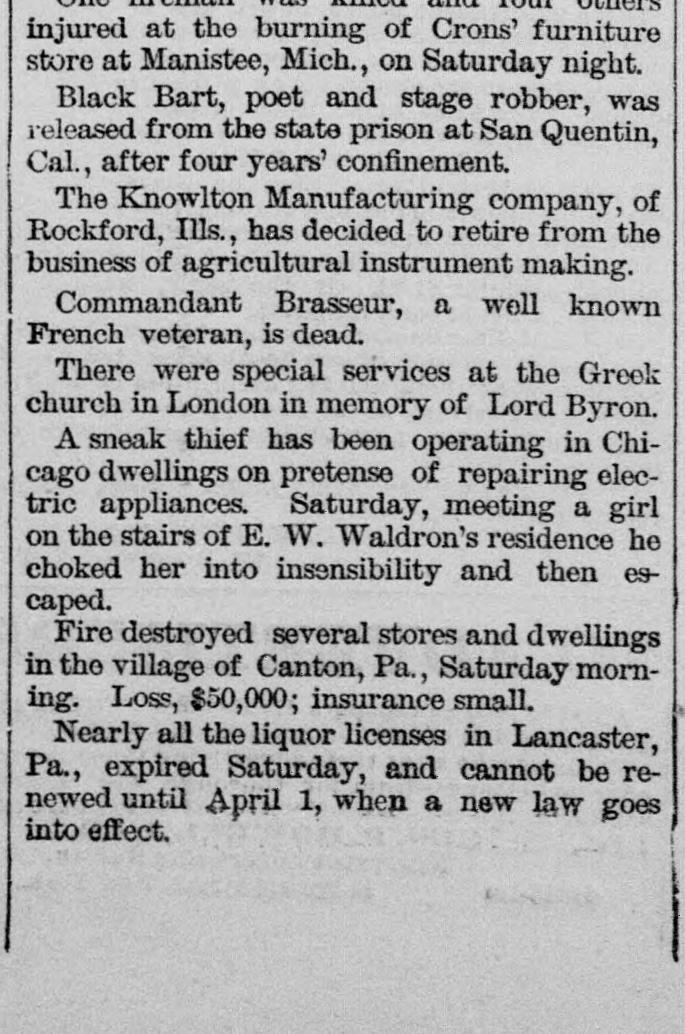
Black Bart, poet and stage robber, was released from tho state prison at San Quentin, Cal., after four years’ confinement The Knowlton Manufacturing company, of Rockford, Ills., has decided to retire from the business of agricultural instrument making. Commandant Brasseur, a well known French veteran, is dead. There were special services at the Greek church in London in memory of Lord Byron. A sneak thief has been …
Wood county reporter (Grand Rapids [I.E. Wisconsin Rapids], wis.)
, page 7 · Release from San Quentin
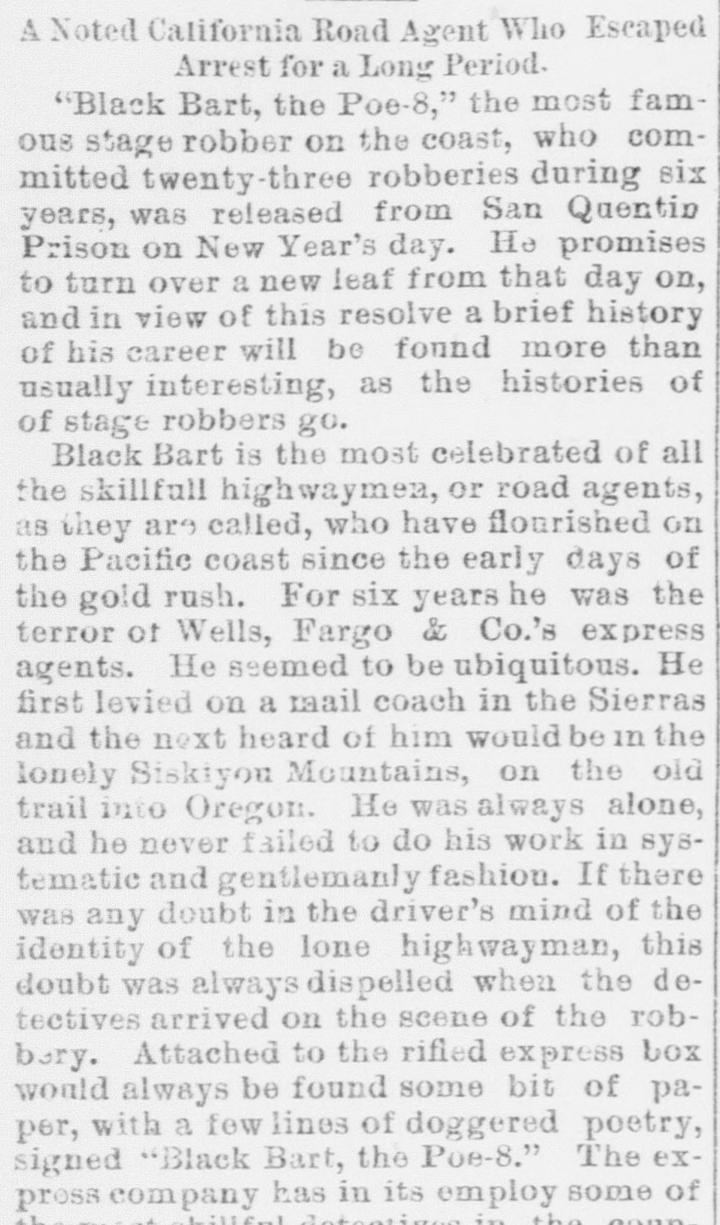
“ Black Bart, the Poe-8,” the most fam- ous stage robber on the coast, who com- mitted twenty-three robberies during six years, was released from San Quentin Prison on New Year’s day. He promises to turn over anew leaf from that day on, and in view of this resolve a brief history of his career will be found more than usually interesting, as the histories of of stage robbers go. Black Bart is the most celebrated of …
Source: Chronicling America: Historic American Newspapers, Library of Congress. Public domain.
Pictures


Afterwards
Wells Fargo followed reports of Boles for some years and found nothing solid. He wrote to his wife after his release but never went back to her. A November 1888 robbery with a verse attached was declared a copycat by Hume after he compared the handwriting.
The flour sack, the courtesy and the verses made him one of the few Western robbers remembered with something like affection, and he has been played on film and television many times. Plaques at Duncans Mills and Oroville mark robbery sites, and San Andreas, the seat of the county where he began and ended his career, has an inn named for him. His capture remains a small classic of detective work: a robbery solved by a laundry mark.
Questions readers ask
Who was Black Bart?
Black Bart was the stagecoach robber Charles E. Boles, an English-born Civil War veteran who held up Wells Fargo stages in California and Oregon at least 28 times between 1875 and 1883. He was known for his politeness, his flour-sack mask and two short poems.
How was Black Bart caught?
At his last robbery in November 1883 he was wounded and dropped a handkerchief with the laundry mark F.X.O.7. Detectives James Hume and Harry Morse traced it through San Francisco's laundries to his lodgings.
Did Black Bart ever kill anyone?
No. He is not known to have fired his shotgun in any of his robberies, and no one was killed in them.
What happened to Black Bart after prison?
He was released in January 1888 and was last seen at a hotel in Visalia, California, in late February 1888. Nothing certain is known about him after that.
Sources and further reading
- Black Bart (outlaw) (Wikipedia)
- Unlocking History: 1870s stagecoach bandit Black Bart (California Department of Corrections and Rehabilitation)
- Wikidata Q880069 (life dates checked here)
Written by Sinister Crimes from the sources above; see our editorial standards. Last checked 1 November 2026.