

The case
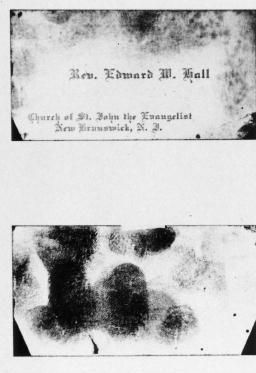
A courting couple walking down De Russey's Lane, a lovers' lane just outside New Brunswick, New Jersey, found them on the morning of Saturday, September 16, 1922: a man and a woman lying side by side under a crab apple tree on an abandoned farm, as if arranged. Both had been shot. The man's calling card had been propped at his feet, and torn-up love letters lay scattered between them. He was the Reverend Edward Wheeler Hall, rector of the Episcopal Church of St. John the Evangelist in New Brunswick. She was Eleanor Mills, who sang in his choir and was married to the church sexton.
Hall and Mills had last been seen on the evening of Thursday, September 14. The letters made plain what much of the parish already suspected: the two had been having an affair for some time, and they wrote about leaving their spouses. Hall was married to Frances Noel Stevens, seven years his senior, whose family was among the wealthiest and best connected in New Brunswick. Eleanor's husband, James Mills, was a poorly paid janitor and sexton.
The investigation began badly and got worse. The bodies lay just across the line in Somerset County, but New Brunswick police in Middlesex County arrived first, and the two counties' officials argued over jurisdiction while sightseers trampled the scene, carried off souvenirs and passed Hall's card from hand to hand. Suspicion soon settled on Mrs. Hall and her two brothers, Henry and William Stevens, and on a cousin, Henry Carpender. Willie Stevens, an eccentric man who lived with his sister, owned a .32-caliber pistol like the weapon used. But a grand jury heard the evidence in November 1922 and returned no indictments.
For four years the case stayed dormant. In 1926 the New York Daily Mirror, a tabloid looking for a sensation, revived it on the strength of claims arising from a former Hall household servant's marriage, suggesting that witnesses had been paid off. Governor A. Harry Moore appointed a special prosecutor, State Senator Alexander Simpson. Mrs. Hall was arrested that summer, and in September a grand jury indicted her, both brothers and Henry Carpender for both murders. Carpender won a separate trial.
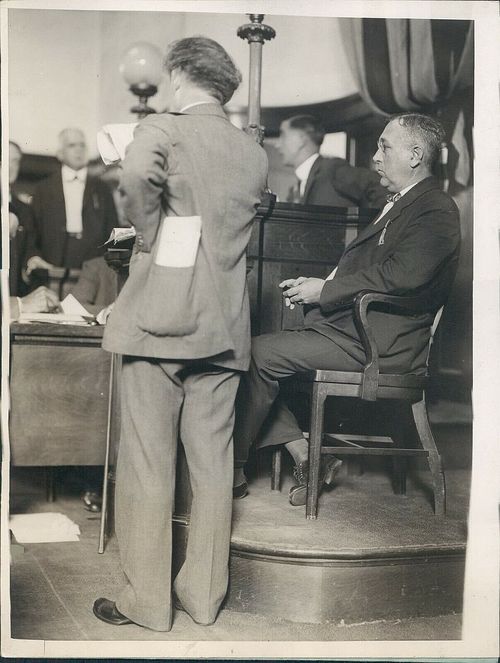
The trial of Mrs. Hall and her brothers for the murder of Eleanor Mills opened at the Somerset County Courthouse in Somerville on November 3, 1926, before Justice Charles W. Parker. It drew hundreds of reporters and was covered in more detail than almost any American trial before it. The prosecution's case depended heavily on Jane Gibson, a farmer known in the papers as the Pig Woman, who said she had ridden her mule toward the lane that night, heard voices and shots and seen figures including, she claimed, Mrs. Hall and one of the brothers. Gibson was by then gravely ill and testified from a hospital bed carried into the courtroom. Her accounts had changed repeatedly, and the defense, led by Robert H. McCarter, attacked her credibility. Willie Stevens, expected to be a weak witness, held up well under cross-examination.
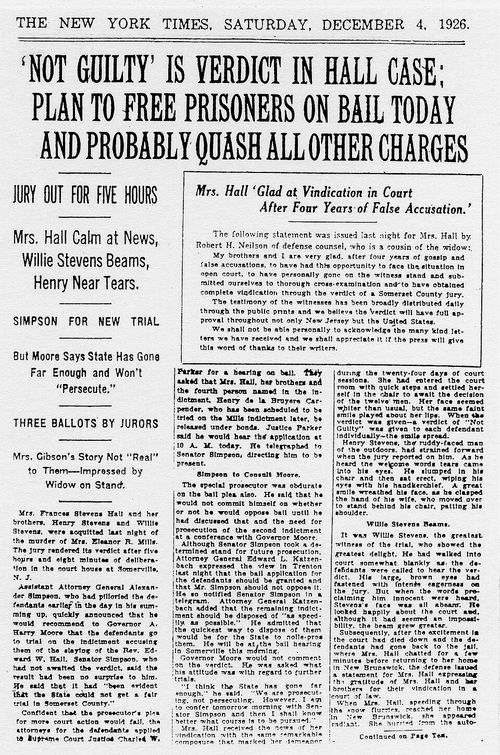
On December 3, 1926, the jury acquitted all three after deliberating for a few hours. Within days the state dropped the remaining indictments, including the one against Carpender. No one else was ever charged, and the murders remain unsolved.
The victims
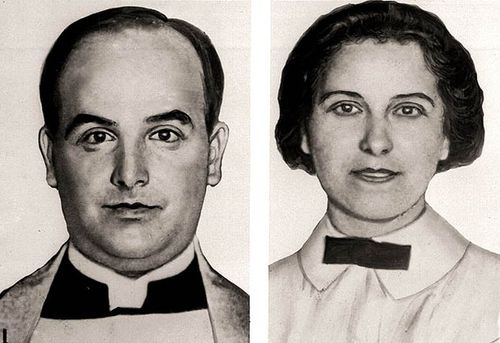
Edward Wheeler Hall, in his early forties, was a Brooklyn-raised clergyman who had trained for the ministry in Manhattan, served in Basking Ridge and become rector of St. John the Evangelist in New Brunswick. He had married Frances Stevens in 1911, and lived in her family's large house on Nichol Avenue. His public role was that of a respectable parish priest; the letters found at the scene showed a more restless and romantic man.
Eleanor Reinhardt Mills, in her mid-thirties, was a soprano in the St. John's choir who lived with her husband James and their two children in modest rooms on Carman Street. The letters suggest she was unhappy in her marriage and hoped Hall would leave his so that they could start again together. Her daughter Charlotte, a teenager at the time of the murders, became a minor celebrity during the 1926 trial.
Timeline
Edward Wheeler Hall marries Frances Noel Stevens.
Hall and Eleanor Mills are last seen alive in New Brunswick.
Their bodies are found under a crab apple tree off De Russey's Lane in Franklin Township.
A Somerset County grand jury declines to indict anyone.
After stories in the New York Daily Mirror, the case is reopened and Mrs. Hall is arrested.
A grand jury indicts Mrs. Hall, her brothers Henry and Willie Stevens and their cousin Henry Carpender for both murders.
Mrs. Hall and her brothers go on trial at Somerville for the murder of Eleanor Mills.
The jury acquits all three defendants.
The state drops the remaining indictments, including the case against Carpender.
Jane Gibson, the Pig Woman, dies.
Frances Stevens Hall dies in New Brunswick; Willie Stevens dies eleven days later.
People in the case
-
Edward Wheeler Hall Victim
1881 – 14 September 1922
Rector of St. John the Evangelist Episcopal Church, New Brunswick.
-
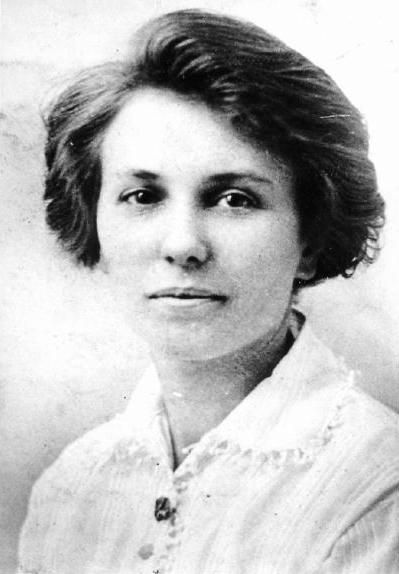
Eleanor Reinhardt Mills Victim
1888 – 14 September 1922
Choir singer at St. John's and wife of the church sexton, James Mills.
-
Frances Noel Stevens Hall Accused
13 January 1874 – 19 December 1942
Hall's widow, indicted for both murders in 1926 and acquitted of Eleanor Mills's murder; the other indictment was dropped.
-
William Carpender Stevens Accused
13 March 1872 – 30 December 1942
Mrs. Hall's brother Willie, owner of a .32-caliber pistol; acquitted.
-
Henry Hewgill Stevens Accused
10 November 1869 – 3 December 1939
Mrs. Hall's brother, a retired exhibition marksman; acquitted.
-
Henry de la Bruyere Carpender Accused
15 May 1882 – 26 May 1934
Mrs. Hall's cousin, a Wall Street stockbroker; indicted but never tried.
-
Jane Gibson Witness
? – 7 February 1930
Farmer called the Pig Woman, the prosecution's main eyewitness; born about 1870.
-
Alexander Simpson Prosecutor
12 June 1872 – 20 July 1953
State senator appointed special prosecutor in 1926.
-
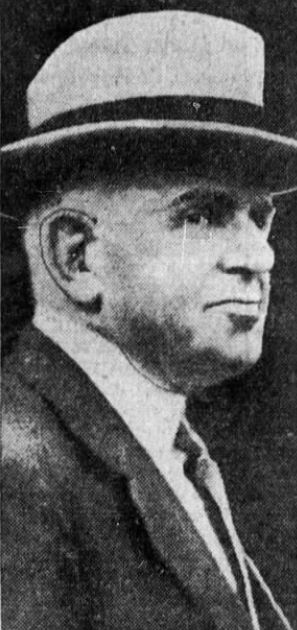
Robert H. McCarter Defence
28 April 1859 – 30 May 1941
Former New Jersey attorney general who led the defense.
Where it happened
- De Russey's Lane (now Franklin Boulevard), Franklin Township. Approximate site of the crab apple tree where the bodies were found.
- Somerset County Courthouse, Somerville. Where the 1926 trial was held.
- New Brunswick, New Jersey. Home of both victims and of the Hall and Stevens families.
Outcome
Acquitted Acquitted
A grand jury declined to indict anyone in 1922. In 1926 Frances Stevens Hall, Henry Stevens, William Stevens and Henry Carpender were each indicted for both murders; Mrs. Hall and her brothers were tried for Eleanor Mills's murder and acquitted on December 3, 1926. The state then dropped the remaining indictments, and Carpender was never tried.
What the record settles, and what it doesn't
Established
- Edward Wheeler Hall and Eleanor Mills were shot dead on or about the night of September 14, 1922, and found on September 16 near De Russey's Lane in Franklin Township.
- The two had been having an affair, documented in letters found with the bodies.
- The crime scene was badly contaminated by sightseers before any proper investigation.
- A 1922 grand jury returned no indictments.
- In 1926 Mrs. Hall, her two brothers and a cousin were indicted; the three who were tried were acquitted on December 3, 1926, and the other charges were dropped.
- No one has been convicted of the murders.
Disputed
- Whether the Hall and Stevens family were responsible: the prosecution argued that Mrs. Hall and her brothers confronted the lovers, while the defense maintained that they were at home and that the evidence against them was invented or mistaken.
- The reliability of Jane Gibson, whose story changed several times and whom the defense portrayed as confused or untruthful; some later writers think she saw something real, others that she saw nothing.
- Whether a fingerprint said to be Willie Stevens's on Hall's calling card was genuine evidence, given how many people handled the card at the scene.
- Alternative theories, including a robbery, a jealous third party and a suggestion by a later author that the Ku Klux Klan was responsible, none of which has been supported by evidence.
- Later books have reached opposite conclusions, some arguing that the Stevens siblings were guilty and others that the wrong people were tried.
Pictures





Afterwards
The acquittal did not end the family's ordeal so much as move it into the libel courts. Mrs. Hall sued the Daily Mirror for libel and settled out of court for an undisclosed sum. Frances Hall lived quietly in New Brunswick until her death in 1942; her house was later bought by Rutgers University. Henry Stevens died in 1939, thirteen years to the day after the acquittal, and Willie Stevens in 1942, eleven days after his sister. James Mills lived until 1965.
In the history of the press the case marked a turning point. The trial was covered by hundreds of reporters and celebrities and dissected at a length that only the Lindbergh kidnapping trial would later exceed. It helped establish the tabloid trial as a national entertainment, and it fed directly into fiction, including the novel The Bellamy Trial and the silent film The Goose Woman. Some critics have suggested it echoes in the ending of The Great Gatsby.
Questions readers ask
Who killed Reverend Hall and Eleanor Mills?
No one knows. Hall's widow and her two brothers were tried and acquitted in 1926, a cousin was indicted but never tried, and no one else was ever charged.
Who was the Pig Woman in the Hall-Mills case?
Jane Gibson, a farmer who lived near the crime scene and raised hogs. She claimed to have seen and heard the killing and testified from a hospital bed in 1926, but her accounts varied and the jury did not accept her evidence.
Why was the Hall-Mills case reopened in 1926?
The New York Daily Mirror published claims that witnesses had been paid to stay silent, prompting Governor A. Harry Moore to appoint a special prosecutor and a new grand jury.
Sources and further reading
- Hall-Mills murder case (Wikipedia)
- Mary S. Hartman, 'The Hall-Mills Murder Case', Journal of the Rutgers University Libraries 46 (2012)
- Chronicling America: 'Mrs. Hall happy when murder charge is dropped', December 1926
- Wikidata Q4157206 (life dates checked here)
Written by Sinister Crimes from the sources above; see our editorial standards. Last checked 1 November 2026.