

The case
When a mechanic named Albert Hofner arrived at the Hinterkaifeck farm on 4 April 1922 to repair the engine of a fodder cutter, nobody came to the door. He could hear the cattle and the dog. He waited an hour, did the job alone, and left about four and a half hours later. What he did not know was that the six people who lived there had been dead in the barn and the house since the night of 31 March, and that someone had been looking after the animals in the meantime.
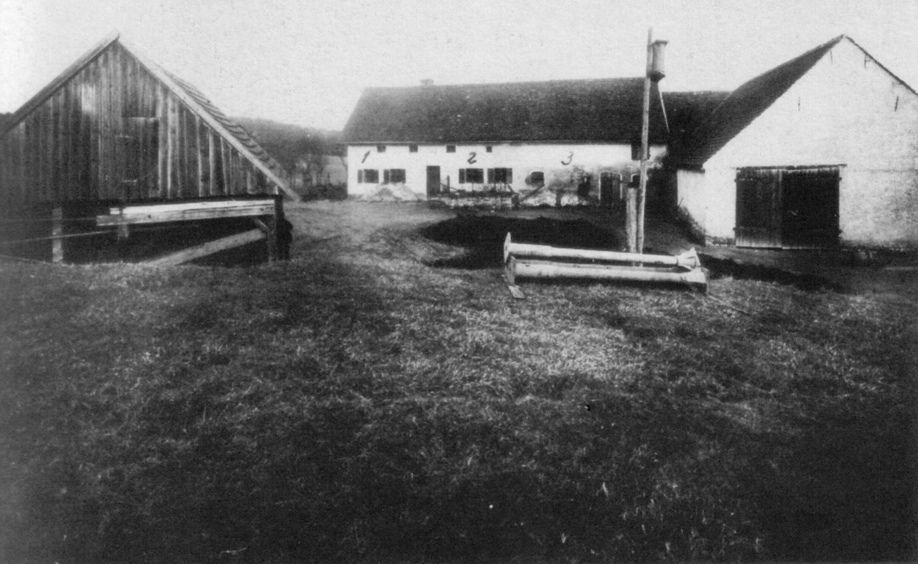
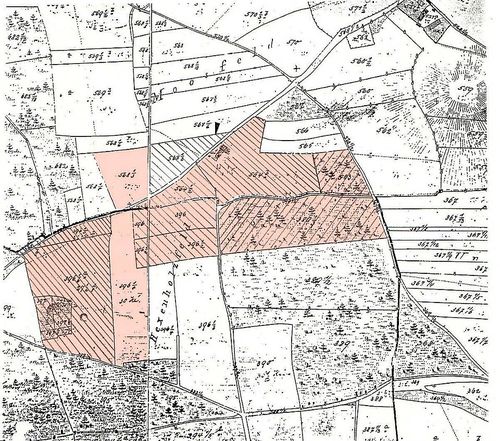
Hinterkaifeck was not a village but the house name of a single farmstead, set apart from the hamlet of Gröbern in the Schrobenhausen district, about 70 kilometres north of Munich, and backed by woods. It belonged to Andreas Gruber, 63, his wife Cäzilia, 72, and their widowed daughter Viktoria Gabriel, 35, whose husband Karl had been killed in France in December 1914. Viktoria's children Cäzilia, seven, and Josef, two, lived there too. The household was known in the district as reclusive and careful with money, and it carried a dark history: in 1915 a court had convicted Andreas Gruber of incest with Viktoria, a relationship that began when she was a teenager. Neighbour Lorenz Schlittenbauer, a widower who had been involved with Viktoria, was named as Josef's father, though he at times disputed it.
In the weeks before the killings Andreas Gruber told neighbours about things he could not explain: footprints in the snow leading from the woods to the farm but not away, a broken lock on the engine shed, a missing house key, a Munich newspaper that nobody in the area took, and footsteps in the attic at night. He searched and found nothing, and he declined offers of help. On the afternoon of Friday 31 March a new maid, Maria Baumgartner, arrived with her sister, who soon left. That evening Viktoria, her parents and her daughter were killed one after another in the barn with a mattock that belonged to the farm. In the house, the killer or killers then killed Maria Baumgartner in her room and the little boy in his cot.
Over the next days the farm seemed merely quiet. Two coffee salesmen called on 1 April and left. Young Cäzilia missed school, and the family missed Sunday mass. On the evening of 4 April Schlittenbauer, having sent his son to look, went to the farm with two other neighbours. They broke into the barn and found four bodies under straw; the other two were inside the house.
Detectives from Munich under Georg Reingruber arrived that night, but onlookers had already walked through the scene, and the evidence was handled in ways that later reviewers found inadequate: few photographs were taken and no fingerprints were secured. Robbery seemed unlikely, since a large amount of money lay untouched in the house. Yet someone had fed and milked the cattle, eaten the bread and cut meat from the larder, and the hay in the attic showed hollows where people might have lain. A passer-by later said he had seen smoke from the farm's oven on the night after the murders. The weapon was found only in 1923, hidden under the attic floorboards when the farm was demolished.
About a hundred people came under suspicion, but no one was ever charged. Schlittenbauer was suspected by many locals because of his entanglement with the family and his conduct on the day the bodies were found, and he won several lawsuits against people who called him the murderer before his death in 1941. Investigators also looked at Karl Gabriel, whose body had never been recovered; at members of a far-right paramilitary group; at local brothers named by a former maid; and at others. The case was formally closed in 1955, though interviews continued into the 1980s. Many of the original files were lost when bombing struck Augsburg in 1944.
The victims
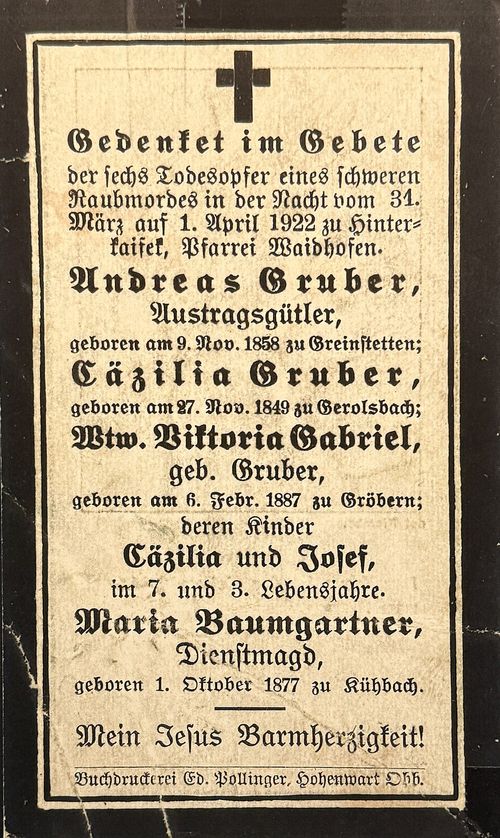
Andreas Gruber, born in 1858 at Grainstetten in Bavaria, had lived at Hinterkaifeck since marrying Cäzilia in 1886. She was nine years older and had acquired the farm in 1877 on divorcing her first husband, with whom she had three children. Their daughter Viktoria, born in 1887, married Karl Gabriel of Waidhofen in March 1914, and the farm was signed over to the young couple on their wedding day; within months he was called up, and by Christmas he was dead. Her daughter Cäzilia, born in January 1915, never knew her father, and was old enough to be at school when she died. Her brother Josef was two.
Maria Baumgartner, in her mid-forties, had been hired as the family's maid and arrived only that afternoon. The previous maid had left months earlier, saying she had heard strange noises in the house. Nothing in Maria Baumgartner's life is known to have connected her to whatever happened that night, though investigators later admitted they had barely looked. The six were buried together in the cemetery at Waidhofen on 8 April 1922, before a crowd of several thousand.
Timeline
Karl Gabriel, Viktoria's husband, is reported killed in action in France.
A court convicts Andreas Gruber and his daughter Viktoria of incest; he is sentenced to a year in prison.
Andreas Gruber reports footprints in the snow, a broken lock, a missing key and noises in the attic.
The new maid Maria Baumgartner arrives in the afternoon; all six people on the farm are killed that night.
Two travelling coffee salesmen find no one at home and leave.
Lorenz Schlittenbauer and two neighbours discover the bodies; Munich detectives arrive overnight.
A court physician carries out the post-mortem examinations at the farm.
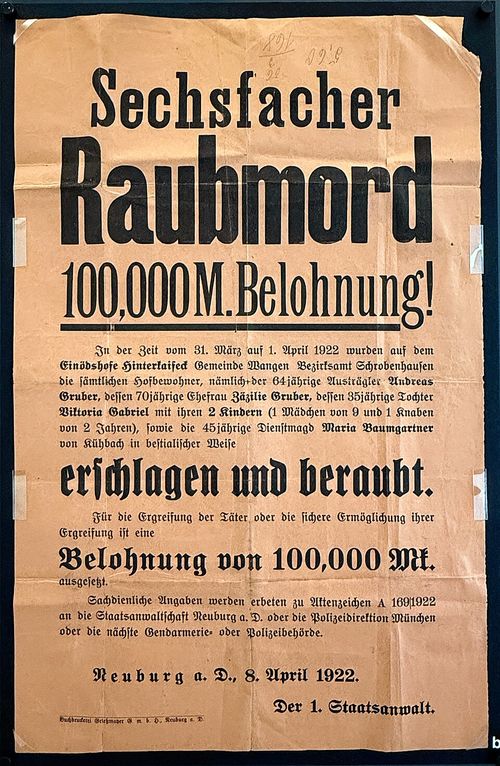
The victims are buried at Waidhofen; the Bavarian interior ministry offers a reward of 100,000 marks.
During demolition of the farm, the bloodstained mattock is found hidden under the attic floor.
Lorenz Schlittenbauer dies, never having been charged.
A prosecutor investigates the brothers Adolf and Anton Gump after their sister's deathbed accusation; the case against Anton is dropped in 1954.
The investigation is formally closed.
Police students in Fürstenfeldbruck review the files and criticise the original forensic work.
People in the case
-
Andreas Gruber Victim
9 November 1858 – 31 March 1922
Farmer at Hinterkaifeck, aged 63; convicted in 1915 of incest with his daughter Viktoria.
-
Cäzilia Gruber Victim
27 November 1849 – 31 March 1922
Andreas Gruber's wife, aged 72, who had owned the farm since 1877.
-
Viktoria Gabriel Victim
1887 – 31 March 1922
Daughter of the Grubers, aged 35, widowed in the First World War; owner of the farm with her late husband from 1914.
-
Cäzilia Gabriel Victim
9 January 1915 – 31 March 1922
Viktoria's daughter, aged seven.
-
Josef Gruber Victim
1919 – 31 March 1922
Viktoria's son, aged two, also recorded under the surname Gabriel.
-
Maria Baumgartner Victim
? – 31 March 1922
The family's new maid, aged 44 or 45, who had arrived that afternoon.
-
Lorenz Schlittenbauer Suspect
? – 1941
Neighbour and local headman who found the bodies; long suspected locally but never charged, and successful in several slander suits.
-
Georg Reingruber Investigator
Chief inspector of the Munich police who led the investigation until his retirement in 1930.
Where it happened
- Site of the Hinterkaifeck farm. The farmstead was demolished in 1923; the site is farmland and a memorial stands nearby.
- Gröbern. Hamlet to which the farm belonged, home of the neighbour Lorenz Schlittenbauer.
- Waidhofen. Parish village where the victims worshipped and where they are buried. Coordinates are for the village.
Outcome
Unsolved Unsolved
No one was ever charged with the murders. Several suspects were arrested or investigated over the following decades, including Anton Gump in 1951, but all were released for lack of evidence. The case was officially closed in 1955.
What the record settles, and what it doesn't
Established
- Six people, Andreas and Cäzilia Gruber, Viktoria Gabriel, her children Cäzilia and Josef, and the maid Maria Baumgartner, were killed at Hinterkaifeck on the evening or night of 31 March 1922.
- Four of the victims were killed in the barn and two in the house, all with a mattock belonging to the farm.
- The killings were not discovered until 4 April, and in the meantime someone tended the livestock and ate food from the house.
- Money and valuables were left in the house, which made robbery an uncertain motive.
- The murder weapon was found hidden in the attic when the farm was demolished in 1923.
- Despite investigation of about a hundred suspects, no one was ever charged, and the case was closed in 1955.
Disputed
- Who the killer or killers were: local opinion long pointed to the neighbour Lorenz Schlittenbauer, who was never charged and won slander actions; other theories name Karl Gabriel, said by some to have survived the war; the Gump brothers; local labourers and thieves; or an outsider.
- Whether there was one killer or more than one: the use of a single mattock suggests one, while reports of two figures at the forest edge and of other tools found at the farm suggest more.
- Whether someone was hiding on the farm before the murders: the hollows in the hay and the moved roof tiles were taken as signs of an intruder, but have also been explained as traces of the household itself.
- The motive: robbery, jealousy, revenge or a family dispute have all been proposed, and the family's history has been used to support several of them.
- Some victim ages differ between sources, such as Andreas Gruber (63 or 64) and Maria Baumgartner (44 or 45).
Pictures



Afterwards
The farm was sold to relatives of Karl Gabriel and torn down in 1923, and nothing was built on the site again. The victims' skulls, removed at the post-mortem and sent to Munich, were later lost when bombing destroyed a court building in Augsburg during the Second World War, along with much of the case file.
Hinterkaifeck remains one of Germany's best-known unsolved crimes. It inspired Andrea Maria Schenkel's bestselling 2006 novel Tannöd and its 2009 film adaptation, as well as television documentaries and dramatisations. In 2007 a group of police trainees reviewed the surviving files; they agreed among themselves on a likely culprit but declined to publish the name out of consideration for descendants, and their conclusion has since been questioned.
Questions readers ask
Was the Hinterkaifeck murder ever solved?
No. About a hundred people were investigated and several were held for a time, but no one was ever charged. The file was closed in 1955.
Who is the main suspect in the Hinterkaifeck murders?
The neighbour Lorenz Schlittenbauer has long been the most discussed suspect because of his relationship with Viktoria Gabriel and his behaviour when the bodies were found. He was never charged, won slander suits against accusers, and nothing conclusive links him to the crime.
Did the killer stay at the farm after the murders?
Someone fed and milked the livestock and ate food from the house in the days between the killings and the discovery, so investigators concluded that the killer either stayed or returned.
Can you visit Hinterkaifeck today?
The farm was demolished in 1923 and the site is farmland. A memorial stands near the spot, and the victims are buried in the cemetery at Waidhofen.
Sources and further reading
- Hinterkaifeck murders (Wikipedia)
- Hinterkaifeck (German Wikipedia)
- Hinterkaifeck murders (Wikidata)
- Wikidata Q878856 (life dates checked here)
Written by Sinister Crimes from the sources above; see our editorial standards. Last checked 1 November 2026.