

The case
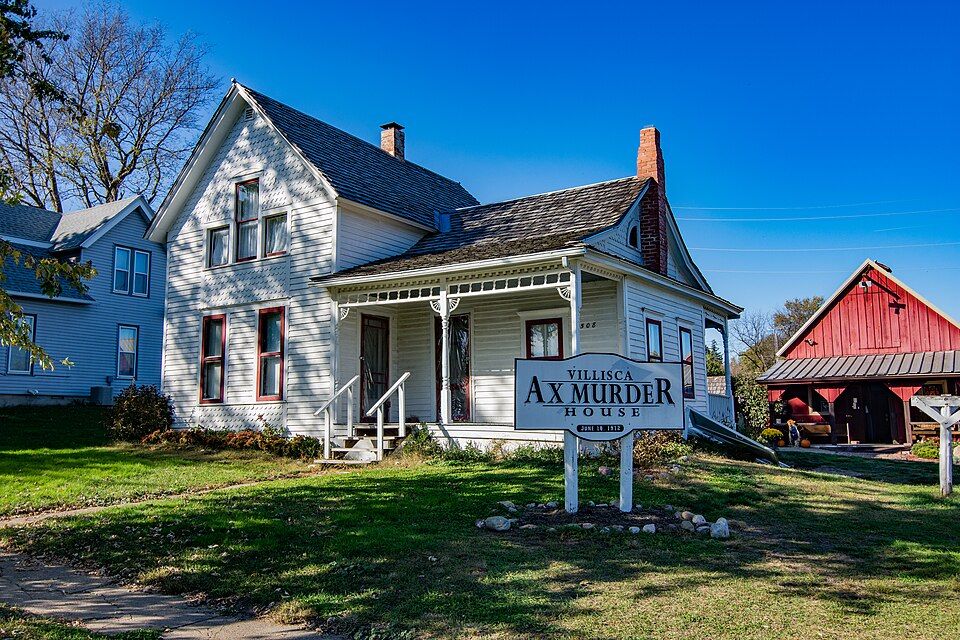
Sunday, June 9, 1912, was Children's Day at the Presbyterian church in Villisca, a small railroad town in southwest Iowa. Sarah Moore had organized the evening program, and her four children took part. Two friends of the Moores' daughter Katherine, the sisters Lena and Ina Stillinger, had permission to stay the night. When the service ended at about half past nine, the eight of them, with Josiah Moore, walked the short distance home to the white frame house on East Second Street.
Nobody came out the next morning. A neighbor, Mary Peckham, noticed that the chores had not been done and the house was quiet. She let the Moores' chickens out, tried the locked door and telephoned Josiah's brother Ross, who had a key. Inside, in a downstairs bedroom, he found the two Stillinger girls dead. The town marshal, Hank Horton, found the rest of the family upstairs. All eight had been killed in their beds with an axe that belonged to Josiah, which was left in the house.
Investigators believed the killer had entered while the family was at church and waited, perhaps in the attic, until everyone was asleep, sometime after midnight. Whoever it was covered every mirror in the house with clothing or cloth and left the doors locked. A lamp was found burning low with its chimney removed.
The scene was ruined within hours. After the town's telephone operator spread the news, hundreds of people walked through the house before the National Guard arrived to seal it off. The axe was handled by many of them. With no fingerprint evidence, no witnesses and little physical evidence, the case turned on theories and suspicion.
Several men drew attention. Frank F. Jones, a Villisca businessman and state senator, had lost his best employee when Josiah Moore left to start a rival implement dealership, and a private detective, James Wilkerson of the Burns Agency, spent years arguing that Jones had paid a drifter named William Mansfield to kill Moore. In 1916 a grand jury heard the evidence and declined to indict Mansfield; payroll records placed him in Illinois at the time. Jones was never charged.
The man who did stand trial was the Reverend George Kelly, an English-born itinerant preacher who had taught at the Children's Day service and left town on an early train the next morning. Kelly, who had a history of mental illness, wrote obsessively about the murders and claimed to have seen them. In 1917, after long questioning, he signed a confession, then withdrew it. His first trial, at Red Oak, ended with a jury that could not agree; the second, in November 1917, acquitted him.
No one has been charged since. Later writers have tried to place Villisca in a wider pattern of axe murders of whole families in the Midwest between about 1910 and 1912, sometimes linked to the railroads. Henry Lee Moore, no relation to the victims, who was convicted of killing his mother and grandmother in Missouri in December 1912, was suggested by a federal investigator at the time. These connections remain theories.
The victims
Josiah B. Moore, 43, ran his own farm equipment business in Villisca after years working for Frank Jones, and was by most accounts prosperous and well liked. His wife Sarah, born Montgomery, was 39 and active in the Presbyterian church; the Children's Day program she organized was the last event of her life. Their children were Herman, 11; Mary Katherine, known as Katherine, 10; Arthur Boyd, 7; and Paul Vernon, 5.
Lena Stillinger, 11, and her sister Ina, 8, were Katherine's friends and had been invited to stay the night after the church program. Their sleepover in the downstairs bedroom made them two of the case's eight victims and has kept their names alongside the Moores' ever since.
Timeline
Josiah and Sarah Moore buy the house on East Second Street.
The Moores and the Stillinger sisters attend the Children's Day program at the Presbyterian church and walk home at about 9:45 p.m.
A neighbor raises the alarm in the morning, and all eight are found dead in the house.
A coroner's inquest opens.
Henry Lee Moore kills his mother and grandmother in Missouri and is later suggested as the Villisca killer.
A Montgomery County grand jury declines to indict William Mansfield, the man accused by detective James Wilkerson.
Rev. George Kelly signs a confession to the murders, which he soon recants.
Kelly's first trial at Red Oak ends in a hung jury.
A second jury acquits Kelly; no one else is ever tried.
The Moore house is listed on the National Register of Historic Places.
People in the case
-
Josiah B. Moore Victim
? – 10 June 1912
Farm equipment dealer, aged 43.
-
Sarah Montgomery Moore Victim
? – 10 June 1912
His wife, aged 39; organizer of the church Children's Day program.
-
Lena and Ina Stillinger Victim
? – 10 June 1912
Sisters aged 11 and 8, overnight guests of the Moore children.
-
George Kelly Accused
English-born itinerant preacher, full name given as Lyn George Jacklin Kelly or George Lyn Jacklin Kelly; confessed in 1917, recanted, and was acquitted at his second trial.
-
Frank Fernando Jones Suspect
26 August 1855 – 29 January 1941
Villisca businessman and Iowa state senator, Josiah Moore's former employer; accused by a private detective but never charged.
-
William Mansfield Suspect
Alleged hired killer named by detective James Wilkerson; a grand jury declined to indict him in 1916.
-
Henry Lee Moore Suspect
1 November 1874 – 30 September 1963
No relation; convicted of murdering his mother and grandmother in Columbia, Missouri, in December 1912 and proposed as a link to other axe murders.
Where it happened
- Moore house, 508 East Second Street, Villisca. Where the murders took place; restored in the 1990s and now open to visitors.
- Red Oak, Iowa. Montgomery County seat, where Kelly was tried.
Outcome
Unsolved Unsolved
A grand jury declined to indict William Mansfield in 1916. The Reverend George Kelly was tried twice in 1917 after a recanted confession; the first jury could not agree and the second acquitted him. No one else has been charged.
What the record settles, and what it doesn't
Established
- Josiah and Sarah Moore, their four children and two young guests, Lena and Ina Stillinger, were killed in the Moore house on the night of June 9-10, 1912.
- The weapon was an axe belonging to the Moores, found inside the house.
- The bodies were discovered on the morning of June 10 after a neighbor noticed the house was silent.
- Crowds walked through the house before it was secured, destroying much of the physical evidence.
- A grand jury declined to indict William Mansfield in 1916.
- George Kelly was tried twice in 1917; the first jury deadlocked and the second acquitted him.
Disputed
- Who killed the eight victims: local suspicion centered on Frank Jones and an alleged hired killer, while others pointed to Reverend Kelly, and many later researchers favor a traveling killer responsible for several family murders.
- Whether Kelly's confession had any value: prosecutors relied on it, but it was obtained after long questioning of a man with a history of mental illness, and he recanted.
- Whether Villisca belongs to a series of Midwestern axe murders of 1910-1912; similarities such as covered windows and mirrors are noted by some writers and called coincidental by others.
- Whether the killer hid in the attic before the family returned from church, as investigators believed from cigarette ends found there.
- The meaning of details such as the covered mirrors and the lamp with its chimney removed, which have generated speculation but no settled explanation.
Afterwards
The murders hung over Villisca for years. Detective Wilkerson's long campaign against Frank Jones divided the town, though Jones was never charged with anything. Mansfield later sued the Burns detective agency over his arrest and was awarded damages.
The Moore house passed through many owners and long periods of vacancy before new owners restored it in the 1990s to its 1912 appearance. It was added to the National Register of Historic Places in 1997 and now operates as a museum that also attracts ghost tours and paranormal television crews. Writers continue to argue for connections with other family axe murders of the period, and a 2017 book, The Man from the Train, made the case for a single traveling killer, but the Villisca file remains officially unsolved.
Questions readers ask
Were the Villisca axe murders ever solved?
No. Reverend George Kelly was tried twice in 1917, with one hung jury and one acquittal, and a grand jury declined to indict William Mansfield in 1916. No one has been convicted.
Who was killed in the Villisca axe murders?
Josiah and Sarah Moore, their children Herman, Katherine, Boyd and Paul, and two overnight guests, the sisters Lena and Ina Stillinger. Six of the eight were children.
Can you visit the Villisca axe murder house?
Yes. The restored house at 508 East Second Street in Villisca is open for daytime tours and overnight stays.
Sources and further reading
- Villisca axe murders (Wikipedia)
- Josiah B. and Sara Moore House (Wikipedia)
- Henry Lee Moore (Wikipedia)
- Wikidata Q401654 (life dates checked here)
Written by Sinister Crimes from the sources above; see our editorial standards. Last checked 1 November 2026.