
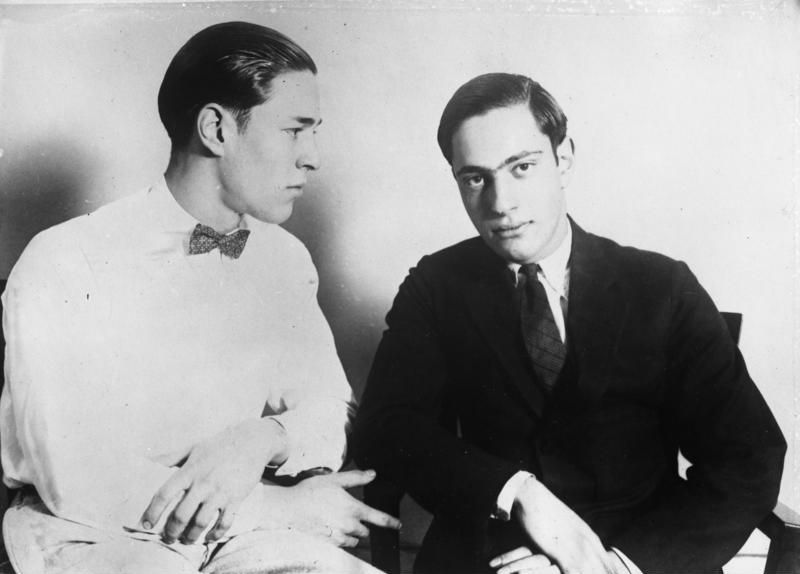

The case
The case broke on a pair of horn-rimmed glasses. When police searched the marshy ground near Wolf Lake, on Chicago's far southern edge, where the body of 14-year-old Bobby Franks had been found in a railroad culvert on May 22, 1924, they picked up a pair of spectacles. The lenses and frames were ordinary, but the hinge was not: only three pairs fitted with it had been sold in Chicago. One belonged to Nathan Leopold Jr., a 19-year-old law student and amateur ornithologist who sometimes went bird-watching in the area.
Leopold and his friend Richard Loeb, 18, were sons of two of the wealthiest families in Kenwood, on Chicago's South Side. Leopold was a prodigy who had already graduated from the University of Chicago and was bound for Harvard Law School; Loeb had become the youngest graduate in the University of Michigan's history. They had been close since 1920, and their relationship was also a sexual one. Together they had graduated from cheating at cards to burglary and arson. Leopold, who read Nietzsche as a license, believed that superior men stood outside ordinary morality. The two spent months planning what they intended to be a perfect crime: the kidnapping and murder of a child, with a ransom demand to disguise the motive.
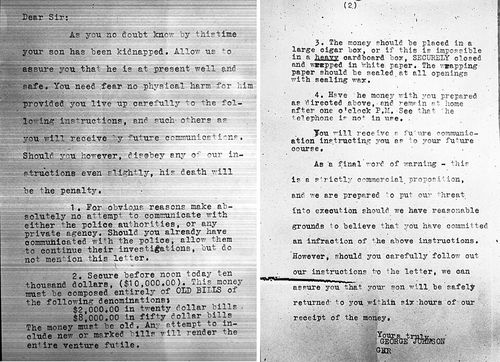
On the afternoon of May 21, 1924, driving a car Leopold had rented under a false name, they stopped Bobby Franks as he walked home from the Harvard School for Boys and persuaded him to get in. Bobby knew Loeb, a neighbor, and had played tennis at the Loeb house. He was killed in the car with blows from a chisel. The pair drove to Wolf Lake, hid the body in the culvert and returned to the city. That night Leopold telephoned Bobby's mother to say her son had been kidnapped; a typed ransom letter demanding $10,000 arrived the next morning. The ransom handover collapsed when news came that the body had been found.
The killers made little effort to stay out of the story. Loeb helped reporters search for the drugstore named in the ransom instructions and offered theories about the crime. Leopold talked freely about the case with friends. Once the glasses led detectives to him, the alibi the two had prepared, an evening driving around with two young women, fell apart when Leopold's chauffeur said the family car had been in the garage for repairs that day. Both confessed by May 31, each naming the other as the one who had struck the blows. The typewriter used for the ransom letter was later recovered from a lagoon in Jackson Park.
The families hired Clarence Darrow, the most famous defense lawyer in the country and a lifelong opponent of capital punishment. Expecting a jury to send both young men to the gallows, Darrow had them plead guilty on July 21, which left the sentence to a single judge, John R. Caverly. The hearing that followed lasted more than a month. The state's attorney, Robert E. Crowe, demanded death; the defense called psychiatrists to describe the young men's emotional abnormalities. Darrow's closing plea, delivered over two days in August, became one of the best-known speeches in American legal history, an argument against hanging the young and against retribution itself.
On September 10, 1924, Caverly sentenced both to life imprisonment for murder and 99 years for kidnapping. He said he was moved chiefly by their youth and by the precedent of Illinois courts in not executing defendants of their age.
The victims
Robert Franks, known as Bobby, was 14, the son of Jacob Franks, a wealthy Chicago manufacturer. He was a pupil at the Harvard School for Boys in Kenwood, a few blocks from the family home, where he was walking back from school when he was picked up. He was a keen tennis player and well known in the neighborhood; his familiarity with Richard Loeb, who lived across the street, is what made it easy to persuade him into the car.
The Franks family withdrew from public life after the trial. Darrow himself, in the closing argument that saved the defendants, paused to acknowledge the grief of Mr. and Mrs. Franks and Bobby's sister, the one moment in the long hearing when the boy's family were placed at the center.
Timeline
Leopold and Loeb pick up Bobby Franks on his way home from school and kill him; that night his mother receives a kidnapping call.
A typed ransom letter arrives, and Bobby's body is found in a culvert near Wolf Lake along with a pair of glasses.
Detectives trace the glasses to Nathan Leopold and bring him and Loeb in for questioning.
The state's attorney announces that both young men have confessed.
The typewriter used for the ransom letter is recovered from the Jackson Park lagoon.
On Clarence Darrow's advice, both plead guilty to murder and kidnapping.
Darrow concludes his closing plea against the death penalty.
Judge Caverly sentences both to life imprisonment plus 99 years.
Richard Loeb is killed by a fellow inmate at Stateville Penitentiary.
Nathan Leopold is released on parole and moves to Puerto Rico.
Leopold dies in Puerto Rico, aged 66.
People in the case
-
Nathan Leopold Perpetrator
19 November 1904 – 29 August 1971
University of Chicago graduate and ornithologist, 19 at the time; paroled in 1958 and died in Puerto Rico.
-
Richard Loeb Perpetrator
11 June 1905 – 28 January 1936
Michigan graduate, 18 at the time; killed by a fellow prisoner at Stateville in 1936.
-
Bobby Franks Victim
19 September 1909 – 21 May 1924
Fourteen-year-old pupil at the Harvard School for Boys, Kenwood.
-
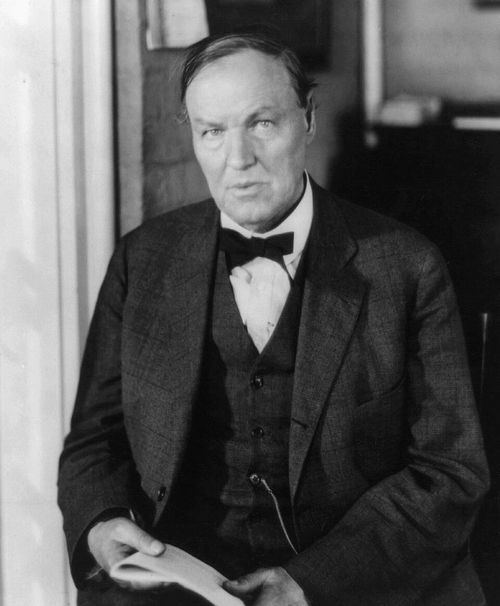
Clarence Darrow Defence
18 April 1857 – 13 March 1938
Lead defense counsel; persuaded the court to spare both defendants.
-
Robert E. Crowe Prosecutor
22 January 1879 – 18 January 1958
Cook County state's attorney who sought the death penalty.
-
John R. Caverly Judge
Chief justice of the Cook County criminal court, who passed sentence.
Where it happened
- Kenwood, Chicago. South Side neighborhood where the Leopold, Loeb and Franks families lived and Bobby was picked up.
- Wolf Lake. On the Illinois-Indiana line, where Bobby Franks's body was hidden in a railroad culvert.
- Cook County Criminal Court Building (Courthouse Place). Where the sentencing hearing was held in 1924; the building still stands.
- Stateville Penitentiary. Where Loeb was killed in 1936 and Leopold served most of his sentence.
Outcome
Convicted Convicted
Leopold and Loeb pleaded guilty to murder and kidnapping on July 21, 1924, so that sentence would be decided by a judge rather than a jury. After a hearing of more than a month, Judge John R. Caverly sentenced each to life imprisonment for murder plus 99 years for kidnapping on September 10, 1924. Loeb was killed in prison in 1936; Leopold was paroled in 1958.
What the record settles, and what it doesn't
Established
- Nathan Leopold and Richard Loeb abducted and killed 14-year-old Bobby Franks in Chicago on May 21, 1924.
- They planned the crime for months as an intellectual exercise, using a ransom demand to disguise their motive.
- A pair of glasses with an unusual hinge, found near the body, led police to Leopold.
- Both confessed within ten days of the murder and pleaded guilty on July 21, 1924.
- Judge John R. Caverly sentenced each to life plus 99 years on September 10, 1924, citing their youth.
- Loeb was killed in prison in 1936, and Leopold was paroled in 1958 after 33 years.
Disputed
- Which of the two struck the fatal blows: each blamed the other, and while most investigators and historians have concluded it was Loeb, a witness claimed to have seen Loeb driving and Leopold in the back seat.
- How far Leopold's reading of Nietzsche motivated the crime, as against Loeb's long fascination with criminality and his wish for excitement.
- The role of their sexual relationship: the prosecution presented it as a motive and the defense as evidence of mental abnormality, and later writers still disagree about its significance.
- Whether Loeb's killer, James Day, acted in self-defense as he claimed; a jury acquitted him, but prison officials and Leopold doubted his account.
- Whether the sentence reflected justice or money: critics at the time argued that only the defendants' wealth bought Darrow and saved them from hanging.
Pictures



Afterwards
In prison the two men helped build an education program for inmates. Loeb was killed with a razor in a Stateville shower room in January 1936 by another prisoner, James Day, who claimed Loeb had made sexual advances and was acquitted. Leopold volunteered for wartime malaria experiments, wrote a memoir, Life Plus 99 Years, and was paroled in 1958. He moved to Puerto Rico, worked in a church-run hospital and later in public health research, married, published a checklist of the island's birds and died there in 1971.
The case has never left American culture. Patrick Hamilton's play Rope (1929) and Alfred Hitchcock's 1948 film were loosely based on it, as were the novel and film Compulsion, and Darrow's closing argument is still read as a landmark in the debate over capital punishment, especially for the young. It also helped fix in the public mind the figure of the clever killer who wants to prove something, a type that crime fiction has used ever since.
Questions readers ask
Why did Leopold and Loeb kill Bobby Franks?
They said they wanted to commit a perfect crime and prove their intellectual superiority. Franks was chosen largely because he was available and knew Loeb; there was no grievance against him.
How were Leopold and Loeb caught?
Police found a pair of glasses near the body with a rare hinge sold to only three people in Chicago, one of whom was Leopold. Their alibi then collapsed when Leopold's chauffeur said the family car had been in the garage that day.
Why weren't Leopold and Loeb executed?
Clarence Darrow had them plead guilty so that a judge, not a jury, would decide the sentence. Judge Caverly gave them life plus 99 years, saying he was influenced mainly by their ages.
What happened to Leopold and Loeb?
Loeb was killed by a fellow prisoner in 1936. Leopold was paroled in 1958, moved to Puerto Rico and died there in 1971.
Sources and further reading
- Leopold and Loeb (Wikipedia)
- Clarence Darrow (Wikipedia)
- Chronicling America: 'Leopold and Loeb plead guilty', July 21, 1924
- Wikidata Q668789 (life dates checked here)
Written by Sinister Crimes from the sources above; see our editorial standards. Last checked 1 November 2026.