

The case
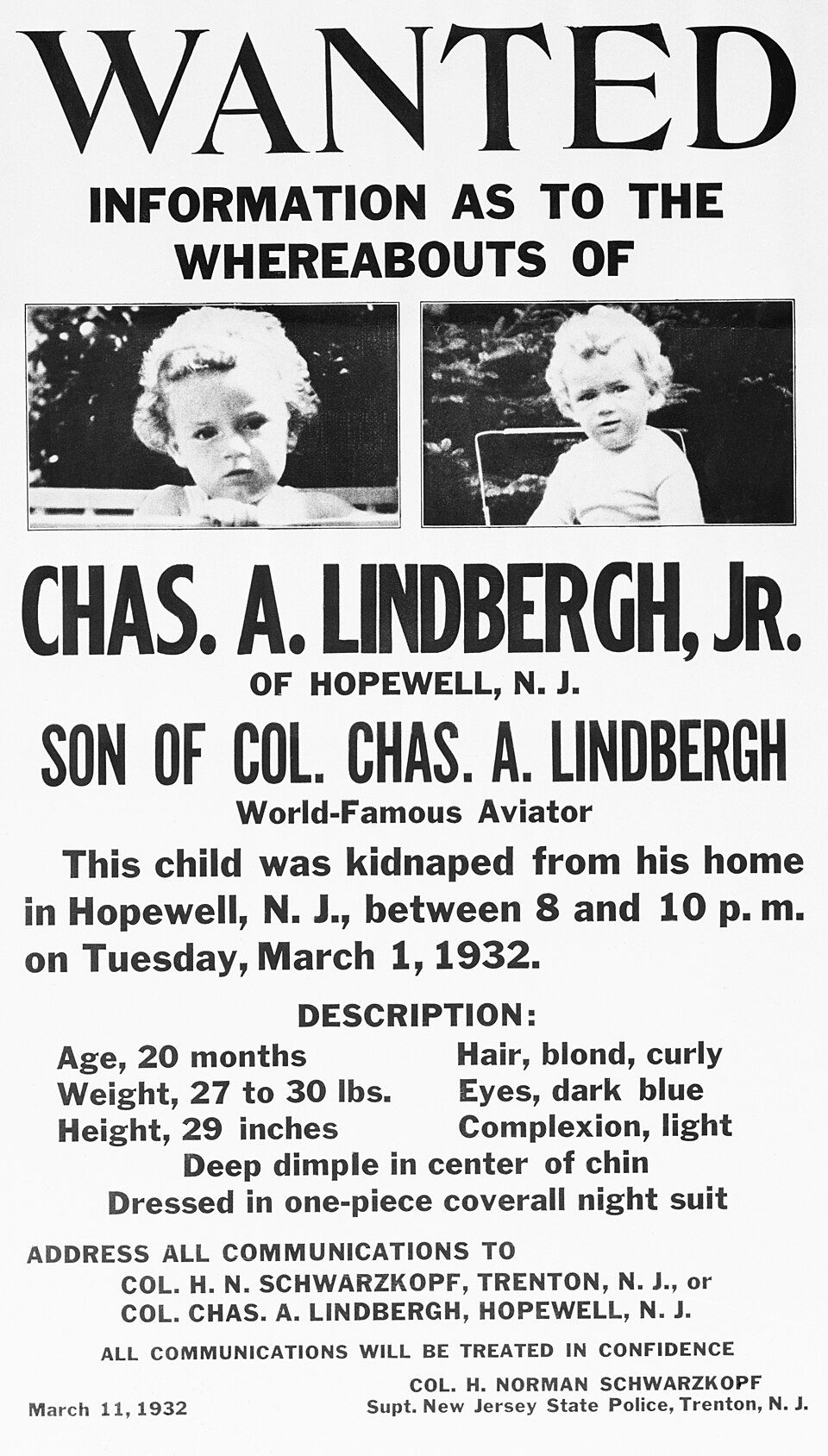
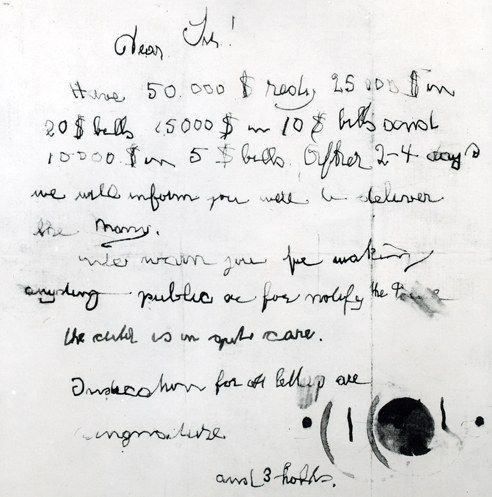
Late on the evening of 1 March 1932, the nurse Betty Gow went to check on twenty-month-old Charles Lindbergh Jr. in his nursery at Highfields, the house his parents had just built in the New Jersey countryside near Hopewell. The cot was empty. On the windowsill was an envelope. Under the window lay a homemade ladder, broken where one rung joined the next. The note inside asked for $50,000 and was written in an English that suggested a German speaker.
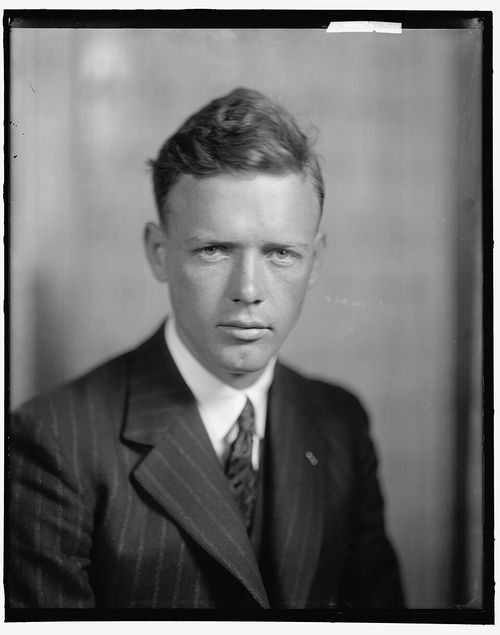
The boy's father was the most famous man in America. Five years earlier Charles Lindbergh had flown alone from New York to Paris, and he and his wife, the writer and aviator Anne Morrow Lindbergh, could not go out without a crowd. Within hours the grounds were trampled by police, reporters and sightseers. Lindbergh took charge of much of the response himself, bringing in friends, lawyers and even go-betweens from the underworld, while the New Jersey State Police under Colonel H. Norman Schwarzkopf ran the official inquiry.
The most important intermediary turned out to be the least likely. John Condon, a retired Bronx schoolteacher in his seventies, offered in a local newspaper to act as go-between, and the kidnapper accepted him. Using the name 'Jafsie', Condon met a man who called himself John in a Bronx cemetery, received the child's sleeping suit as proof, and on 2 April 1932 handed over $50,000 at St. Raymond's Cemetery. Much of it was in gold certificates, whose serial numbers the Treasury had recorded. In return Condon got a note saying the boy could be found on a boat called the Nellie off the Massachusetts coast. No such boat was ever found.
On 12 May a truck driver stopped by the road near Mount Rose, a few miles from Highfields, and found the child's remains in the woods. He had probably died on the night he was taken, from a blow to the head. The country's grief turned into a demand for action, and within weeks Congress passed the Federal Kidnapping Act, soon known as the Lindbergh Law. The investigation drifted. A servant at the Morrow family home, Violet Sharpe, took poison during repeated questioning; her alibi was later confirmed.
The case was solved by the ransom money. Gold certificates surfaced in New York for two and a half years, many along a subway line between the Bronx and Manhattan. In September 1934 a petrol station attendant who took a ten-dollar gold note from a customer wrote down his car's licence number. It led to Bruno Richard Hauptmann, a German carpenter who had entered the country as a stowaway in 1923 and had a criminal record at home. More than $13,000 of the ransom was hidden in his garage. Hauptmann said a friend, Isidor Fisch, had left it with him before returning to Germany, where Fisch had since died.
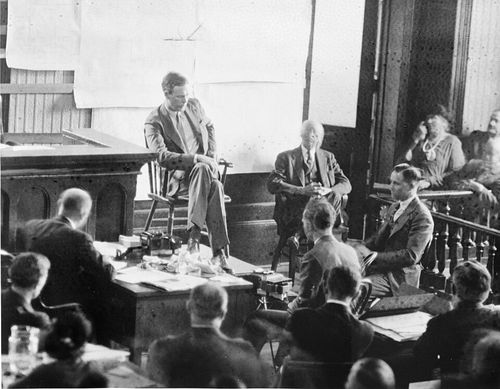
The trial at Flemington in January and February 1935 drew hundreds of reporters. The prosecution, led by Attorney General David Wilentz, had Condon and Lindbergh identify Hauptmann's voice and face, handwriting experts compare his writing with the notes, and the wood scientist Arthur Koehler testify that one rail of the ladder had come from a floorboard in Hauptmann's attic. Condon's telephone number was written inside a closet in his flat. On 13 February the jury convicted him of murder in the course of a burglary, and he was sentenced to death.
Hauptmann insisted he was innocent to the end. He refused offers of money and of a life sentence in exchange for a confession. New Jersey's governor, Harold Hoffman, publicly doubted that one man could have done it alone and delayed the execution, but the appeals failed. Hauptmann was electrocuted at the state prison in Trenton on 3 April 1936.
The victims
Charles Augustus Lindbergh Jr. was born on 22 June 1930, the first child of Charles and Anne Morrow Lindbergh. He was a fair-haired toddler who had just begun to talk, and the family's nurse knew him well enough to identify him by his overlapping toes and the undershirt she had sewn for him. He lived his short life under intense public interest, which his parents had moved to remote Highfields partly to escape.
The case cost others dearly too. Violet Sharpe, a young English maid at the Morrow household in Englewood, took her own life in June 1932 after police questioned her repeatedly; she was later cleared. Anna Hauptmann, the convicted man's widow, spent almost sixty years trying to clear her husband's name and died in 1994 without succeeding.
Timeline
Charles Lindbergh Jr. is taken from his nursery at Highfields; a ransom note and a broken ladder are found.
John Condon receives the child's sleeping suit by post as proof from the kidnapper.
Condon pays $50,000 to 'Cemetery John' at St. Raymond's Cemetery in the Bronx.
The child's body is found in woods near Mount Rose, a few miles from the house.
Violet Sharpe, a maid at the Morrow home, takes her own life before further questioning; she is later cleared.
The Federal Kidnapping Act, the 'Lindbergh Law', becomes law.
The Federal Reserve Bank of New York finds 296 ten-dollar ransom gold certificates exchanged by a man who gave a false name.
Bruno Richard Hauptmann is arrested in the Bronx after a ransom note is traced to his car.
Hauptmann is indicted for murder in New Jersey.
The trial opens at the Hunterdon County Courthouse in Flemington.
Hauptmann is convicted of first-degree murder and sentenced to death.
The New Jersey Court of Errors and Appeals upholds the conviction.
Hauptmann is executed in the electric chair at the New Jersey State Prison in Trenton.
People in the case
-
Charles Augustus Lindbergh Jr. Victim
22 June 1930 – March 1932
Twenty-month-old son of the Lindberghs; taken from his nursery on 1 March 1932 and found dead on 12 May.
-
Charles Lindbergh Also involved
4 February 1902 – 26 August 1974
The child's father, the transatlantic aviator; directed much of the early response and testified at the trial.
-
Anne Morrow Lindbergh Also involved
22 June 1906 – 7 February 2001
The child's mother, aviator and author.
-
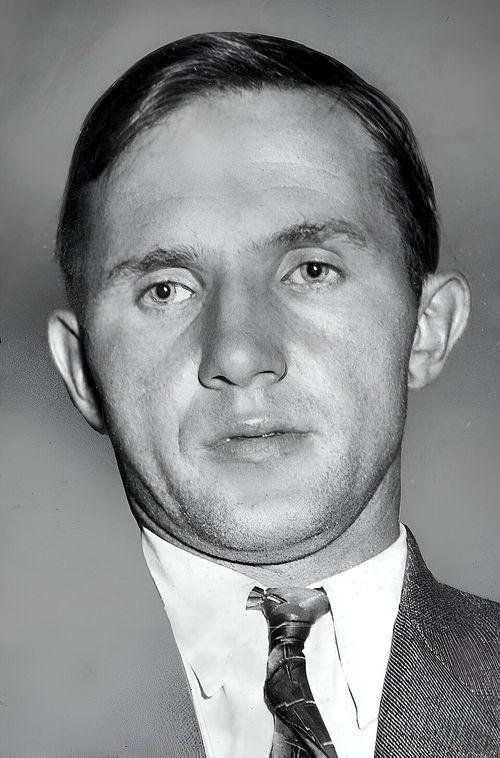
Bruno Richard Hauptmann Perpetrator
26 November 1899 – 3 April 1936
German-born carpenter convicted of the murder and executed; maintained his innocence.
-
John F. Condon Witness
1 June 1860 – 2 January 1945
Retired Bronx teacher, 'Jafsie', who paid the ransom and later identified Hauptmann as 'Cemetery John'.
-
David T. Wilentz Prosecutor
21 December 1894 – 6 July 1988
New Jersey Attorney General who led the prosecution personally.
-
Thomas Whitaker Trenchard Judge
13 December 1863 – 23 July 1942
Presided over the trial at Flemington.
-
Arthur Koehler Witness
1885 – 1967
Wood scientist at the Forest Products Laboratory who matched a ladder rail to a floorboard in Hauptmann's attic.
-
Norman Schwarzkopf Sr. Investigator
28 August 1895 – 25 November 1958
Superintendent of the New Jersey State Police, in charge of the investigation.
Where it happened
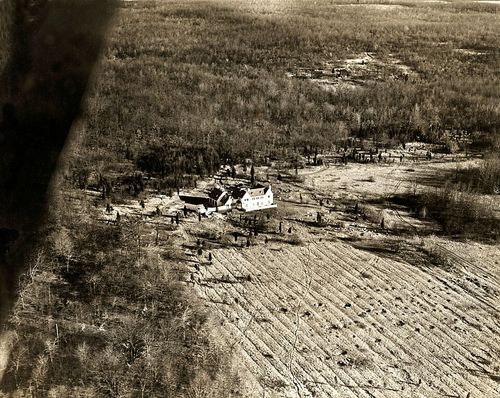
- Highfields, East Amwell, New Jersey. The Lindbergh house from which the child was taken; later given to the state.
- Mount Rose, Hopewell Township. The child's body was found in woods beside the road near this hamlet.
- Hunterdon County Courthouse, Flemington. Scene of the six-week trial in 1935.
- New Jersey State Prison, Trenton. Where Hauptmann was executed on 3 April 1936.
Outcome
Executed Convicted and executed
Hauptmann was tried for murder committed in the course of a burglary, a capital charge in New Jersey, and convicted on 13 February 1935 after a trial of about six weeks. He was sentenced to death. The Court of Errors and Appeals affirmed, the United States Supreme Court declined to intervene, the Board of Pardons denied clemency, and he was executed on 3 April 1936. His widow's later lawsuits to clear his name were dismissed.
What the record settles, and what it doesn't
Established
- Charles Lindbergh Jr. was taken from his nursery at Highfields on the evening of 1 March 1932, and a ransom note was left behind.
- John Condon paid $50,000 in recorded notes, many of them gold certificates, to a man at St. Raymond's Cemetery on 2 April 1932.
- The child's body was found near Mount Rose on 12 May 1932; he appeared to have died of a head injury.
- Hauptmann was arrested on 19 September 1934 after spending a ransom gold certificate, and more than $13,000 of the ransom was found in his garage.
- Wood expert Arthur Koehler testified that part of the kidnap ladder matched a floorboard in Hauptmann's attic.
- Hauptmann was convicted on 13 February 1935 and executed on 3 April 1936, denying his guilt to the end.
- The case led directly to the Federal Kidnapping Act of 1932.
Disputed
- Whether Hauptmann was guilty: most historians who have examined the evidence, including a former FBI agent who wrote two books on the case, consider him guilty; a substantial revisionist literature argues he was framed.
- Whether evidence was manipulated: critics point to the absence of his fingerprints on the ladder and notes, claims that a reporter wrote Condon's number in the closet, and police pressure on witnesses; defenders answer that the money, handwriting and wood evidence are strong.
- Whether he acted alone: Governor Hoffman and others thought the crime needed more than one person, and several conspiracy theories name accomplices, none proven.
- The Isidor Fisch story: Hauptmann said Fisch left him the money; the prosecution showed Fisch was poor and not near the scene, but the claim has never been fully disproved.
- The fairness of the trial: the press frenzy, the defence lawyer's arrangement with a Hearst newspaper and the eyewitness identifications made long after the events are widely criticised.
Pictures




Afterwards
The Lindberghs left Highfields and, after the trial, left the United States for several years to escape the press. Highfields passed to the State of New Jersey in 1941 and since 1952 has been a residential rehabilitation centre for young offenders. The Federal Kidnapping Act and its 1934 amendments made the FBI the lead agency in kidnapping cases, part of the same expansion of federal power that followed Dillinger.
The trial set a pattern for celebrity justice in America, with newsreels, souvenir sellers and a courtroom packed with reporters. In the 1970s and 1980s, books arguing Hauptmann's innocence prompted Anna Hauptmann's lawsuits and a public re-examination.
Questions readers ask
Who kidnapped the Lindbergh baby?
Bruno Richard Hauptmann, a German-born carpenter, was convicted of the kidnapping and murder in 1935 and executed in 1936. He denied it to the end, and some writers still argue he was innocent or had accomplices.
How was Bruno Hauptmann caught?
Through the ransom money. The serial numbers of the gold certificates had been recorded, and in September 1934 a petrol station attendant noted the licence plate of a customer who paid with one. More than $13,000 of the ransom was found in Hauptmann's garage.
Was the Lindbergh baby ever found?
Yes. His body was found on 12 May 1932 in woods a few miles from the family home, more than two months after the kidnapping and after the ransom had been paid.
What is the Lindbergh Law?
The Federal Kidnapping Act of 1932, passed in response to the case, made it a federal crime to take a kidnapping victim across state lines, bringing the FBI into such cases.
Sources and further reading
- Lindbergh kidnapping (Wikipedia)
- Bruno Richard Hauptmann (Wikipedia)
- The Lindbergh Kidnapping (FBI history)
- Wikidata Q844495 (life dates checked here)
Written by Sinister Crimes from the sources above; see our editorial standards. Last checked 1 November 2026.