

The case
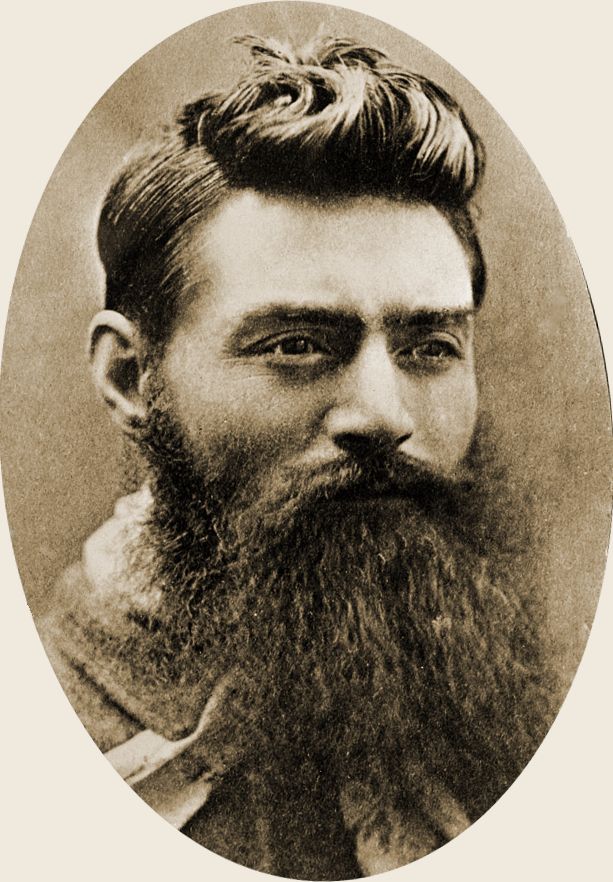
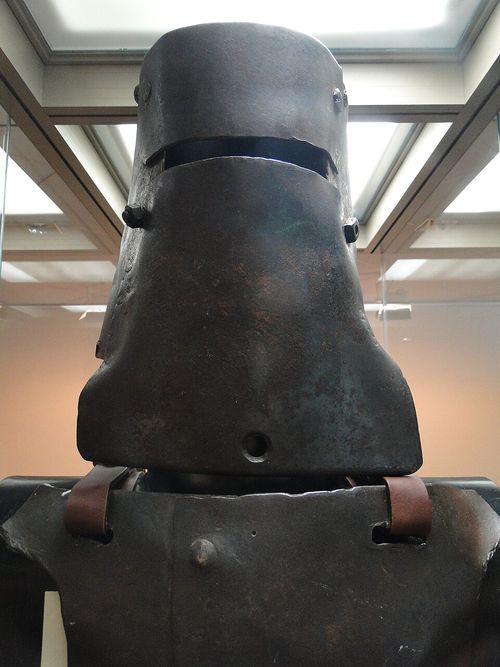
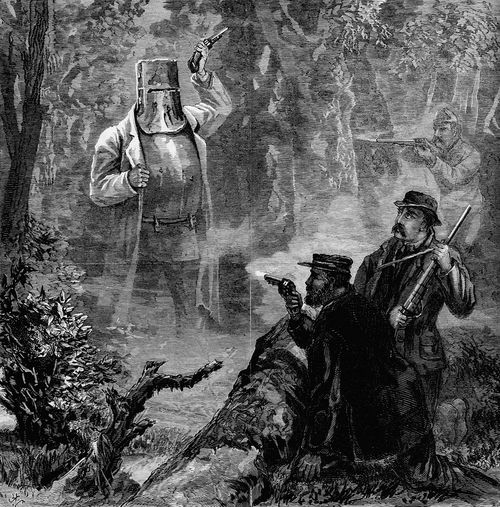
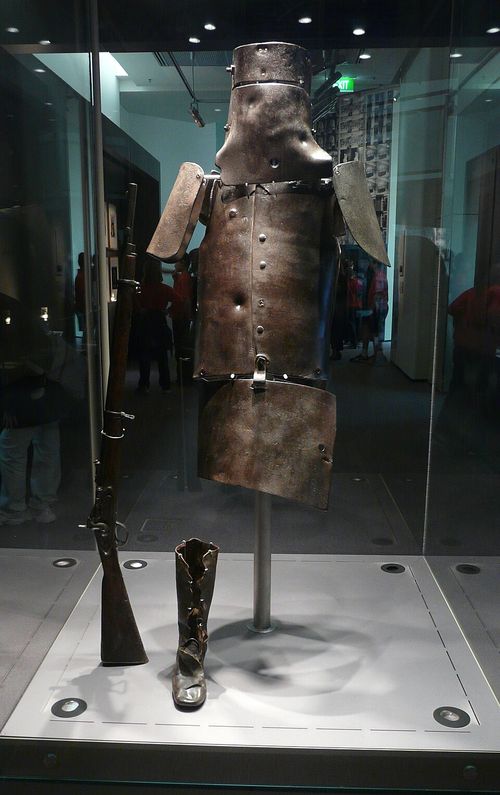
At first light on 28 June 1880 police surrounding the Glenrowan Inn saw a figure walking toward them out of the bush mist, a long iron cylinder where its head should have been. Their bullets rang off it. For about a quarter of an hour Ned Kelly, wearing about 44 kilograms of armour beaten out of plough mouldboards, moved from tree to tree firing a revolver with his one good arm, until Sergeant Steele brought him down with shotgun fire to the legs, which the armour did not cover. The Kelly outbreak, which had defied the colony of Victoria for twenty months, ended that afternoon when police burned the inn.
Edward Kelly was born at Beveridge, north of Melbourne, probably in December 1854, the son of an Irish convict transported for stealing pigs and of Ellen Quinn, whose family were small selectors in the north-east. His father died when Ned was twelve. The family settled near Greta, on poor land, among relatives often in trouble for stock theft, and at sixteen Ned was sentenced to three years for receiving a stolen horse, having already served a term for assault.
The outbreak began on 15 April 1878, when Constable Alexander Fitzpatrick went to the Kelly house to arrest Ned's younger brother Dan for horse stealing. What followed is disputed. Fitzpatrick said Ned shot him in the wrist and Ellen Kelly struck him with a fire shovel; the family later said he was drunk, made advances to Ned's sister Kate, and injured his wrist on a door. Ellen Kelly was convicted as an accessory and sentenced to three years' hard labour. Ned and Dan took to the bush in the Wombat Ranges, joined by their friends Joe Byrne and Steve Hart.
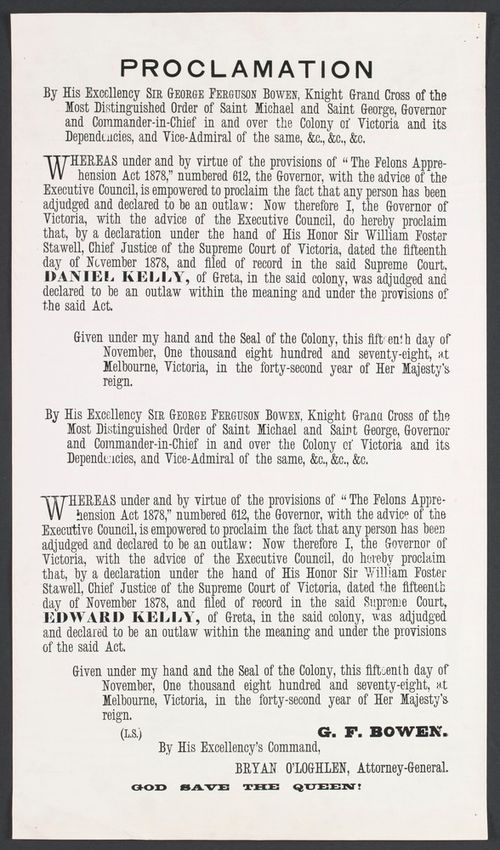
On 26 October 1878 the gang came upon a police party of four camped at Stringybark Creek, sent out from Mansfield to find them. Ned shot Constable Thomas Lonigan when he went for his revolver. When Sergeant Michael Kennedy and Constable Michael Scanlan rode back into the camp, the gang opened fire, killing Scanlan; Kennedy was chased into the bush and killed. Constable Thomas McIntyre escaped on Kennedy's horse and reached Mansfield the next day. Within weeks Victoria passed the Felons Apprehension Act, and from 15 November the four men were outlaws whom anyone could shoot.
The gang then did what made them famous. In December 1878 they held up a station homestead outside Euroa, took dozens of people hostage and robbed the National Bank of more than £2,000. In February 1879 they crossed into New South Wales, locked the two Jerilderie constables in their own cells, put on police uniforms and robbed the Bank of New South Wales. Kelly burned mortgage papers and left behind a long dictated letter, the Jerilderie Letter, setting out his grievances against the police, landlords and the English. Then they vanished for sixteen months, sheltered by a network of relatives and sympathisers, while the combined reward rose to £8,000.
They came back with a plan to kill. On 26 June 1880 Byrne shot his former friend Aaron Sherritt, a police informer, at his door in the Woolshed Valley. The gang expected a police special train to be sent up the line, and at Glenrowan they had railway workers tear up the track on a curve above a gully, intending to wreck it and shoot the survivors. They held some sixty townspeople in Ann Jones's inn through the night. One hostage, the schoolteacher Thomas Curnow, won Kelly's trust, was allowed home, and signalled the pilot engine running ahead of the train to stop before it reached the break.
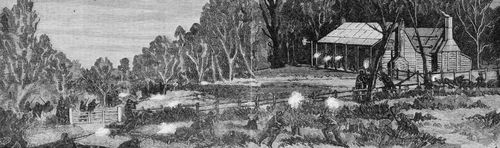
In the shooting that followed, police fire into the weatherboard inn killed thirteen-year-old John Jones and the labourer Martin Cherry, and a third man, George Metcalf, died of a wound whose source is uncertain. Byrne was shot in the bar. Dan Kelly and Hart died inside before the building was set alight, by what means is unknown. Ned was taken to Melbourne, tried before Sir Redmond Barry for Lonigan's murder, convicted on 29 October 1880 and hanged at Melbourne Gaol on 11 November, despite a petition for clemency carrying more than 32,000 signatures.
The victims
The three police killed at Stringybark Creek were Sergeant Michael Kennedy and Constables Thomas Lonigan and Michael Scanlan, members of a Mansfield search party sent into the Wombat Ranges to find the Kelly brothers. They were buried at Mansfield, where the town raised a public monument to them in 1880. Aaron Sherritt had been Joe Byrne's lifelong friend and a member of the same Greta larrikin crowd before he began taking police money; his pregnant wife Ellen was in the hut when he was shot. At Glenrowan, John Jones, the publican's son, was thirteen, and Martin Cherry was a railway worker held there as a hostage. Both died from police gunfire into the building, a fact the later royal commission did not ignore.
Timeline
Edward Kelly is born at Beveridge, Victoria, by the usual estimate.
Constable Fitzpatrick is wounded at the Kelly house near Greta; Ned and Dan Kelly flee into the bush.
Ellen Kelly is convicted as an accessory and later sentenced to three years' hard labour.
The gang kills Constables Lonigan and Scanlan and Sergeant Kennedy at Stringybark Creek.
The four are declared outlaws under the Felons Apprehension Act.
The gang robs the National Bank at Euroa, holding hostages at Younghusband Station.
The gang robs the Bank of New South Wales at Jerilderie; Kelly leaves the Jerilderie Letter.
Joe Byrne shoots police informer Aaron Sherritt in the Woolshed Valley.
The siege of the Glenrowan Inn: Ned Kelly is captured in his armour, Byrne, Dan Kelly and Hart die, and the inn is burned.
Kelly is convicted of Lonigan's murder in Melbourne and sentenced to death by Sir Redmond Barry.
Ned Kelly is hanged at Melbourne Gaol.
A royal commission into the police handling of the outbreak is approved; its report ends several police careers.
Kelly's identified remains are buried at Greta Cemetery.
People in the case
-
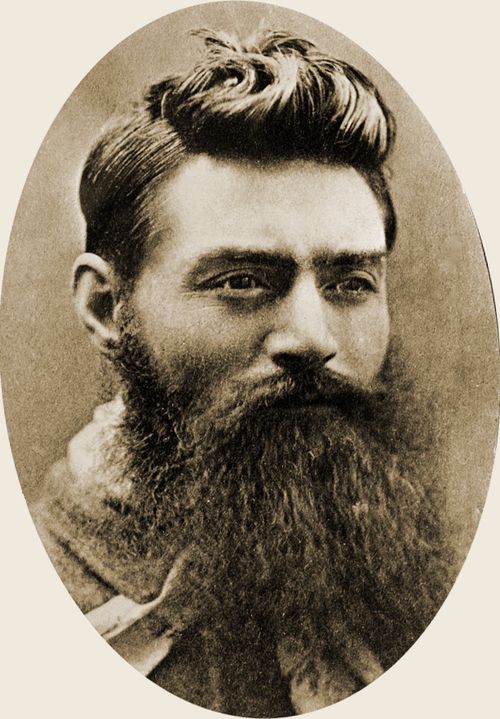
Ned Kelly Perpetrator
December 1854 – 11 November 1880
Leader of the Kelly gang; convicted of the murder of Constable Lonigan and hanged at Melbourne Gaol. Birth month is the usual estimate; some records point to 1855.
-
-
Joe Byrne Accomplice
November 1856 – 28 June 1880
Wrote out Kelly's letters; killed Aaron Sherritt and was shot dead at Glenrowan.
-
Thomas Lonigan Victim
? – 26 October 1878
Constable shot by Ned Kelly at Stringybark Creek; Kelly was hanged for his murder.
-
Michael Kennedy Victim
? – 26 October 1878
Sergeant leading the Stringybark Creek party; pursued into the bush and killed. His body was found two days later.
-
Michael Scanlan Victim
? – 26 October 1878
Constable shot as he rode back into the camp at Stringybark Creek.
-
Thomas McIntyre Witness
The only survivor of the Stringybark Creek party; his evidence convicted Kelly.
-
Ellen Kelly Also involved
1832 – 1923
Ned's mother, imprisoned for her part in the Fitzpatrick incident; released in 1881.
-
Sir Redmond Barry Judge
7 June 1813 – 23 November 1880
Judge who sentenced both Ellen Kelly and Ned Kelly; died twelve days after the execution.
Where it happened
- Glenrowan, Victoria. Site of the siege of the Glenrowan Inn and Kelly's capture.
- Euroa, Victoria. Town of the December 1878 bank robbery.
- Jerilderie, New South Wales. Town of the February 1879 bank robbery.
- Old Melbourne Gaol. Where Kelly was hanged on 11 November 1880; now a museum.
- Greta, Victoria. The Kelly family's home district; Ned Kelly's remains were buried in its cemetery in 2013.
Outcome
Executed Convicted and hanged
Kelly was committed for trial at Beechworth on charges of murdering Constables Lonigan and Scanlan; the trial was moved to Melbourne and the prosecution proceeded on Lonigan's murder alone. He was convicted on 29 October 1880, sentenced to death by Sir Redmond Barry, and hanged at Melbourne Gaol on 11 November 1880. Dan Kelly, Joe Byrne and Steve Hart died at Glenrowan and were never tried.
What the record settles, and what it doesn't
Established
- Ned Kelly shot Constable Thomas Lonigan at Stringybark Creek on 26 October 1878; Constable Scanlan and Sergeant Kennedy were also killed there by the gang.
- Constable McIntyre was the only member of the police party to survive, and his evidence was central at the trial.
- The gang robbed banks at Euroa in December 1878 and Jerilderie in February 1879, taking hostages but harming none of them.
- Joe Byrne shot Aaron Sherritt dead on 26 June 1880, and the gang tore up the railway line at Glenrowan intending to wreck a police train.
- Schoolteacher Thomas Curnow warned the train, and the police besieged the inn where the gang held its hostages.
- Two hostages, John Jones and Martin Cherry, were killed by police fire during the siege.
- Kelly was hanged at Melbourne Gaol on 11 November 1880; his skeleton was identified among remains exhumed at Pentridge Prison, though most of his skull has never been recovered.
Disputed
- What happened at the Kelly house on 15 April 1878 is contested: Fitzpatrick's account of being shot by Ned against the family's later claims that he was drunk, molested Kate Kelly and was not shot at all. Most historians conclude that Kelly did shoot him.
- Kelly said Stringybark Creek was self-defence against police who meant to kill him; McIntyre and the prosecution said it was an ambush of men trying to make an arrest. Historians have questioned parts of both accounts.
- Whether Kelly was a political rebel planning a north-eastern republic, as some read the Jerilderie Letter, or a criminal using grievance as justification, divides writers sharply.
- Whether moving the trial from Beechworth to Melbourne was meant to secure a conviction or to prevent jury tampering is argued both ways.
- Kelly's last words are uncertain; 'Such is life' was reported by one journalist but may come from an exchange in his cell that morning.
Pictures





Afterwards
The royal commission of 1881 found the police had been right to pursue the gang but exposed incompetence and rivalry among senior officers, and Chief Commissioner Frederick Standish's career ended with it. The £8,000 reward was divided among police and civilians; Curnow, after objecting to his first award, received £1,000. Ellen Kelly was released in February 1881 and lived until 1923.
Kelly's armour is displayed in the State Library of Victoria, and the Jerilderie Letter is held there too. The skull long exhibited as his was stolen in 1978 and later shown by testing not to be his. His identified bones were reburied at Greta in 2013. He remains the subject of more biographies than any other Australian, and opinion on him has never settled between folk hero and killer of police.
Questions readers ask
What did Ned Kelly do?
With his brother Dan, Joe Byrne and Steve Hart, he killed three police at Stringybark Creek in 1878, robbed banks at Euroa and Jerilderie, and in 1880 tried to derail a police train at Glenrowan. He was captured there in home-made armour and hanged in Melbourne.
When was Ned Kelly hanged?
He was hanged at Melbourne Gaol at 10 am on 11 November 1880, after being convicted of murdering Constable Thomas Lonigan.
What was Ned Kelly's armour made of?
The four suits worn by the gang were made from stolen plough mouldboards, probably shaped in a bush forge. Kelly's weighed about 44 kilograms and bore 18 bullet marks after Glenrowan.
Did Ned Kelly really say 'Such is life'?
One journalist reported those as his words on the scaffold, but they may have been spoken earlier that morning in his cell, and another account gives different words. His last words are not certain.
Sources and further reading
- Ned Kelly (Wikipedia)
- Stringybark Creek (Wikipedia)
- Kelly family (Irish-Australian) (Wikipedia)
- Jerilderie Letter (Wikisource)
- Wikidata Q301816 (life dates checked here)
Written by Sinister Crimes from the sources above; see our editorial standards. Last checked 1 November 2026.