

The case
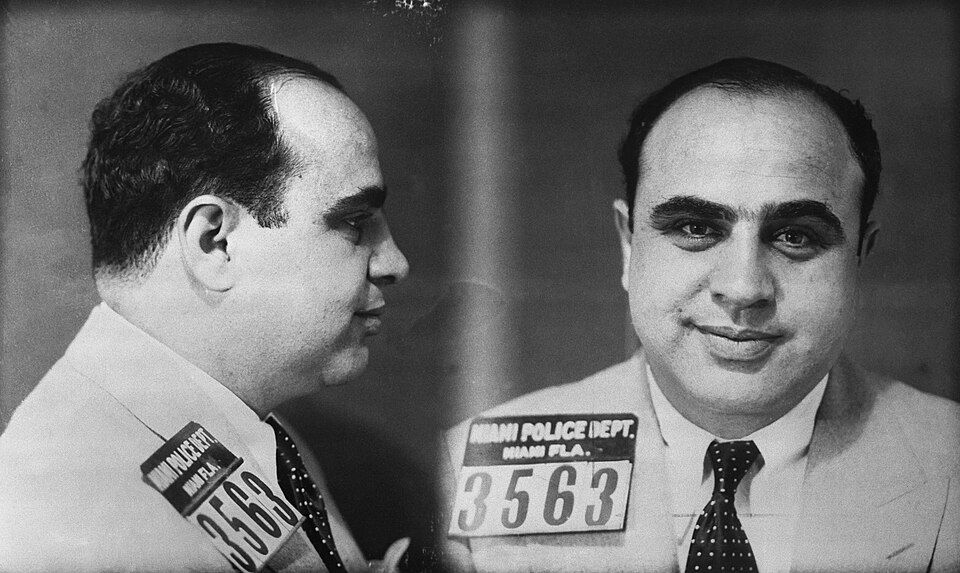
The evidence that sent Al Capone to prison did not come from a gunfight or an informer's deathbed. Much of it came from a letter his own tax lawyer, Mattingly, had written to the Bureau of Internal Revenue in 1930, offering to settle up and conceding what Capone had earned in years for which he had never filed a return. Capone had wanted to stay out of the trouble that had just caught his brother Ralph. The letter did the opposite.
Federal interest in Capone sharpened after the St. Valentine's Day Massacre in February 1929, when a delegation of Chicago businessmen asked President Herbert Hoover for help and Hoover told his departments to concentrate on the man. Two lines of attack followed. Prohibition agents under Eliot Ness raided breweries and drew the headlines. The case that mattered was built quietly by the Treasury's Intelligence Unit under Elmer Irey, who sent the agent Frank J. Wilson to Chicago. A Supreme Court ruling of 1927, United States v. Sullivan, had already settled that illegal income was taxable. The difficulty was proving Capone had any income at all, since he kept almost nothing in his own name and was careful never to sign for anything.
Wilson's breakthrough was an old ledger from a gambling house in Cicero, with profits split among initials and a line recording money paid for 'Al'. With help from Edward O'Hare, a lawyer who ran a dog track with the Outfit and had secretly turned informant, Wilson traced the bookkeeper, Leslie Shumway, to a racetrack in Florida and persuaded him to testify. Another witness, Fred Ries, was kept out of harm's way in South America until he was needed, his trip paid for by the Chicago businessmen known as the Secret Six.
A grand jury indicted Capone in March 1931 for 1924 and again in June on twenty-two counts covering 1925 to 1929. On 16 June he pleaded guilty, expecting a sentence of two and a half years under a deal the prosecutors had approved. Judge James H. Wilkerson let it be known that he did not consider himself bound by any bargain, and on 30 July Capone withdrew his plea.
The trial opened in the Federal Building in Chicago on 6 October 1931. Tipped off that the Outfit had a list of the prospective jurors, Wilkerson swapped his entire panel with that of another judge on the morning the trial began, and kept the jury locked up at night. The prosecution, led by United States Attorney George E. Q. Johnson, put Shumway on the stand and read out the Mattingly letter over the defence's objection that a lawyer could not confess for his client. Then came a long list of the things Capone had paid for: furniture and suits, a Palm Island estate and its improvements, parties, telephone bills, meat by the week. A man who spent like that, the argument ran, had income.
The defence, led by Michael Ahern and Albert Fink, had prepared for a guilty plea and had little time to change course. Its main answer was that Capone had lost his money gambling, an argument with no force in tax law, since gambling losses can only be set against gambling winnings. On 17 October, after about nine hours, the jury acquitted him on the 1924 indictment and on most counts of the second, but found him guilty on five: three felonies of attempting to evade tax for 1925, 1926 and 1927, and two misdemeanours of failing to file returns for 1928 and 1929.
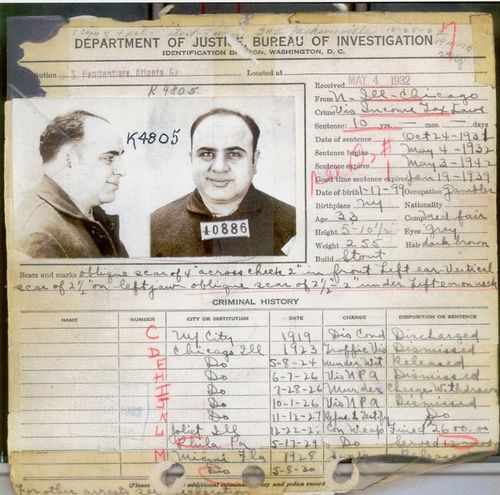
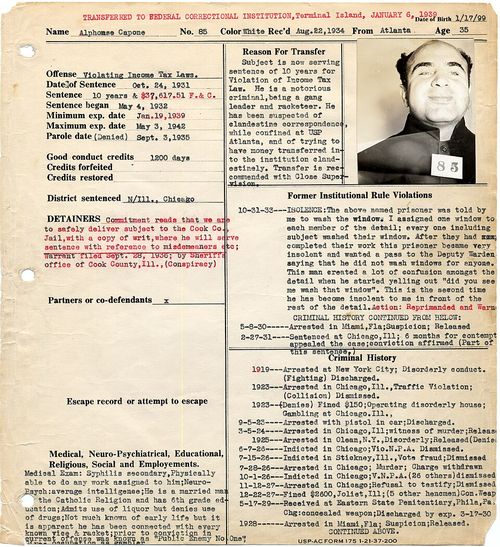
A week later Wilkerson imposed five years on each felony count and one year on each misdemeanour, arranged to total eleven years, with $50,000 in fines and the costs of prosecution. Capone went to the Cook County Jail while new lawyers appealed. The appeals failed, and in May 1932 he was taken to the federal penitentiary in Atlanta.
Timeline
In United States v. Sullivan the Supreme Court rules that income from illegal business is taxable.
Chicago civic leaders meet President Hoover, who orders federal agencies to concentrate on Capone.
Ralph Capone is convicted of income tax evasion.
Capone is convicted of contempt of court for evading a grand jury subpoena and sentenced to six months.
A grand jury indicts Capone for evading tax on his 1924 income.
A second indictment charges twenty-two counts covering 1925 to 1929.
Capone pleads guilty, expecting a sentence of two and a half years.
Judge Wilkerson says he is not bound by the bargain, and Capone withdraws his plea.
The trial opens after Wilkerson swaps the jury panel with another courtroom's.
The jury finds Capone guilty on five counts and not guilty on the rest.
Wilkerson sentences Capone to eleven years in prison and $50,000 in fines plus costs.
The Seventh Circuit Court of Appeals upholds the conviction.
Capone is taken to the federal penitentiary in Atlanta; he is moved to Alcatraz in August 1934.
Capone, weakened by syphilis, is released on parole.
People in the case
-
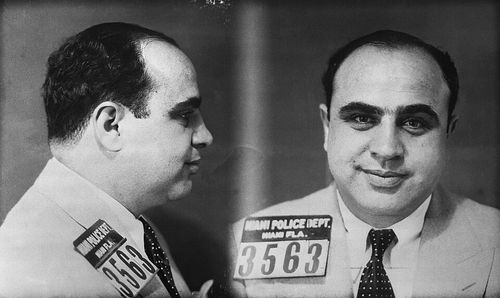
Al Capone Accused
17 January 1899 – 25 January 1947
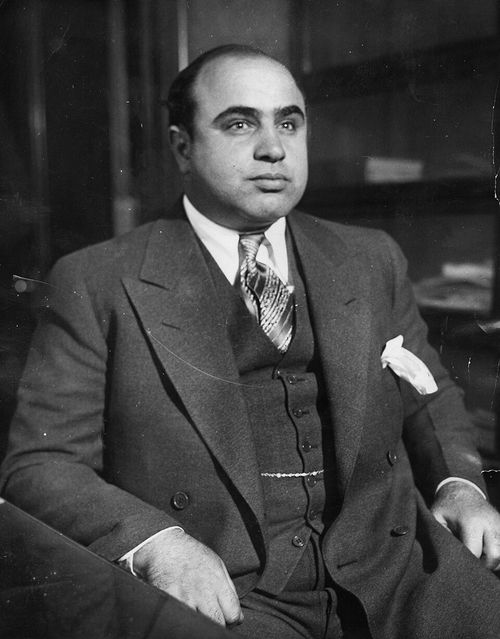
Boss of the Chicago Outfit; convicted on five counts of tax evasion and failure to file, and sentenced to eleven years.
-
James Herbert Wilkerson Judge
11 December 1869 – 30 September 1948
Federal judge who refused the plea bargain, switched the jury panel and passed the eleven-year sentence.
-
George E. Q. Johnson Prosecutor
11 July 1874 – 19 September 1949
United States Attorney in Chicago; had already won tax convictions against Ralph Capone, Jake Guzik and Frank Nitti.
-
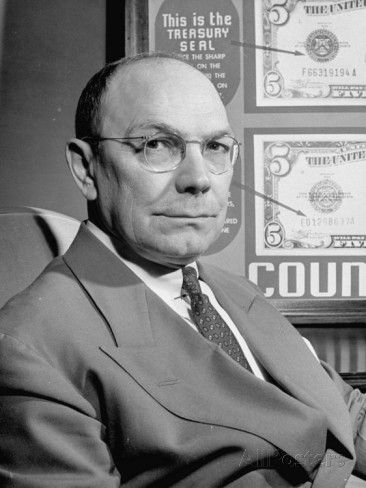
Frank J. Wilson Investigator
1887 – 22 June 1970
Treasury Intelligence Unit agent who found the ledger and the bookkeeper. Later Chief of the Secret Service. Sources give his birth date as 19 May 1887.
-
Edward J. O'Hare Witness
5 September 1893 – 8 November 1939
Lawyer and dog-track operator who secretly helped the Treasury; shot dead in Chicago in 1939, a week before Capone's release.
-
Ralph Capone Also involved
12 January 1894 – 22 November 1974
Al's elder brother, convicted of tax evasion in 1930; his case showed the method worked.
-
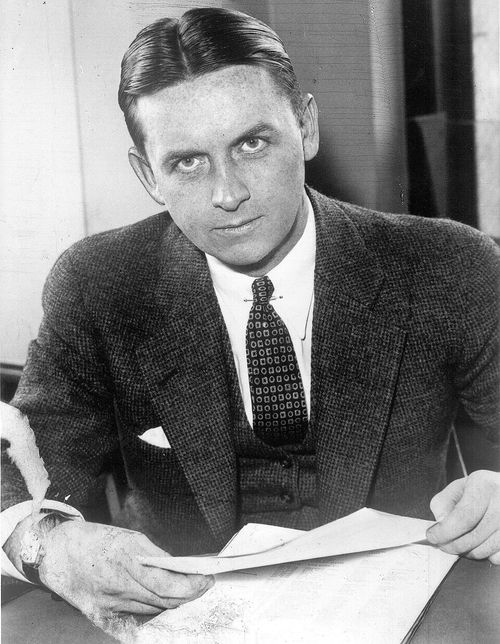
Eliot Ness Investigator
19 April 1903 – 16 May 1957
Prohibition agent whose squad raided Capone breweries; his work was separate from the tax case that convicted Capone.
Where it happened
- Chicago Federal Building. Domed federal courthouse where Capone was tried; demolished in 1965.
- Palm Island, Miami Beach. Site of Capone's Florida estate, whose purchase and improvements the prosecution used as evidence of income.
- Alcatraz Federal Penitentiary. Where Capone served most of his sentence from August 1934 to January 1939.
Outcome
Convicted Convicted
On 17 October 1931 a federal jury in Chicago convicted Capone of three felony counts of attempted tax evasion (1925 to 1927) and two misdemeanour counts of failing to file returns (1928 and 1929), acquitting him on the remaining charges. On 24 October Judge Wilkerson sentenced him to eleven years in prison, $50,000 in fines and the costs of prosecution, with his earlier six-month contempt sentence to run alongside. The Seventh Circuit affirmed in 1932 and the Supreme Court declined to review the case. Capone was released in November 1939 after serving about seven and a half years.
What the record settles, and what it doesn't
Established
- Capone was indicted on 13 March 1931 for 1924 and on 5 June 1931 on twenty-two counts covering 1925 to 1929.
- He pleaded guilty on 16 June 1931 under a negotiated deal for two and a half years, then withdrew the plea after Judge Wilkerson said he would not be bound by it.
- The trial opened on 6 October 1931, and Wilkerson exchanged the jury panel with another judge's after a warning that the original panel had been compromised.
- A 1930 letter from Capone's tax lawyer admitting substantial income was admitted in evidence over defence objections.
- The jury returned guilty verdicts on five counts on 17 October 1931, and Capone was sentenced on 24 October to eleven years and $50,000 in fines.
- The conviction was upheld on appeal in 1932.
- The case rested on the Supreme Court's 1927 ruling in United States v. Sullivan that illegal income is taxable.
Disputed
- Who deserves the credit: popular culture, led by Ness's own memoir and later films, gives it to the Untouchables, while most historians credit the Treasury's Intelligence Unit and agents such as Frank Wilson.
- Whether the jury had really been bribed or merely listed: the panel switch is well documented, but how far the Outfit had got with the original jurors is not.
- Whether the trial was fair: some legal writers argue that admitting a lawyer's settlement letter as a confession and allowing so much evidence of spending stretched the law, while the appeals court found no error.
- Whether the Outfit killed Edward O'Hare in 1939 for helping the government: it is widely suspected, but the murder was never solved and other motives have been suggested.
- How much Capone actually earned: the government charged about $1 million in income and $215,000 in tax over five years, a fraction of what most estimates put his real income at.
Pictures




Afterwards
Capone never returned to power. In Atlanta and then on Alcatraz, where he arrived in August 1934, the syphilis he had contracted as a young man reached his brain, and by the time of his release in November 1939 he was unable to run anything. He spent his last years at his Palm Island house and died there in January 1947. The Outfit carried on under others, more quietly than before.
The case became the template for prosecuting people whose crimes were hard to prove directly: follow the money, compare what a man spends with what he declares, and charge the gap. Frank Wilson went on to head the Secret Service. The signed verdict form is held by the National Archives, and the trial remains the standard example, taught in law schools and repeated in films, of a powerful criminal brought down on the paperwork rather than the violence.
Questions readers ask
Why was Al Capone convicted of tax evasion and not murder?
Nobody could ever produce witnesses or evidence tying him personally to a killing in a way that would stand up in court. Income tax was a federal matter outside the reach of Chicago's corrupt police and courts, and the Supreme Court had ruled in 1927 that illegal income was taxable.
How long was Al Capone's sentence?
Eleven years in federal prison, plus $50,000 in fines and court costs. He served about seven and a half years, in Atlanta, Alcatraz and finally Terminal Island, before being released in November 1939.
Did Eliot Ness convict Al Capone?
Not directly. Ness's Prohibition squad raided Capone's breweries, but the tax case that sent him to prison was built by Treasury investigators and prosecuted by the United States Attorney's office.
How much tax did Al Capone owe?
The government charged him with evading about $215,000 in tax on roughly $1 million of income between 1924 and 1929. The figures were a deliberately provable minimum, far below what he was believed to earn.
Sources and further reading
- Al Capone (Wikipedia)
- Al Capone (FBI history)
- Al Capone verdict (National Archives, American Originals)
- Capone tax evasion trial, part 2 (The Mob Museum)
- Wikidata Q80048 (life dates checked here)
Written by Sinister Crimes from the sources above; see our editorial standards. Last checked 1 November 2026.