

The case
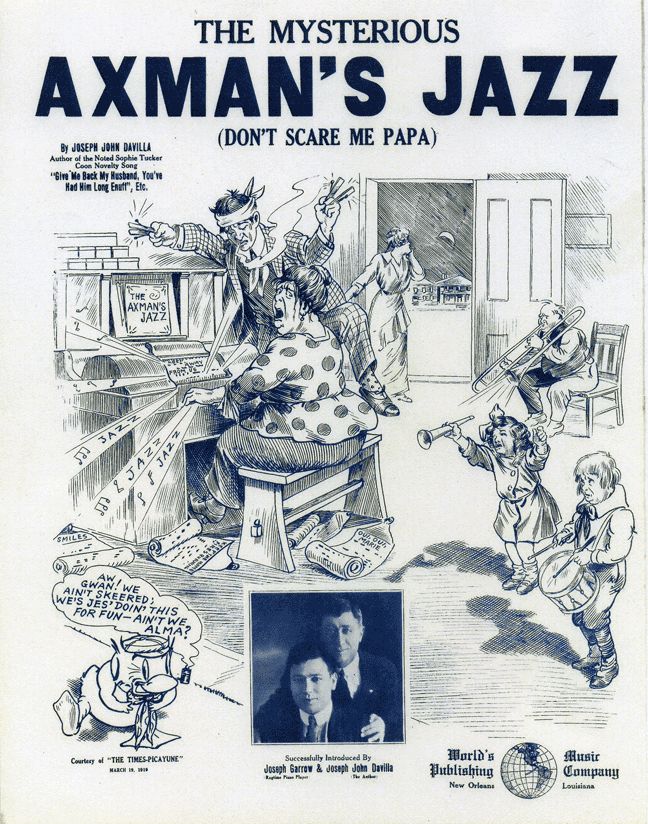
On the night of March 18, 1919, New Orleans played jazz in self-defense. A letter printed in the city's papers that week, headed "Hell" and signed "The Axeman," promised that at a quarter past midnight on Tuesday its author would pass over the city and spare every household where a jazz band was playing. Dance halls filled, parties ran late, and a local composer quickly published a song called "The Mysterious Axman's Jazz (Don't Scare Me Papa)." Nobody was attacked that night. Whether the letter came from the killer at all has never been settled.
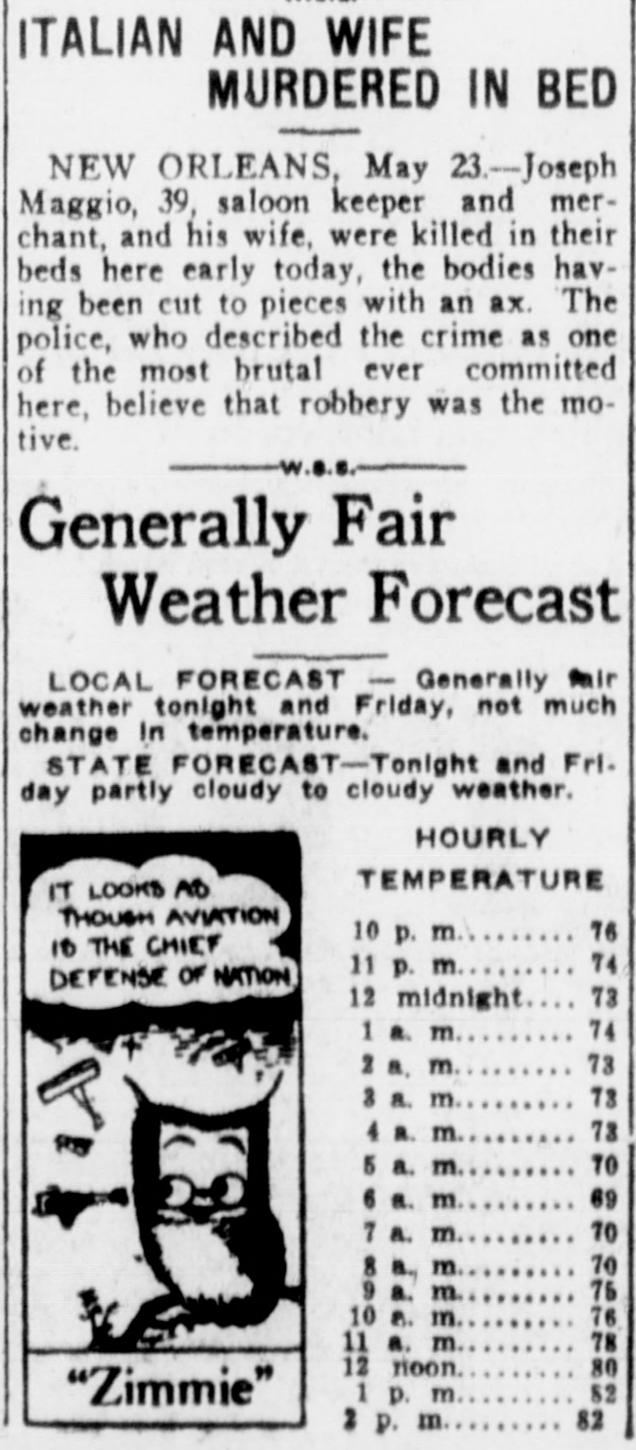
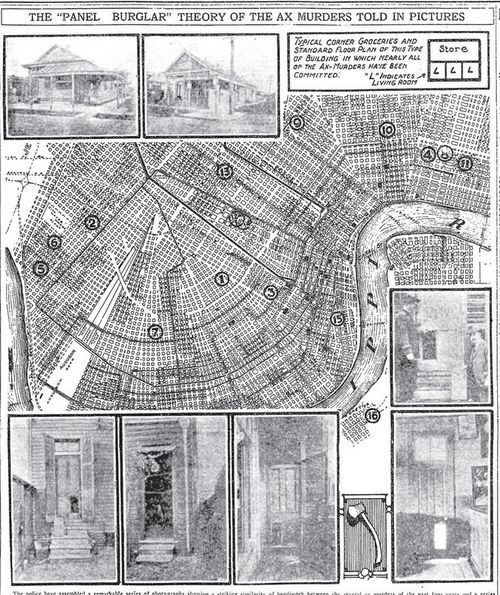
The attacks that gave the letter its power had begun ten months earlier. In the early hours of May 23, 1918, an intruder entered the rooms behind the Maggio family's grocery at Upperline and Magnolia Streets, attacked Joseph and Catherine Maggio in their bed with a razor and an axe, and left. Catherine died at the scene and Joseph shortly afterward. A panel had been chiseled out of the back door, the method that would become the Axeman's signature, and money in plain sight was left untouched.
Over the next eighteen months the pattern recurred across the city. Louis Besumer, a grocer, and Harriet Lowe were attacked in June 1918; Lowe later died after surgery. Anna Schneider, eight months pregnant, was struck in her bed in August and survived. Days later Joseph Romano, an elderly man living with his nieces, was killed. Many of the victims were Italian immigrants who kept small groceries, which led newspapers to talk of the Black Hand and the Mafia, though no evidence of organized crime ever emerged. Often the weapon was an axe from the victims' own house, left behind.
The worst attack came on March 10, 1919, across the river in Gretna. Charles and Rosie Cortimiglia were badly injured, and their infant daughter Mary was killed. Rosie, still recovering, accused their neighbors Iorlando Jordano and his son Frank. Despite Charles's denials, the Jordanos were convicted of murder; the father was sentenced to life imprisonment and the son to death. The Axeman letter appeared in the newspapers within days of the Gretna attack.
Attacks continued later that year. Steve Boca, a grocer, survived a blow to the head in August 1919; Sarah Laumann, 19, was injured in her bed in September; and on October 27, 1919, Mike Pepitone was killed in his bedroom while his wife watched a large man flee. After that the attacks stopped as abruptly as they had begun.
The investigation suffered from the methods of its day. Police arrested the obvious suspects in each case, including Joseph Maggio's brother Andrew, a Black employee of Besumer's, Besumer himself and the Jordanos, and released or eventually cleared nearly all of them. Besumer was charged with Harriet Lowe's murder on her deathbed accusation and acquitted in May 1919 after a jury deliberated for minutes. In December 1920 Rosie Cortimiglia admitted that she had falsely accused the Jordanos, and both men were freed. The killer was never identified.
The victims
Most of those attacked were working people of modest means: Italian and Italian-American grocers and their families who lived behind or above their shops, in neighborhoods where back doors opened onto yards and alleys. Joseph Maggio was a grocer who lived with his wife Catherine in rooms next door to his brother Andrew. Joseph Romano was an elderly man who shared his home with his two nieces, Pauline and Mary Bruno, who saw his attacker escape. Mike Pepitone left a widow and six children.
The youngest victim, Mary Cortimiglia, was a baby killed in her mother's arms in Gretna. Her family was destroyed twice over: her parents' marriage broke up after the trial, and her mother's mistaken accusation sent two innocent neighbors to prison until she withdrew it. Others survived with lasting injuries, among them Harriet Lowe, who lived for some weeks before dying after an operation, and Anna Schneider, who gave birth to a healthy daughter two days after being attacked.
Timeline
Joseph and Catherine Maggio are attacked in their home behind their grocery and both die.
Louis Besumer and Harriet Lowe are attacked in rooms behind his grocery; Lowe dies weeks later.
Anna Schneider, eight months pregnant, is attacked in her bed and survives.
Joseph Romano is attacked in his home and dies two days later.
Charles and Rosie Cortimiglia are injured and their baby daughter Mary killed in Gretna.
A letter signed "The Axeman," dated March 13, appears in the press promising to spare houses where jazz is playing.
New Orleans fills its dance halls and parlors with jazz; no attack takes place.
Louis Besumer is acquitted of Harriet Lowe's murder.
Grocer Steve Boca is attacked and survives.
Sarah Laumann, 19, is attacked and survives.
Mike Pepitone is killed, the last attack attributed to the Axeman.
Rosie Cortimiglia retracts her accusation, and the Jordanos are released.
People in the case
-
Joseph and Catherine Maggio Victim
? – 23 May 1918
Grocers on Upperline Street; the first victims generally attributed to the Axeman.
-
Joseph Romano Victim
? – August 1918
Elderly man attacked on August 10, 1918, who died two days later.
-
Mary Cortimiglia Victim
? – 10 March 1919
Infant daughter of Charles and Rosie Cortimiglia, killed in Gretna.
-
Mike Pepitone Victim
? – 27 October 1919
Grocer killed in his bedroom; the last attack attributed to the Axeman.
-
Louis Besumer Accused
Grocer attacked in June 1918, later charged with Harriet Lowe's murder and acquitted on May 1, 1919.
-
Iorlando and Frank Jordano Accused
Father and son wrongly convicted of the Cortimiglia murder on Rosie Cortimiglia's evidence; freed after she recanted in December 1920.
-
Rosie Cortimiglia Witness
Survivor of the Gretna attack whose false accusation convicted the Jordanos; she later retracted it.
Where it happened
- Upperline and Magnolia Streets, New Orleans. Approximate area of the Maggio grocery, scene of the first attack.
- Gretna, Louisiana. West-bank suburb where the Cortimiglia family was attacked in March 1919.
- New Orleans. The city where most of the attacks took place.
Outcome
Unsolved Unsolved
No one was ever convicted of the Axeman attacks. Louis Besumer was tried for Harriet Lowe's murder and acquitted in May 1919. Iorlando and Frank Jordano were convicted of the Cortimiglia murder but released after the chief witness admitted lying, and the killer has never been identified.
What the record settles, and what it doesn't
Established
- Between May 1918 and October 1919 a series of night-time attacks with axes and similar weapons killed at least six people in New Orleans and Gretna and injured several more.
- In many cases the intruder entered by chiseling out a panel of the back door and used an axe belonging to the household, and in most cases nothing was stolen.
- Many of the victims were Italian or Italian-American grocers and their families.
- A letter signed "The Axeman" and dated March 13, 1919, appeared in the press offering to spare houses where jazz was playing, and no attack took place on the night it named.
- Louis Besumer was acquitted of murder in May 1919, and the Jordanos' convictions collapsed when the only eyewitness retracted her accusation in December 1920.
- No one has ever been identified as the Axeman.
Disputed
- Whether the jazz letter was written by the killer or by a hoaxer, journalist or prankster exploiting the panic; nothing in it can be tied to the attacks.
- How many attacks were the work of one person: some lists include similar crimes from 1911 and 1912 and some later cases, while others treat only a handful of 1918-1919 attacks as linked.
- Motive: contemporary papers pointed to Mafia or Black Hand extortion of Italian grocers, while later writers have suggested a killer with a personal or sexual motive, and none of these has been proven.
- Identity: several men have been proposed by later researchers, including a New Orleans man with a criminal record who died in 1921, but the evidence for each is circumstantial.
- A popular story that Mike Pepitone's widow later shot the Axeman in Los Angeles appears to rest on no surviving record.
In the newspapers of the day
Clippings from American newspapers digitised by the Library of Congress. The excerpt under each is the library's machine-read text, uncorrected; read the original page for the full report.
The oklahoma city times (Oklahoma City, Okla.)
, page 1 · The first murders
NEW ORLEANS. May 2J.Joseph Maggio, 39, saloon keeper and mer- chant, and his wife, were killed in their beds here early today, the …
Source: Chronicling America: Historic American Newspapers, Library of Congress. Public domain.
Pictures

Afterwards
The Axeman became part of New Orleans folklore almost before the attacks had stopped. The jazz letter, true or false, made a strange marriage between the city's new music and its fear, and the 1919 sheet music for "The Mysterious Axman's Jazz" survives as a period piece. Writers in later decades padded the story, adding victims, a dramatic end in California and confident solutions that the record does not support.
The case also left a record of injustice. Andrew Maggio, Louis Besumer and the Jordanos all spent time under arrest or in prison for crimes they did not commit, and police treatment of a Black employee arrested on no evidence shows how suspicion was distributed in the city at the time. Novels, films, television and music have since returned to the Axeman, usually through the jazz letter, which remains the most quoted and least verified part of the story.
Questions readers ask
Was the Axeman of New Orleans ever caught?
No. Several people were arrested and two men were wrongly convicted, but nobody was ever shown to be the Axeman. The attacks stopped after October 1919.
Did the Axeman really write a letter about jazz?
A letter signed "The Axeman" and dated March 13, 1919, was printed in the press, promising to spare homes where jazz was playing. Many historians doubt that the killer wrote it; it may have been a hoax by a reader or journalist.
How many people did the Axeman kill?
At least six deaths are generally attributed to the 1918-1919 attacks, with several more people injured. Some accounts add earlier or later crimes, which inflates the total.
Sources and further reading
- Axeman of New Orleans (Wikipedia)
- Chronicling America: New Orleans press, March 1919
- Wikidata Q278475 (life dates checked here)
Written by Sinister Crimes from the sources above; see our editorial standards. Last checked 1 November 2026.