

The case
The price Blackbeard demanded for releasing a shipload of Charles Town's leading citizens in May 1718 was not gold. It was a chest of medicines. For about a week his flotilla sat across the bar at the harbour mouth, stopping every vessel that tried to come or go, while a hostage delegation went ashore with the demand and the threat that the prisoners would die if it were refused. The medicines came. The prisoners were sent back, minus their valuables and some of their clothes. Nobody was killed.
That episode sums up the man better than the legend does. Edward Teach, or Thatch as people who actually met him tended to write it, was probably born around 1680, possibly in Bristol, and probably served on privateers during Queen Anne's War. Almost nothing about his early life is documented. He surfaces in the record around 1716 on New Providence in the Bahamas, then a lawless anchorage, sailing under the veteran pirate Benjamin Hornigold, who gave him a captured sloop to command.
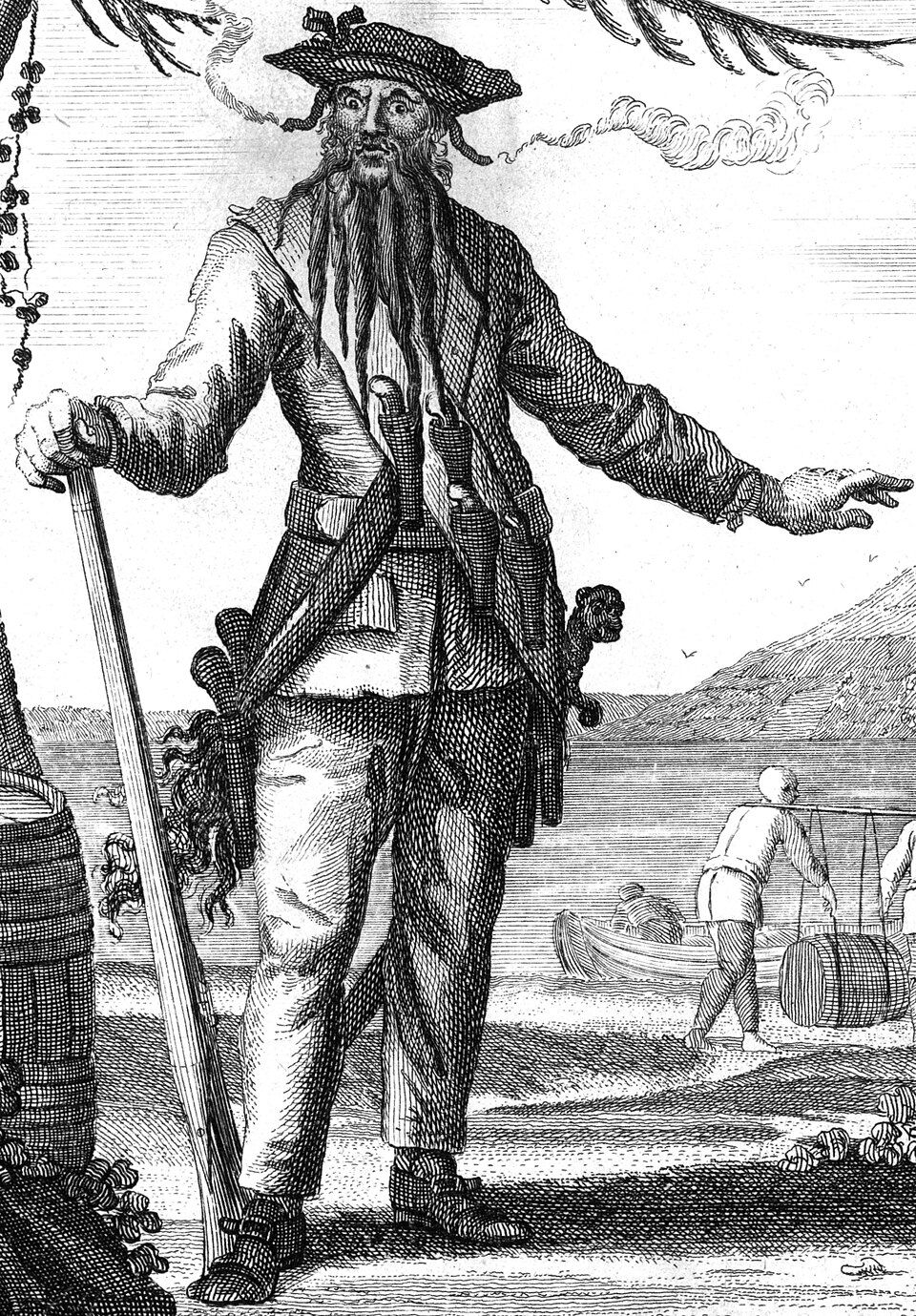
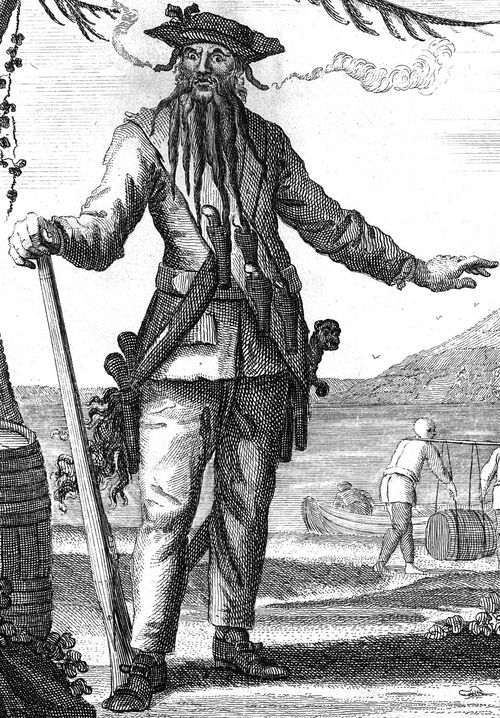
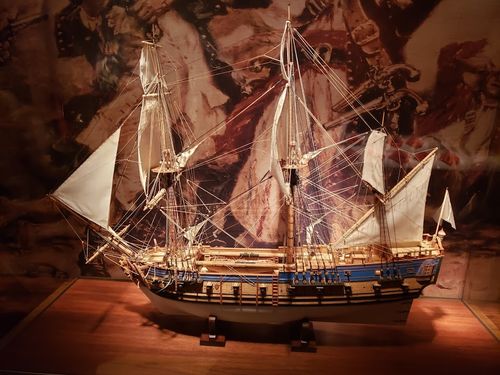
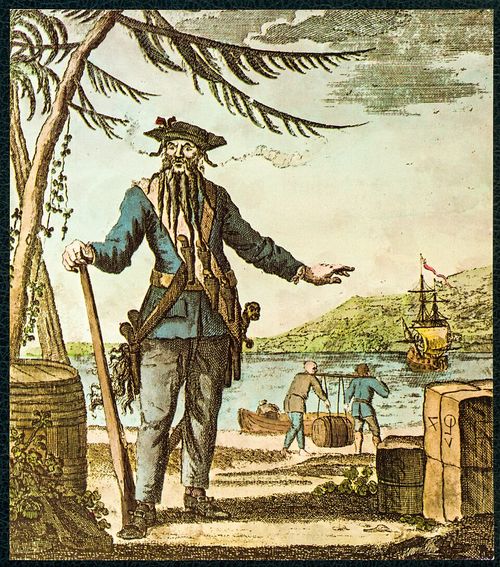
In late 1717, after Hornigold was voted out and quit the trade, Teach took a large French slaver, La Concorde, off Saint Vincent. He renamed her Queen Anne's Revenge and mounted some forty guns on her. A merchant captain named Henry Bostock, held aboard for several hours that December, gave a sworn description of a tall, spare man with a very long black beard. That deposition is the earliest account of his appearance and the source of the name. Later writers added the braids, the ribbons and the slow-burning matches tucked under his hat; those details come from Charles Johnson's 1724 General History of the Pyrates and cannot be checked.
What the documents do show is a pirate who worked by intimidation. No reliable account has him killing a prisoner. Through the spring of 1718 his squadron grew, absorbing the gentleman pirate Stede Bonnet's sloop Revenge, a Jamaican logwood sloop called Adventure and several prizes, until he styled himself commodore. The Charles Town blockade was the high point.
Then he shrank his own operation. In June 1718 Queen Anne's Revenge ran aground in Topsail Inlet, now Beaufort Inlet, North Carolina, and so did Adventure. A crew member later testified that Teach caused the grounding deliberately, and several historians think he did it to cut the number of men sharing the plunder. He stripped the remaining sloop, marooned a group of the crew on a sandbar, and went up the Pamlico to Bath, where Governor Charles Eden granted him the king's pardon.
The retirement lasted weeks. By late summer Teach was raiding again, and he returned with a French ship that a vice-admiralty court in North Carolina obligingly declared a derelict found at sea; part of its sugar ended up with Eden and with Tobias Knight, the colony's secretary. In Virginia, Governor Alexander Spotswood had no faith in North Carolina's willingness to act. Without clear legal authority to do so, he paid for an expedition himself: soldiers overland to Bath, and two hired sloops under Lieutenant Robert Maynard of HMS Pearl to go in by water.
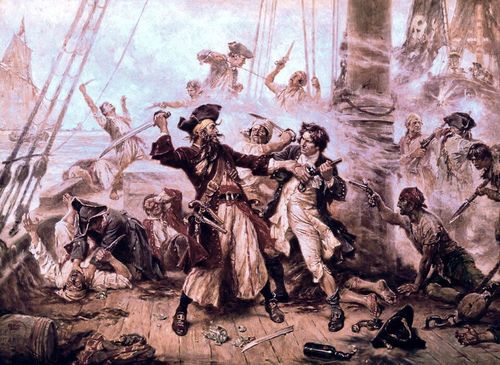
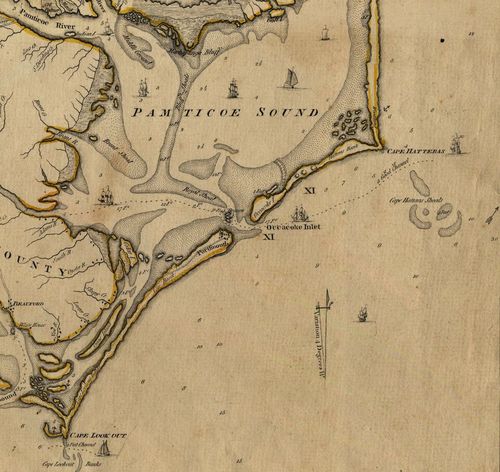
Maynard found Teach's sloop anchored on the inside of Ocracoke Island on the evening of 21 November 1718 and attacked at first light. A broadside from Adventure killed or wounded a large part of Maynard's force and put one sloop out of the fight. Maynard kept his surviving men below decks, and when Teach's crew boarded what looked like an empty ship they came up fighting. Teach was shot and cut many times and died on the deck of Maynard's sloop. Around ten pirates and a similar number of the attackers were killed, by the differing official counts.
Maynard took Teach's head back to Virginia to claim the bounty. Surviving crew members and associates rounded up at Bath were tried at Williamsburg in March 1719.
The victims
Blackbeard's victims were mostly the owners, masters and crews of the merchant vessels he stopped between the Caribbean and Delaware Bay, men like Henry Bostock of the sloop Margaret, held for hours and released with nothing. Samuel Wragg, a member of the South Carolina council, was among the Charles Town hostages threatened with death in May 1718. The people with the least choice were the Africans held captive aboard La Concorde when Teach took her: they were landed on Bequia, a few may have been taken into the crew, and most were later recaptured by the French. The heaviest loss of life in the whole story fell on Maynard's own men at Ocracoke, sailors from HMS Pearl and HMS Lyme, of whom about ten were killed.
Timeline
Teach is given command of a captured sloop by Benjamin Hornigold, operating out of New Providence.
Teach captures the French slave ship La Concorde off Saint Vincent and renames her Queen Anne's Revenge.
Henry Bostock of the sloop Margaret is held by Teach; his deposition gives the first description of the black beard.
Teach's squadron blockades Charles Town, South Carolina, and ransoms its hostages for a chest of medicines.
Queen Anne's Revenge runs aground at Topsail (Beaufort) Inlet, North Carolina.
Teach accepts the king's pardon from Governor Charles Eden at Bath.
Robert Maynard takes command of two hired sloops in Virginia and sails for North Carolina.
Teach is killed in the fight with Maynard's sloops at Ocracoke Inlet.
Members of Teach's crew are tried at Williamsburg; fourteen of sixteen are convicted.
Divers locate the wreck identified as Queen Anne's Revenge in Beaufort Inlet.
People in the case
-
Edward Teach (Blackbeard) Perpetrator
1680 – 22 November 1718
Pirate captain, c. 1680 to 1718; killed in action at Ocracoke Inlet. Surname also recorded as Thatch.
-
Robert Maynard Investigator
1684 – 1751
First lieutenant of HMS Pearl; commanded the sloops that attacked Teach at Ocracoke.
-
Alexander Spotswood Also involved
1676 – 7 June 1740
Lieutenant governor of Virginia; organised and paid for the expedition into North Carolina.
-
Charles Eden Also involved
? – 17 March 1722
Governor of North Carolina who pardoned Teach in 1718; accused by Spotswood of shielding him.
-
Benjamin Hornigold Accomplice
1680 – 1719
Bahamas pirate captain under whom Teach served; later took the pardon and hunted pirates.
-
Stede Bonnet Accomplice
29 July 1688 – 10 December 1718
Barbados landowner turned pirate whose sloop Revenge Teach took over; hanged at Charles Town.
-
Israel Hands Accomplice
Captain of Adventure under Teach; ashore during the final battle, he testified for the Crown and escaped hanging. Dates unknown.
-
Tobias Knight Also involved
? – 1719
Secretary of North Carolina; tried by the colony's council for dealings with Teach and cleared, dying later in 1719.
Where it happened
- Ocracoke Inlet. Teach's favourite anchorage and the scene of his last fight.
- Bath, North Carolina. Colonial town where Teach took his pardon and briefly settled.
- Queen Anne's Revenge wreck, Beaufort Inlet. Where the flagship grounded in June 1718; the wreck was found in 1996.
- Charleston Harbor. Blockaded by Teach's squadron in May 1718.
- Williamsburg, Virginia. Where the surviving crew were tried in March 1719.
Outcome
Killed before trial Killed in action
Teach never stood trial; he was killed at Ocracoke on 22 November 1718 (Old Style) by a Royal Navy party acting on the Virginia governor's orders. Sixteen associates were tried before a court of admiralty at Williamsburg on 12 March 1719; fourteen were convicted and hanged. Israel Hands escaped execution by testifying and claiming the royal pardon, and one man showed he had been aboard only as a guest.
What the record settles, and what it doesn't
Established
- A man recorded as Edward Thatch or Teach commanded pirate vessels in the Caribbean and along the North American coast between about 1716 and 1718.
- He captured the French slaver La Concorde in late 1717 and turned her into his flagship Queen Anne's Revenge.
- In May 1718 his squadron blockaded Charles Town and released its hostages in exchange for medical supplies.
- Queen Anne's Revenge was lost at Topsail (Beaufort) Inlet in June 1718, and Teach then took a pardon from Governor Eden.
- He was killed at Ocracoke Inlet on 22 November 1718 in a fight with sloops commanded by Lieutenant Robert Maynard.
- Fourteen of his men were convicted of piracy at Williamsburg in March 1719 and hanged.
Disputed
- His real name and origins: Teach, Thatch and other spellings appear, Bristol is only probable, and a claim that he was really named Drummond has no documentary support.
- Whether the grounding of Queen Anne's Revenge was deliberate: one crewman testified that Teach caused it, and some historians see a plan to shed crew, while others treat it as an accident in a difficult inlet.
- How far Governor Eden and Tobias Knight protected him: Spotswood accused them, Knight was cleared by the North Carolina council, and historians still divide on how much the officials knew.
- The famous details of his appearance, such as lit matches under his hat, come from Johnson's 1724 book and may be embellished.
- Whether Spotswood had any legal right to send armed men into North Carolina; several historians judge that he did not.
Pictures





Afterwards
Spotswood auctioned the seized goods for a little over £2,200 and paid for the operation from the proceeds. Maynard felt cheated when the prize money was shared with the crews who had marched to Bath, was never promoted, and slipped from view. The quarrel between Virginia and North Carolina over the raid ran on until Eden's death in 1722. Teach himself became the model for the stage pirate: a fixture of nineteenth-century pirate books, cigarette cards and, eventually, film. Divers found the wreck identified as Queen Anne's Revenge in Beaufort Inlet in 1996; hundreds of thousands of artefacts have since been raised, and many are on show at the North Carolina Maritime Museum in Beaufort.
Questions readers ask
How did Blackbeard die?
He was killed in hand-to-hand fighting on the deck of Lieutenant Robert Maynard's sloop at Ocracoke Inlet, North Carolina, on 22 November 1718. Maynard reported that the body had been shot five times and cut about twenty times.
What was Blackbeard's real name?
Contemporary records usually call him Edward Thatch or Teach, with many spelling variants. Pirates often used assumed names, so his birth name may never be known.
Did Blackbeard bury treasure?
There is no evidence that he did, and nothing found along the American coast has ever been tied to him. The only material recovered from his career comes from the wreck believed to be Queen Anne's Revenge.
Did Blackbeard kill people?
No reliable source records him killing a captive before his final battle. He relied on reputation and threats, though men certainly died in his last fight at Ocracoke.
Sources and further reading
- Blackbeard (Wikipedia)
- Stede Bonnet (Wikipedia)
- A General History of the Pyrates, Charles Johnson (Project Gutenberg)
- Wikidata Q213518 (life dates checked here)
Written by Sinister Crimes from the sources above; see our editorial standards. Last checked 1 November 2026.