

The case
On the afternoon of 1 July 1874, two small boys playing outside their house in Germantown, then a prosperous suburb of Philadelphia, climbed into a horse-drawn buggy with two men who had been chatting to them and handing out sweets for several days. The men promised fireworks for the Fourth of July. They drove the boys across the city, stopped at a shop, and gave five-year-old Walter Ross a quarter to go in and buy firecrackers. When Walter came out, the buggy had gone. His brother Charley, aged four, was never seen by his family again.
Within two days their father, Christian Ross, received the first of a long series of letters. They came from post offices in Philadelphia and elsewhere, in a crude hand with words misspelled in ways that seemed almost deliberate, and they soon set the price at $20,000. They warned him against the police and threatened the boy's life if anyone came near his hiding place. The kidnappers had read the large house as a sign of wealth, but Ross, a dry-goods merchant, had been badly hurt by the financial panic of 1873. His wife's family offered to help with the money, and the police were brought in.
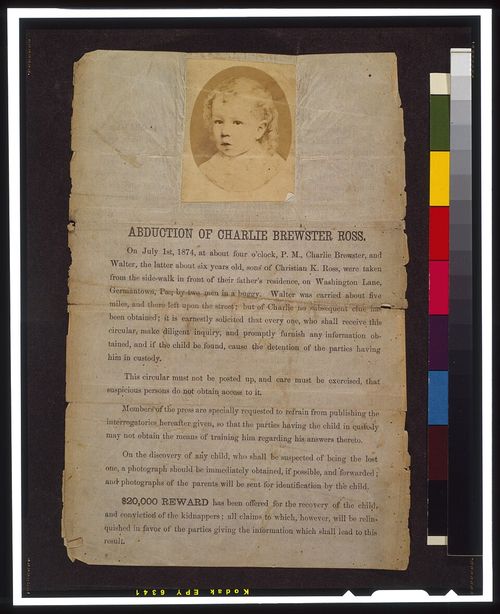
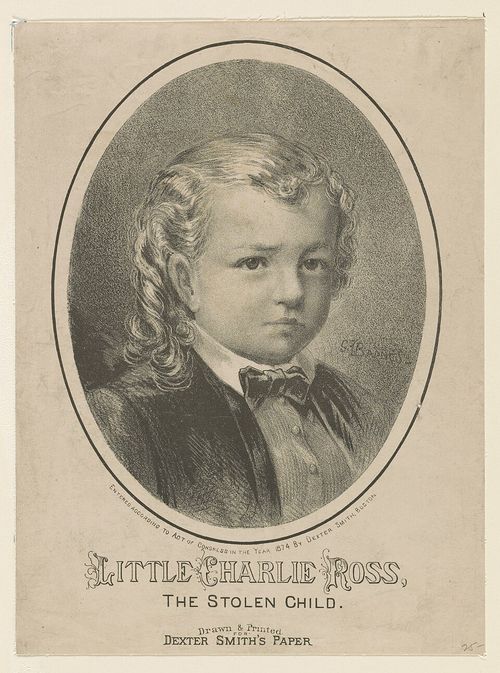
Kidnapping a child for ransom was almost unknown in the United States, and the case became a national sensation. Leading citizens offered rewards, the Pinkerton agency circulated vast numbers of posters and handbills with Charley's portrait, and a sentimental song, 'Bring Back Our Darling', sold widely. The letters went on through the summer and autumn, setting up handovers at which no one ever appeared to take the money. Then they stopped.
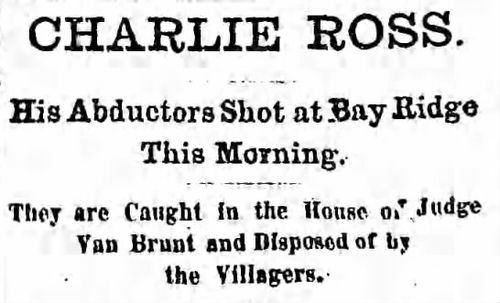
The break came by accident in the early hours of 14 December 1874, at Bay Ridge in Brooklyn. Two burglars broke into the summer house of Judge Charles Van Brunt, setting off an alarm in the house next door, where his brother Holmes lived. Holmes gathered armed men from his household and surprised them inside. William Mosher was killed at once. Joseph Douglas, mortally wounded, lived for a short time and told the men standing over him that there was no use lying now: he had helped to steal Charley Ross. What else he said is less certain. By some accounts he added that only Mosher knew where the boy was, or that the child would be returned within days. He gave no location.
Walter was taken to New York to see the bodies and identified both men as the strangers from the buggy. Mosher, whose nose had been eaten away by disease, matched the description Walter had given months earlier. But the only people who knew where Charley had been taken were dead.
Police then arrested William Westervelt, a former New York policeman who was Mosher's brother-in-law and had been in contact with the investigators and with Christian Ross during the long negotiations. His trial in Philadelphia lasted three weeks, from 30 August to 21 September 1875. Walter said Westervelt was not one of the men in the buggy, and he was not convicted of the abduction itself, but the jury found him guilty on three counts that accounts describe as conspiracy, and he was sentenced to seven years in solitary confinement at labour. He always denied knowing where the boy was.
No trace of Charley Ross was ever found. His parents spent the rest of their lives and a great part of their money following leads, and they interviewed hundreds of boys and later grown men who claimed to be their son. None was.
The victims
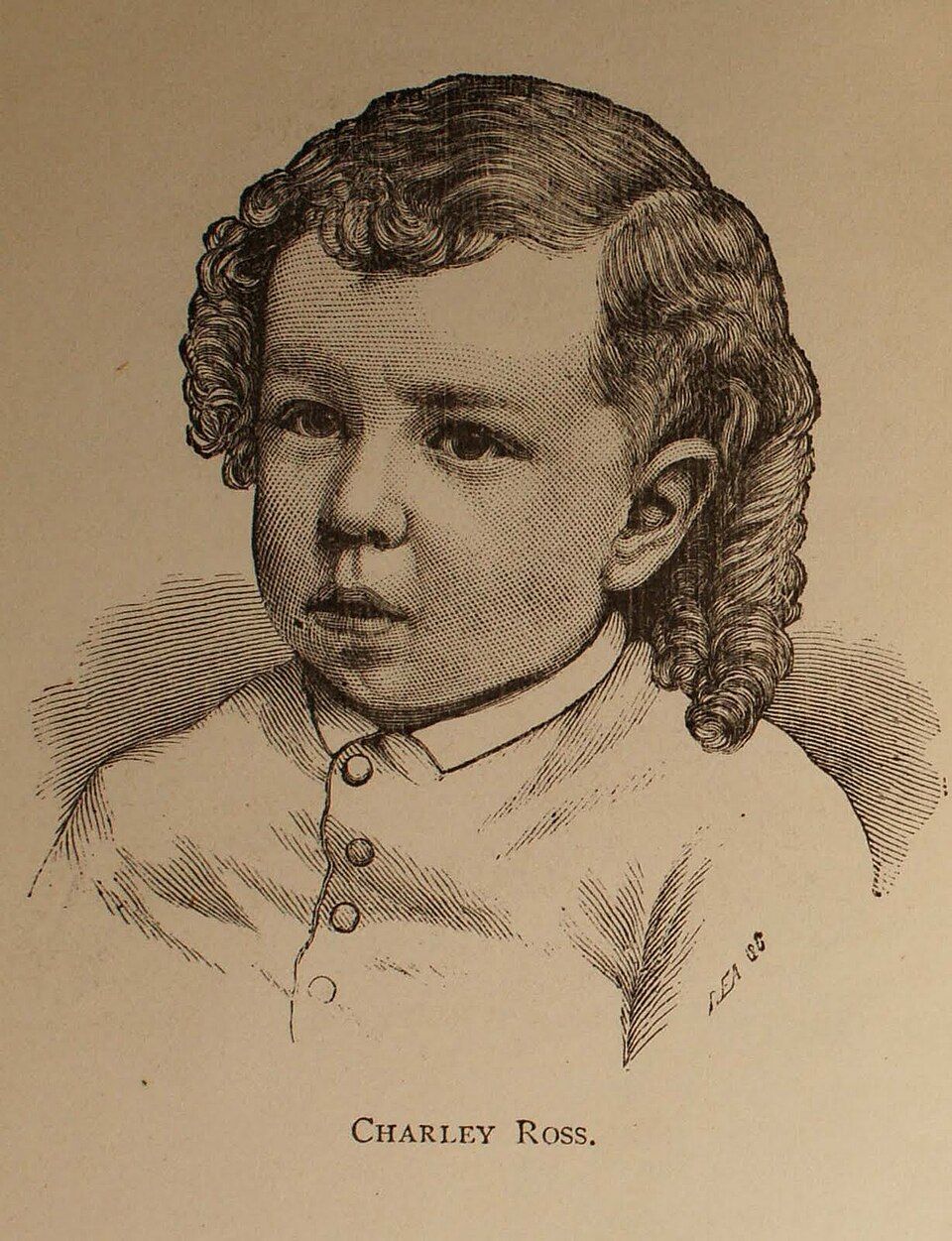
Charles Brewster Ross was born on 4 May 1870, a younger son of Christian and Sarah Ross of Germantown, and was known to everyone as Charley. His father described him as a sturdy, round-faced boy with dark brown eyes and light flaxen hair that curled into ringlets when it grew long. He was shy with strangers, with a habit of putting his arm up over his eyes when someone he did not know approached, and so sensitive that a harsh word would bring silent tears. His older brothers adored him. He was four years and two months old when he was taken.
His disappearance consumed his family. Christian Ross published The Father's Story of Charley Ross in 1876 to raise money for the search, and he and Sarah kept looking until they died, he in 1897 and she in 1912. Walter Ross, the brother who had come out of the shop to find the buggy gone, grew up to be a stockbroker and was still receiving letters from men claiming to be Charley in the 1920s and 1930s.
Timeline
A man in a wagon gives sweets to Walter and Charley Ross outside their Germantown home, the first of several such visits.
Charley Ross is driven away in a buggy after his brother Walter is sent into a shop to buy fireworks.
The first letter from the kidnappers reaches Christian Ross, warning him not to involve the police.
Later letters demand $20,000; a series of arranged handovers fails when no one comes for the money.
William Mosher and Joseph Douglas are shot while burgling Judge Van Brunt's house in Bay Ridge; Douglas admits taking part in the kidnapping before he dies.
Walter Ross identifies the two dead men as the kidnappers.
Pennsylvania passes a law making kidnapping a child for ransom a felony punishable by up to twenty-five years.
William Westervelt's trial opens in Philadelphia.
The jury finds Westervelt guilty on three counts; he is sentenced to seven years in solitary confinement.
Christian Ross publishes The Father's Story of Charley Ross.
Christian Ross dies without having found his son.
An Arizona court declares a Phoenix carpenter, Gustave Blair, to be Charles Brewster Ross; the family rejects him and a 2011 DNA study later disproves the claim.
People in the case
-
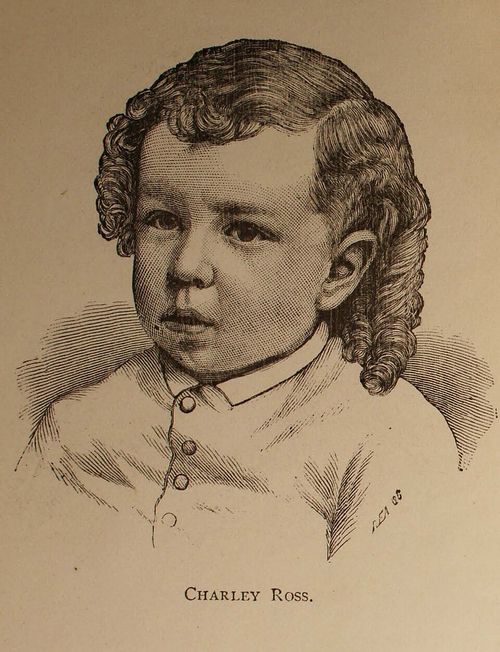
Charley Ross Victim
4 May 1870 – ?
Four-year-old taken from outside his Germantown home on 1 July 1874; his fate is unknown.
-
Christian K. Ross Also involved
? – 1897
Charley's father, a Philadelphia dry-goods merchant; received the ransom letters and searched for his son until his death.
-
Walter Lewis Ross Witness
Charley's older brother, aged five in 1874; later identified both kidnappers. Became a stockbroker. Birth and death dates not verified.
-
William Mosher Suspect
? – 14 December 1874
Career criminal identified by Walter as one of the men in the buggy; shot dead during a burglary in Bay Ridge, Brooklyn.
-
Joseph Douglas Suspect
? – 14 December 1874
Mosher's partner; before dying of his wounds he said he had helped to steal Charley Ross.
-
William Westervelt Accused
Former New York policeman and Mosher's brother-in-law; tried in Philadelphia in 1875 and sentenced to seven years on conspiracy counts.
-
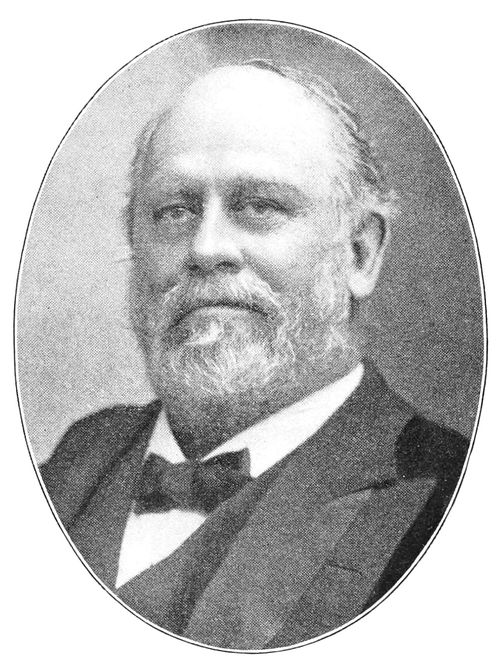
Charles H. Van Brunt Also involved
1835 – 1905
New York judge whose Bay Ridge house Mosher and Douglas were burgling when they were shot.
Where it happened
- Germantown, Philadelphia. The Ross family home stood in this suburb; Charley was taken from the street outside it.
- Bay Ridge, Brooklyn. Where Mosher and Douglas were shot while burgling Judge Van Brunt's house in December 1874.
Outcome
Unsolved Unsolved
The two men identified as the kidnappers, William Mosher and Joseph Douglas, were shot dead during a burglary in December 1874 and never tried. William Westervelt was tried in Philadelphia from 30 August to 21 September 1875; he was not convicted of the abduction itself but was found guilty on three counts described as conspiracy and sentenced to seven years in solitary confinement at labour. Charley Ross was never found and his fate has never been established.
What the record settles, and what it doesn't
Established
- Charley Ross, aged four, was taken from outside his family's home in Germantown, Philadelphia, on 1 July 1874.
- His father received a series of letters demanding a $20,000 ransom, but every planned handover failed.
- William Mosher and Joseph Douglas were shot during a burglary in Bay Ridge, Brooklyn, in December 1874, and Douglas reportedly admitted the kidnapping before he died.
- Walter Ross identified the bodies of Mosher and Douglas as the men who had taken the boys.
- William Westervelt was convicted on three counts in September 1875 and sentenced to seven years, but was not found to have taken part in the abduction itself.
- Charley Ross was never found, and no claimant to his identity was ever accepted by his family.
- It was the first kidnapping for ransom in the United States to draw national attention.
Disputed
- What Douglas actually said as he died: witnesses gave differing accounts, ranging from a plain admission that Charley was dead to a claim that only Mosher knew where he was and that he would be returned.
- Whether Charley died soon after the abduction or was kept alive and passed on to others: no body or trace was ever found, and both possibilities have been argued.
- Westervelt's role: some thought he was the go-between who wrote or posted letters for Mosher, while he insisted he had only been trying to help the Ross family.
- Whether the case is the origin of the warning 'don't take candy from strangers': it is often said to be, but the phrase's history has not been firmly traced.
- The many later claimants, including Gustave Blair, whom an Arizona court recognised as Charley Ross in 1939; the family rejected him, and a DNA study in 2011 showed he had been born into another family.
Pictures





Afterwards
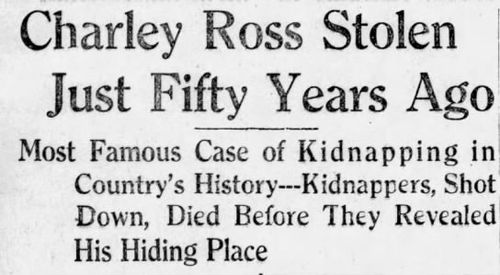
The Ross case changed how American parents thought about strangers, and it changed the law: in February 1875 Pennsylvania made kidnapping a child for ransom a felony carrying up to twenty-five years. It was a quarter of a century before another ransom kidnapping drew comparable attention, the abduction of Edward Cudahy Jr. in Omaha in 1900, and Charley's name remained shorthand for a lost child for decades. In 1924, fifty years on, newspapers were still running the story, and Walter Ross was still being asked about it.
Christian Ross's book went through several editions, and the family spent an estimated $60,000 on the search. A steady stream of men, some sincere and some fraudulent, came forward over the years claiming to be Charley. The most persistent, Gustave Blair of Phoenix, won a court ruling in 1939 that the Ross family never accepted, and he died in 1943 still making the claim.
Questions readers ask
Was Charley Ross ever found?
No. Despite a nationwide search and hundreds of claimants, no trace of Charley Ross was ever found, and his fate is unknown.
Who kidnapped Charley Ross?
His brother Walter identified two career criminals, William Mosher and Joseph Douglas, who were shot during a burglary in Brooklyn in December 1874. Douglas reportedly admitted the kidnapping before he died. A third man, William Westervelt, was convicted of conspiracy.
Is Charley Ross where 'don't take candy from strangers' comes from?
The case is often credited with popularising the warning, because the kidnappers won the boys' trust with sweets over several days. The exact origin of the phrase has not been proved.
Was Gustave Blair really Charley Ross?
No. An Arizona court accepted his claim in 1939 when no one contested it, but the Ross family rejected him, and a DNA study in 2011 showed he was a biological member of another family.
Sources and further reading
- Kidnapping of Charley Ross (Wikipedia)
- The Father's Story of Charley Ross (Internet Archive)
- Life, trial and conviction of William H. Westervelt (HathiTrust)
- The Kidnapping of Little Charley Ross, 1874 (The Yale Review)
- Wikidata Q137398815 (life dates checked here)
Written by Sinister Crimes from the sources above; see our editorial standards. Last checked 1 November 2026.