

The case
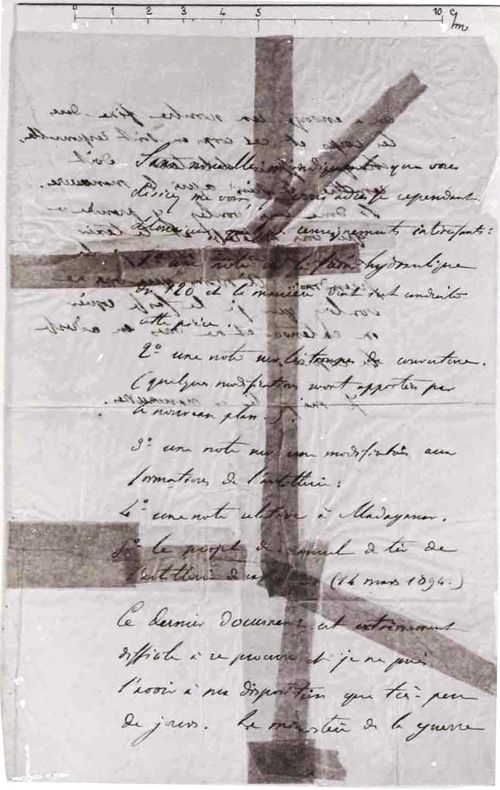
The evidence was a single sheet of paper, torn into six pieces. In September 1894 a French cleaner employed at the German embassy in Paris, secretly working for French military intelligence, passed on the contents of the waste paper of the German military attaché, Maximilian von Schwartzkoppen. Among them was an unsigned, undated covering note listing military documents its writer was offering to send. French intelligence called it the bordereau, the memorandum. Its author was clearly a French officer selling secrets, and the General Staff needed a name quickly.
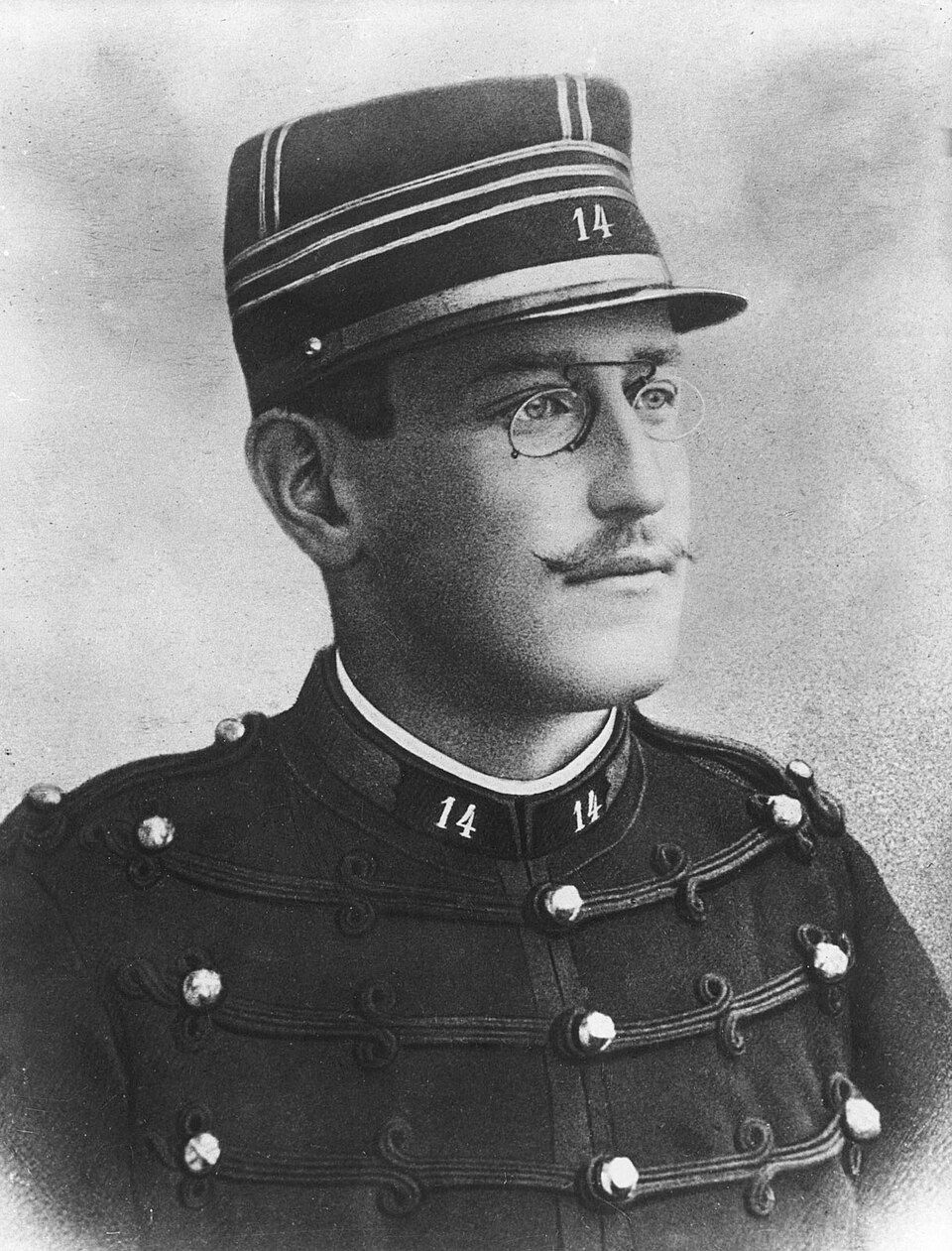
They settled on Captain Alfred Dreyfus, a 35-year-old artillery officer on probation at the General Staff. He was Jewish, from a wealthy Alsatian family, and his handwriting looked somewhat like the note's. On the morning of 15 October 1894 Major Armand du Paty de Clam, a self-styled handwriting expert, had him write out a dictated letter echoing the bordereau's wording, then arrested him. A loaded revolver was left in reach in case he wished to spare the army a trial. Dreyfus refused it, saying he wanted to live to prove his innocence. The antisemitic paper La Libre Parole broke the news of the arrest at the end of the month.
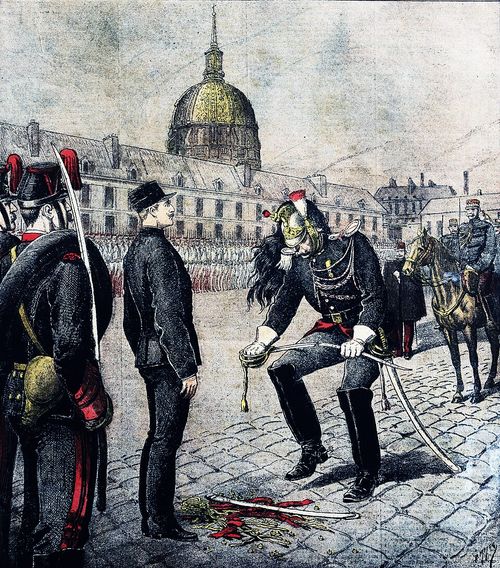
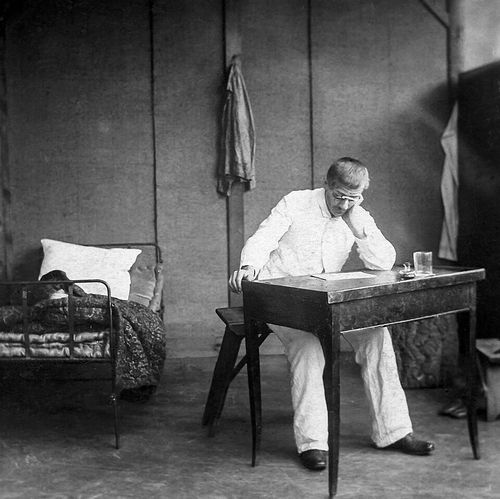
The court-martial sat behind closed doors in December. The handwriting evidence was contested, and the prosecution case was thin enough that the War Minister, General Auguste Mercier, had a secret file of documents passed privately to the judges, which the defence never saw. On 22 December 1894 the seven judges unanimously found Dreyfus guilty of treason and sentenced him to deportation for life. On 5 January 1895, in the courtyard of the École Militaire, his insignia were torn off and his sword broken while crowds outside shouted against him; he called out that he was innocent. In April he was confined alone in a stone hut on Devil's Island off French Guiana, where from September 1896 he was for a time shackled to his bed.
In March 1896 the new head of counter-intelligence, Lieutenant Colonel Georges Picquart, read an intercepted card-telegram from Schwartzkoppen addressed to another officer, Major Ferdinand Walsin Esterhazy. Esterhazy's handwriting matched the bordereau. Picquart told his superiors, who wanted no reopening of the case, and he was sent off to Tunisia. Meanwhile his deputy, Major Hubert-Joseph Henry, forged a document in November 1896 naming Dreyfus. When Dreyfus's brother Mathieu publicly accused Esterhazy in November 1897, the army staged a court-martial and acquitted him on 11 January 1898 after a few minutes' deliberation.
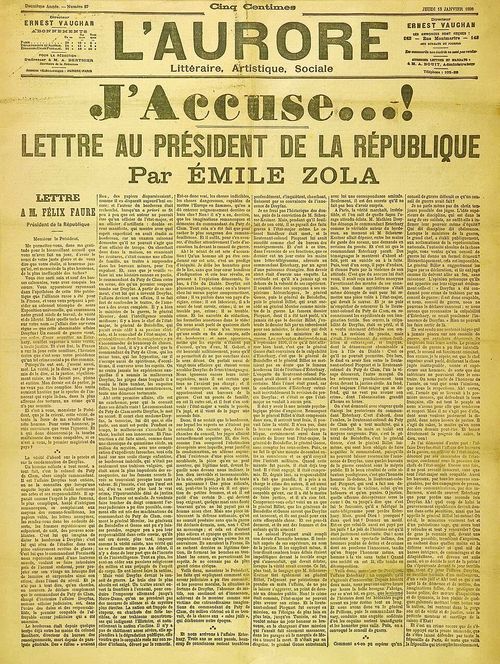
Two days later the novelist Émile Zola published an open letter to the President of the Republic on the front page of L'Aurore under the headline J'Accuse...!, naming the officers he held responsible. Zola was convicted of libel and fled to England, but the case had become the Affair, dividing France between Dreyfusards and their opponents, with antisemitic riots in many cities. In August 1898 Henry confessed to his forgery and cut his throat in his cell the next day. Esterhazy fled to London and admitted to a newspaper that he had written the bordereau, claiming it had been done on orders.
The Court of Cassation annulled the 1894 verdict on 3 June 1899 and sent Dreyfus, by now physically broken, before a new court-martial at Rennes. On 9 September 1899, by five votes to two, it convicted him again, with "extenuating circumstances", and sentenced him to ten years. The government offered a pardon, which he accepted on 19 September at the cost of not being cleared. Only on 12 July 1906 did the Court of Cassation quash the Rennes verdict outright and declare him innocent. He was reinstated as a major and made a knight of the Legion of Honour.
The victims
Alfred Dreyfus was born in Mulhouse on 9 October 1859, the youngest of nine children of a Jewish textile family. When Germany annexed Alsace after 1871, his family chose France, and he grew up wanting to serve it, entering the École Polytechnique and the artillery. He was reserved, correct and not well liked by some colleagues, which made him easier to suspect. In 1891 he married Lucie Hadamard; they had two children, Pierre and Jeanne, who were small when he was taken away.
He spent more than four years on Devil's Island, much of it under a rule of silence, uncertain whether anyone in France was fighting for him. Lucie and Mathieu Dreyfus led that fight for years. After his rehabilitation he served through the First World War, including at Verdun, and died in Paris on 12 July 1935, the twenty-ninth anniversary of the judgment that cleared him. Those who lost by the affair also included Picquart, imprisoned for his part in exposing the truth, and Zola, driven into exile.
Timeline
French intelligence obtains the torn bordereau from the German military attaché's waste paper.
Dreyfus is made to take a dictation test at the War Ministry and arrested.
A closed court-martial unanimously convicts Dreyfus of treason after judges see a secret file.
Dreyfus is publicly degraded in the courtyard of the École Militaire.
Dreyfus is placed in solitary confinement on Devil's Island.
Picquart reads the 'petit bleu' telegram linking Schwartzkoppen to Esterhazy.
Major Henry forges a document naming Dreyfus.
A court-martial acquits Esterhazy.
Zola's J'Accuse...! is published in L'Aurore.
Henry, having confessed to forgery the day before, kills himself in custody.
The Court of Cassation annuls the 1894 verdict and orders a new court-martial.
The Rennes court-martial convicts Dreyfus again, with extenuating circumstances, and sentences him to ten years.
President Loubet pardons Dreyfus; he is released two days later.
The Court of Cassation quashes the Rennes verdict and declares Dreyfus innocent.
People in the case
-
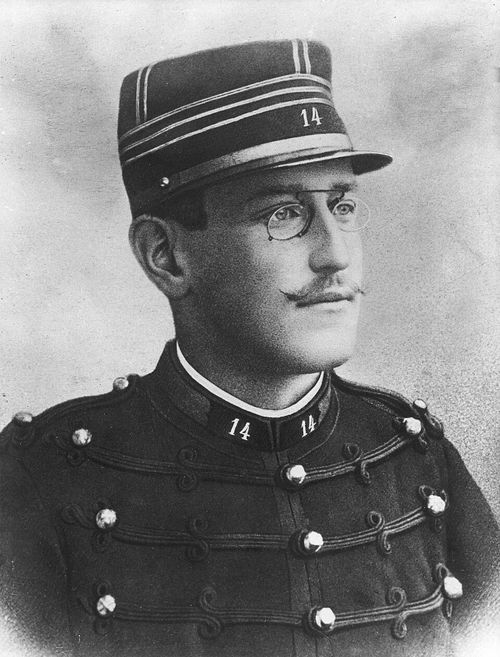
Alfred Dreyfus Victim
9 October 1859 – 12 July 1935
Artillery captain wrongly convicted of treason in 1894 and again in 1899; pardoned in 1899 and fully exonerated in 1906.
-
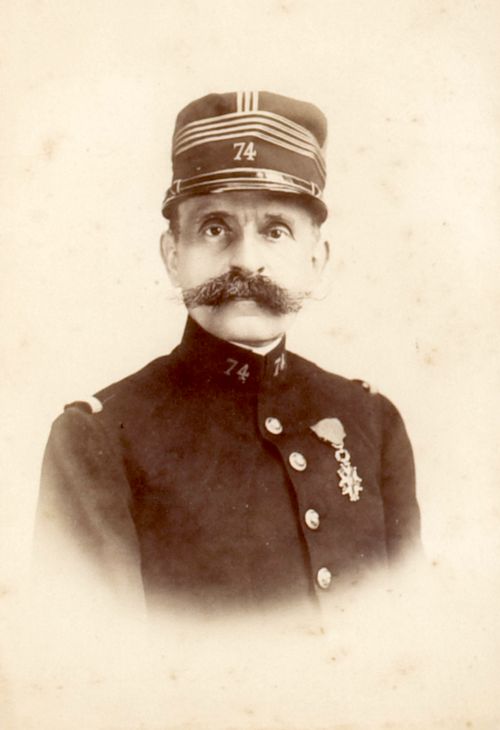
Ferdinand Walsin Esterhazy Perpetrator
16 December 1847 – 21 May 1923
Army major whose handwriting matched the bordereau and who was in contact with the German attaché; acquitted by court-martial in 1898, then fled to England and admitted writing it.
-
Georges Picquart Investigator
6 September 1854 – 18 January 1914
Head of counter-intelligence who identified Esterhazy; posted to Tunisia, then arrested and held awaiting court-martial; later Minister of War. Death date given as 18 or 19 January 1914.
-
Hubert-Joseph Henry Also involved
2 June 1846 – 31 August 1898
Intelligence officer who forged evidence against Dreyfus; confessed in August 1898 and killed himself in custody.
-
Émile Zola Also involved
2 April 1840 – 29 September 1902
Novelist whose open letter J'Accuse...! (1898) turned the case into a national crisis; convicted of libel and went into exile in England.
-
Mathieu Dreyfus Also involved
1857 – 22 October 1930
Alfred's elder brother, who organised the campaign for his release and publicly denounced Esterhazy in 1897. Death date given as 22 or 24 October 1930.
-
Lucie Dreyfus Also involved
23 August 1869 – 14 December 1945
Alfred's wife; petitioned for the review that led to the 1899 annulment.
-
Auguste Mercier Also involved
8 December 1833 – 3 March 1921
War Minister in 1894, who had a secret file illegally shown to the judges.
-
Armand du Paty de Clam Investigator
21 February 1853 – 3 September 1916
Officer who conducted the dictation test and arrest and led the interrogation of Dreyfus.
-
Maximilian von Schwartzkoppen Also involved
24 February 1850 – 8 January 1917
German military attaché in Paris to whom the bordereau was addressed.
Where it happened
- École Militaire, Paris. Where Dreyfus was publicly degraded on 5 January 1895.
- Devil's Island, French Guiana. Where Dreyfus was held in solitary confinement from 1895 to 1899.
- Rennes. Where the second court-martial sat in August and September 1899.
Outcome
Disputed verdict Wrongful conviction, annulled
Dreyfus was convicted of treason by a court-martial on 22 December 1894 and deported for life. After the Court of Cassation annulled that verdict in 1899, a second court-martial at Rennes convicted him again with extenuating circumstances and sentenced him to ten years; he was pardoned on 19 September 1899. On 12 July 1906 the Court of Cassation set aside the Rennes judgment without retrial and declared him innocent. Esterhazy, acquitted by court-martial in 1898, was never convicted of the espionage.
What the record settles, and what it doesn't
Established
- Dreyfus was convicted in 1894 on the basis of a handwriting comparison and a secret file shown to the judges without the defence's knowledge.
- The bordereau was in the handwriting of Major Ferdinand Walsin Esterhazy, who had been in contact with the German military attaché.
- Major Henry forged documents to strengthen the case against Dreyfus, confessed in 1898 and killed himself.
- Senior officers suppressed Picquart's evidence against Esterhazy, and a court-martial acquitted Esterhazy in January 1898.
- Dreyfus was held on Devil's Island from 1895 to 1899, convicted again at Rennes in 1899 and then pardoned.
- France's highest court declared Dreyfus innocent on 12 July 1906, and he was reinstated in the army.
Disputed
- Whether Esterhazy acted alone or as part of a wider operation: he claimed to have written the bordereau on the orders of his superiors in intelligence, a claim most historians treat as self-serving, though some have argued for a more complex counter-intelligence scheme.
- How far antisemitism caused the original accusation, as opposed to bureaucratic haste and the army's later determination to protect itself: most historians see both at work, giving different weight to each.
- What Esterhazy actually passed to the Germans and its value; Schwartzkoppen's posthumously published notes support his role, but the details of what was delivered remain uncertain.
- Whether accepting the 1899 pardon was right: some Dreyfusards saw it as an abandonment of the fight for full justice, others as the only way to save a dying man.
Pictures





Afterwards
The affair reshaped French politics. It brought a coalition of republicans, radicals and socialists to power, helped lead to the 1905 law separating church and state, and left a lasting suspicion between the army and the left. The Human Rights League grew out of the campaign for Dreyfus. Picquart was cleared, promoted and served as War Minister from 1906; Esterhazy lived out his life quietly at Harpenden in Hertfordshire and died in 1923; Zola died in 1902, asphyxiated by fumes from a blocked chimney in his Paris flat.
The case also had effects far beyond France. Theodor Herzl, who reported on the degradation as a Viennese correspondent, later said it helped convince him that Jews needed a state of their own, though historians debate how decisive it was. In France it became the reference point for every later argument about state lies, antisemitism and the duty of intellectuals to speak. Dreyfus is buried in Montparnasse Cemetery, and a statue of him stands on the Boulevard Raspail in Paris.
Questions readers ask
What was Alfred Dreyfus accused of?
Of passing French military secrets to the German embassy in Paris, on the strength of a handwritten note found in the German military attaché's waste paper in 1894. He was convicted of treason and deported to Devil's Island.
Who was the real traitor in the Dreyfus affair?
The evidence points to Major Ferdinand Walsin Esterhazy, whose handwriting matched the note and who was in contact with the German attaché. He was acquitted by a court-martial in 1898, fled to England and later admitted writing the note.
When was Dreyfus exonerated?
On 12 July 1906, when the Court of Cassation set aside his second conviction and declared him innocent. He was reinstated as a major and given the Legion of Honour.
What was J'Accuse?
An open letter by the novelist Émile Zola, published on 13 January 1898 in L'Aurore, accusing army officers of framing Dreyfus and covering up for Esterhazy. Zola was convicted of libel for it.
Sources and further reading
- Dreyfus affair (Wikipedia)
- Alfred Dreyfus (Wikipedia)
- Ferdinand Walsin Esterhazy (Wikipedia)
- Wikidata Q173457 (life dates checked here)
Written by Sinister Crimes from the sources above; see our editorial standards. Last checked 1 November 2026.