

The case
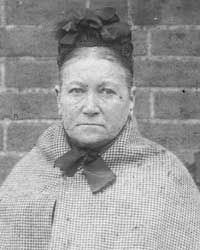
On 30 March 1896 a bargeman on the Thames at Reading pulled a parcel out of the water. Inside was the body of a baby girl, later identified as Helena Fry. The wrapping paper carried a faint name and address, and a label from Bristol Temple Meads station. Detective Constable James Anderson of the Reading Borough Police worked out the writing: a Mrs Thomas, of an address in Reading. The woman who lived there called herself Mrs Harding when she answered newspaper advertisements, and her real name was Amelia Dyer.
Dyer was born Amelia Hobley in 1837 at Pyle Marsh, near Bristol, the daughter of a shoemaker. She trained as a nurse, and after her first husband died she turned to baby farming, the Victorian trade of taking in children born outside marriage in return for a fee. Since 1834 the Poor Law had made it very hard for unmarried mothers to claim support from the fathers, and many could keep their jobs, and their names, only by giving their babies up. Some baby farmers cared for the children. Many did not. In 1879 Dyer served six months' hard labour after a doctor grew suspicious of how many children in her care had died.
She spent the following years moving between Bristol lodgings, workhouses and asylums, where she was admitted at least three times, after suicide attempts and violent episodes. Her daughter later testified that some of these crises followed visits from parents asking for their children back. Each time she returned to the trade, under a succession of names, advertising in the papers as a respectable married woman who would adopt a child for a single payment.
Evelina Marmon, a 25-year-old barmaid in Cheltenham, had a daughter, Doris, in January 1896. In March she answered an advertisement in the Bristol Times and Mirror and received warm letters from 'Mrs Harding' of 45 Kensington Road, Reading, who wrote that she and her husband were plain, homely people who longed for a little girl. Marmon wanted to pay weekly so that she could stay in touch; Harding insisted on £10 in advance. On 31 March Dyer collected the ten-week-old baby in Cheltenham. That night she arrived at her daughter's lodgings at 76 Mayo Road, Willesden, carrying a heavy carpet bag. The next day she collected a second child, 13-month-old Harry Simmons, at Paddington station. Neither baby left the house alive. On 2 April she took the carpet bag back to Reading.
Police, now watching the Kensington Road house, used a young woman as a decoy client, and Dyer was arrested in the first days of April. Inside they found baby clothes, pawn tickets for children's clothing, white edging tape, telegrams about adoptions and letters from mothers asking how their children were. When the Thames was dragged, a labourer brought up the carpet bag on 10 April near the footbridge at Caversham; it held the bodies of Doris Marmon and Harry Simmons. Other infants were recovered from the river in the weeks that followed. On 11 April Evelina Marmon identified her daughter.
Dyer was tried at the Old Bailey in May 1896 for the murder of Doris Marmon. Her defence was insanity, pointing to her asylum committals; the prosecution argued that her breakdowns had tended to arrive when discovery threatened. The jury took minutes to convict, and she was sentenced to death. In the condemned cell she wrote a long confession and insisted that her daughter and son-in-law had known nothing. She was hanged at Newgate by James Billington on 10 June 1896.
The victims
Doris Marmon was about ten weeks old. Her mother, Evelina, was a young barmaid in Cheltenham who meant to go back to work and one day reclaim her daughter; she travelled with 'Mrs Harding' as far as Gloucester to be with the baby a little longer, and wrote afterwards asking for news. She identified Doris in the mortuary at Reading on 11 April 1896 and gave evidence at the trial. Harry Simmons was thirteen months old, handed over at Paddington station on 1 April by a couple named Sargeant, together with a payment. Helena Fry, whose body was the first to be found, had also been placed in Dyer's care.
These three are only the children whose names reached the record. Police found evidence that some twenty children had passed through the hands of 'Mrs Thomas' in the months before her arrest alone, and Dyer had been in the trade for a quarter of a century. Most of the infants were born to working women, servants, governesses and barmaids, who paid what they could in the belief that their children were going to a better home.
Timeline
Amelia Hobley is born at Pyle Marsh, near Bristol.
Dyer is sentenced to six months' hard labour after a doctor reports the deaths of children in her care.
The first of several committals to asylums in Gloucester and Wells, which continue until 1894.
Doris Marmon is born in Cheltenham to Evelina Marmon.
A bargeman recovers the body of Helena Fry from the Thames at Reading.
Posing as Mrs Harding, Dyer collects Doris Marmon in Cheltenham and takes her to Mayo Road, Willesden.
Dyer collects Harry Simmons at Paddington station.
Dyer travels back to Reading with a weighted carpet bag.
Police arrest Dyer at 45 Kensington Road, Reading, after using a decoy client.
The carpet bag holding Doris Marmon and Harry Simmons is dragged from the Thames at Caversham.
Dyer is tried at the Old Bailey for the murder of Doris Marmon, convicted and sentenced to death.
Amelia Dyer is hanged at Newgate Prison.
People in the case
-
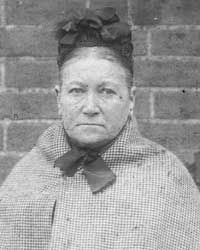
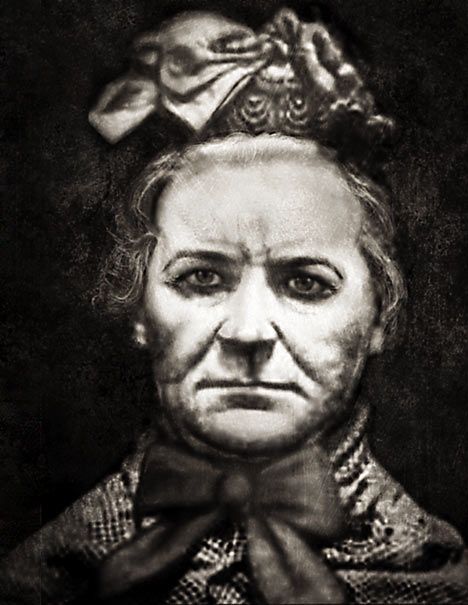
Amelia Dyer Perpetrator
27 November 1837 – 10 June 1896
Former nurse and baby farmer who used many aliases; convicted of murdering Doris Marmon and hanged at Newgate.
-
Doris Marmon Victim
January 1896 – ?
Infant daughter of Evelina Marmon, handed to Dyer on 31 March 1896 and killed at Mayo Road, Willesden, that night or soon after.
-
Harry Simmons Victim
? – 1 April 1896
Thirteen-month-old boy handed to Dyer at Paddington station on 1 April 1896.
-
Helena Fry Victim
Baby girl whose body, recovered from the Thames on 30 March 1896, led police to Dyer.
-
Evelina Marmon Witness
Doris's mother, a barmaid in Cheltenham, aged about 25 in 1896; she identified her daughter's body and testified at the Old Bailey.
-
Mary Ann Palmer Witness
Dyer's daughter, known as Polly; charges against her were dropped and she gave evidence at the trial.
-
James Anderson Investigator
Detective Constable of Reading Borough Police who traced the wrapping paper to Dyer.
-
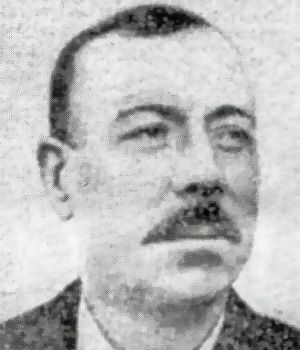
James Billington Also involved
1847 – 13 December 1901
Hangman who carried out Dyer's execution at Newgate.
Where it happened
- 45 Kensington Road, Reading. Dyer's home at the time of her arrest. Coordinates are for the present-day address; house numbering may have changed.
- Mayo Road, Willesden. Street where Dyer's daughter lodged at number 76 and where the two babies were killed. Coordinates are for the street.
- Caversham Lock, River Thames. Stretch of the Thames near the weir and footbridge at Caversham where the carpet bag was recovered.
- Newgate Prison, London. Where Dyer was hanged on 10 June 1896; demolished in 1904 and replaced by the Central Criminal Court.
Outcome
Executed Convicted and executed
Dyer was indicted at the Central Criminal Court (the Old Bailey) for the wilful murder of Doris Marmon. Her counsel argued insanity, but the jury convicted her after a very short retirement and she was sentenced to death. She was hanged at Newgate on 10 June 1896. Her son-in-law Arthur Palmer, charged as an accessory, was discharged, and the charge against her daughter was dropped.
What the record settles, and what it doesn't
Established
- Amelia Dyer took in infants for payment over many years, using a series of aliases and advertising as a respectable married woman.
- She had served six months' hard labour in 1879 after deaths of children in her care, and was committed to asylums several times in the 1890s.
- She collected Doris Marmon in Cheltenham on 31 March 1896 for a fee of £10, and Harry Simmons at Paddington on 1 April.
- The bodies of both children were recovered from the Thames at Caversham in a carpet bag on 10 April 1896.
- Wrapping paper on an earlier body, Helena Fry's, led Reading police to Dyer's house.
- She was convicted at the Old Bailey of murdering Doris Marmon and hanged at Newgate on 10 June 1896.
Disputed
- How many children Dyer killed: she was tried for one murder, several more bodies were recovered, and estimates of the total over her career range from a few dozen to the hundreds sometimes claimed.
- Whether her mental illness was genuine or partly feigned: her daughter described real suicide attempts and violent episodes, while the prosecution argued her committals were timed to escape scrutiny.
- The exact date of her arrest, given in different accounts as 3 or 4 April 1896.
- How much her daughter and son-in-law knew: both were cleared, and Dyer's written confession insisted they were innocent, but some later writers have doubted it.
In the newspapers of the day
Clippings from American newspapers digitised by the Library of Congress. The excerpt under each is the library's machine-read text, uncorrected; read the original page for the full report.
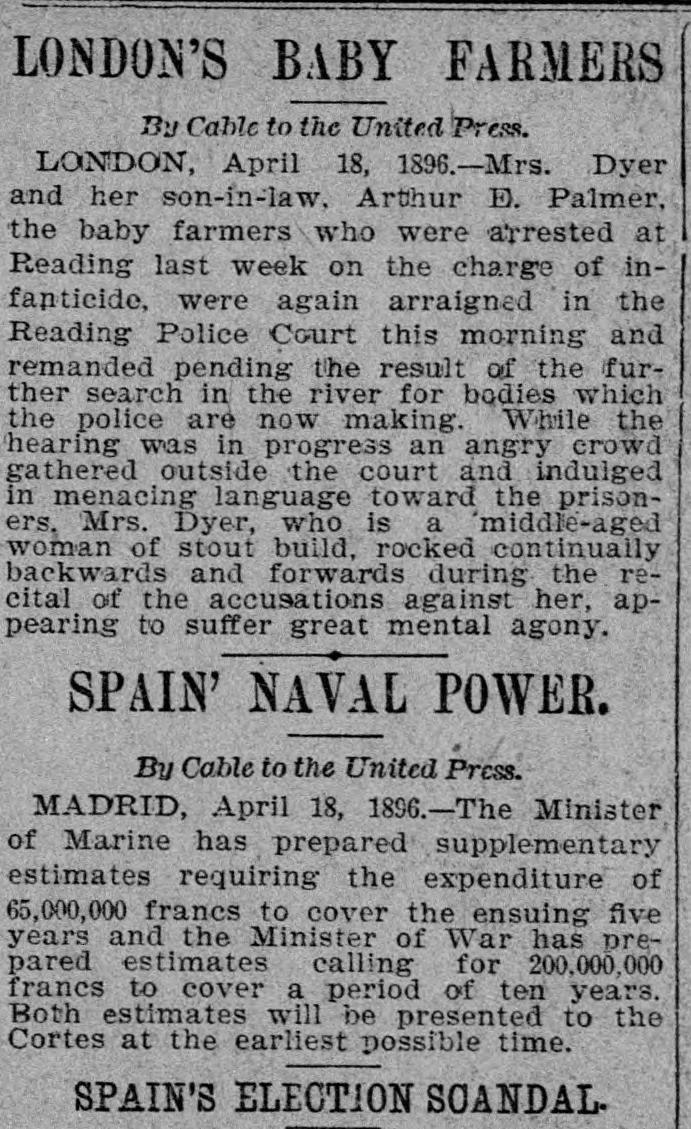
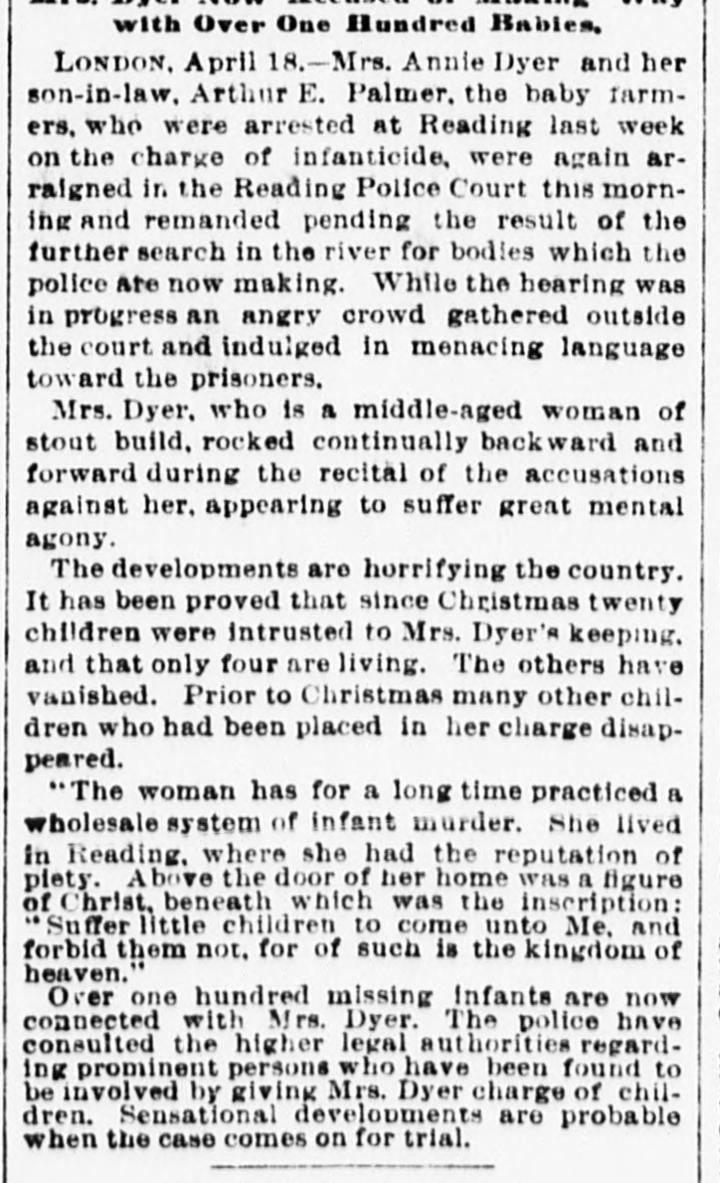
The jersey city news (Jersey City [N.J.])
, page 1 · Bodies in the Thames at Reading
LONDON’S BABY FARMERS Tt'j Cable to the United Cress. LONDON, April 18, 1896.—Mrs. Dyer ind her son-in-law. Arthur D. Palmer, :he baby farmers who were a*rrested at Reading last week on the charge of in- :an ticido, were again arraigned in the Reading Police Court this morning and •emanded pending the result otf the fur- :her search in the river for …
The sun (New York [N.Y.])
, page 1 · Bodies in the Thames at Reading
snnlnlaw Arthur E Palmer time baby farm el who acre aricMcd at Heading last week on time charge of Infanticide were nznln ar- raigned Ir the Heading Pollen Court this morn Ihl amid remanded pending the result of the I further search In the river for …
Rock island argus (Rock Island, Ill.)
, page 3 · Bodies in the Thames at Reading
Farmer Norman's had made hint amia- ble, or whether. Anally, he was cowed by his slimy prison, certain it is he was as decile as possible. Colonel Orniond rode close behind M. Crosby. Ho rolled another log up for the bear, and tbo bear clambered on it, after a deal of struggling and pull- ing. Safe on the shore he put his head down aiiU followed the horses like a dog. When they took the bear away not before, you may be sure, tho same kindly log had bridged the mud for the bear's follow prisoners Claude called trat warmly : "Thank you. Mist' Good Bear. I wish yon well, sir." Later in the day he told Mr. Crosby and Colonel Orniond the whole story", while Mr. Crosby told Claude how they lia1 safely returned Mr. Good Bear to his circus home. " "Did ha ben lost?" inquired Clande. with deep sympathy. "Pore Mist' Good Bear!" "Yes." Mr. Crosby answered, "he was lost, and the circus people felt so bad that they offered a reward of $50 for his capture . unhurt. Aud Colonel Orniond and I" here he took a bank note out of his purse and turned to Mrs. Wild who had been all this while in a state of extraordinary agitation, at one moment sobbing over the children's peril, at another hugging Jhem into a smothered bunch together because they had been so good "Colonel Orniond and I, madam, are convinced that your boy caught the bear really, and should have the reward. Because if he had not kept the brute in tho mud, ho was mak- ing for the river, which most probably he would have swum, and there is uo knowing where he would have stopped or how many people he ' would have killed. ' So hero is the money and our congratulations on ycwrave-"little jon."-Jiwao j ' It was of no use for Mrs. Wild to pro- test Tliey were determined, and at last the yielded with tears of gratitude. But 3no thing the mother could not holp laying "Evangeline done well, too," iho replied to Colonel Ormond's praises of Claude. "Me good now !" Baby Sister agreed, railing sweetly. Claude aiso had his own littlo com- ment: "Say. Mist Crosby," he inter- posed eagerly at the first pause, "the bear ho wouldn't have hurted nary. He ben the good bearl" Who knows? Perhaps he was. In any event, Claude has no doubts. He is busy at present collecting a store of walnuts and pecans against the next coming of the circus, when he hopes to see his friend and prefect his gifts. " 'Cause I love Mist' Good Boar!' says Claude. THE END. A Valuable Preaertptloo. Editor Morrison, of the Worthing- ton, Ind., Son, writes: "Ton have a valuable prescription in Electric Bitters, and I can cheerfully recom. mend it for constipation and sick headache, and as a general system tonic it has no equal." Mrs. Annie Stehle, 2625 Cottage Grove avenue. Chicago, was all ran down, could not eat nor digest food, bad a back- ache which never left her and felt tired and weary, bat six bottles of r.lcctric Bitters restored ner health and renewed her strength. Price 50 cents and f 1. bet s- bottle at Hartz dt Ullemeycrs drae store. Foley ' Sarsaparilla combines the most searching remedies scientific ally prepared to extract their utmost value. U yon need a spring …
San antonio daily light (San Antonio, Tex.)
, page 5 · Trial and execution of the baby farmer
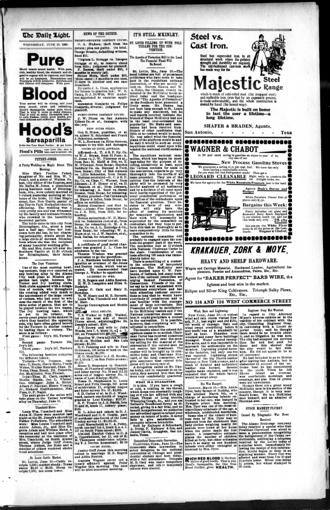
She Was Hanged. London, March 10. —Mrs. Annie Dyer, baby farmer of Ruddig, who was arrested March 9th, on a charge of murdering Infante en- trusted to her care, was hanged In Newgate prison thia morning. Mrs. Dyer was one of the most ex- traordinary criminals of the age, a wholesale …
The democratic advocate (Westminster, Md.)
, page 2 · Trial and execution of the baby farmer
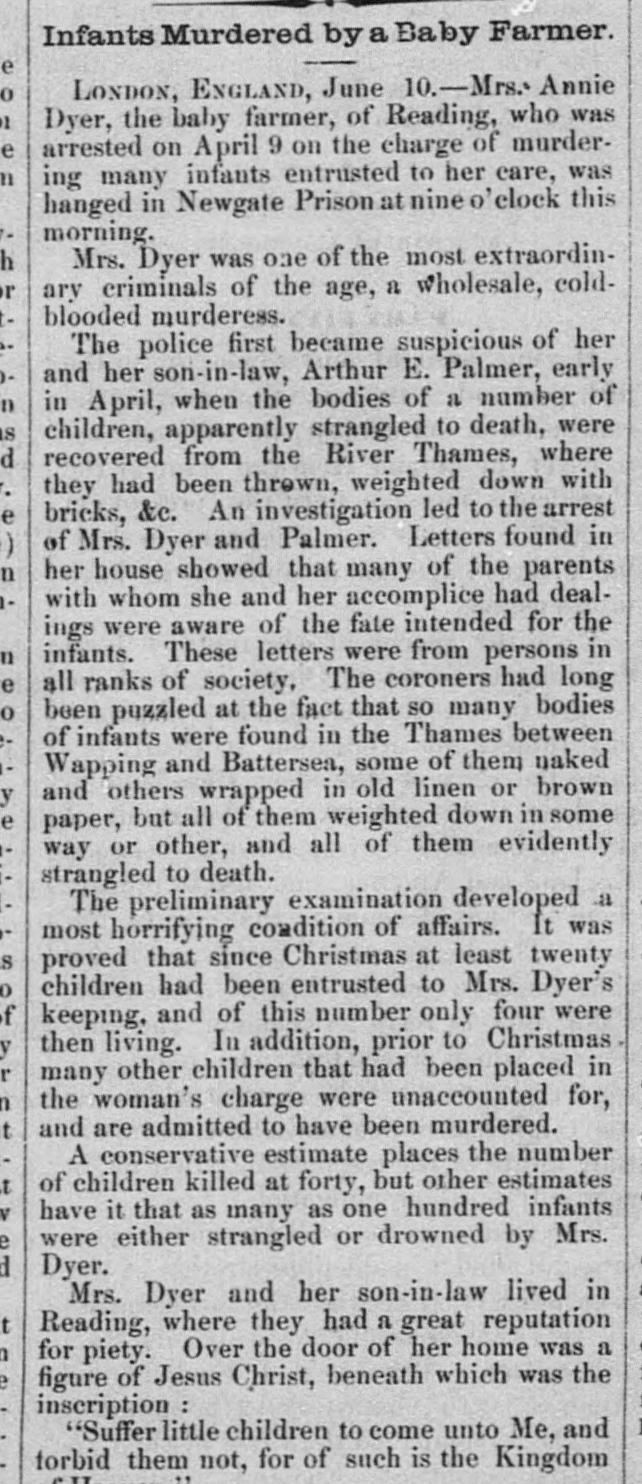
Dyer, the baby farmer, of Reading, who was arrested on A|ril 9on the charge of murder- ing many infants entrusted to her care, was hanged in Newgate Prison at nine o’clock this morning. Mrs. Dyer was one of the most extraordin- ary criminals of the age, a wholesale, cold …
Eagle river democrat (Eagle River, Vilas County, Wis.)
, page 3 · Trial and execution of the baby farmer
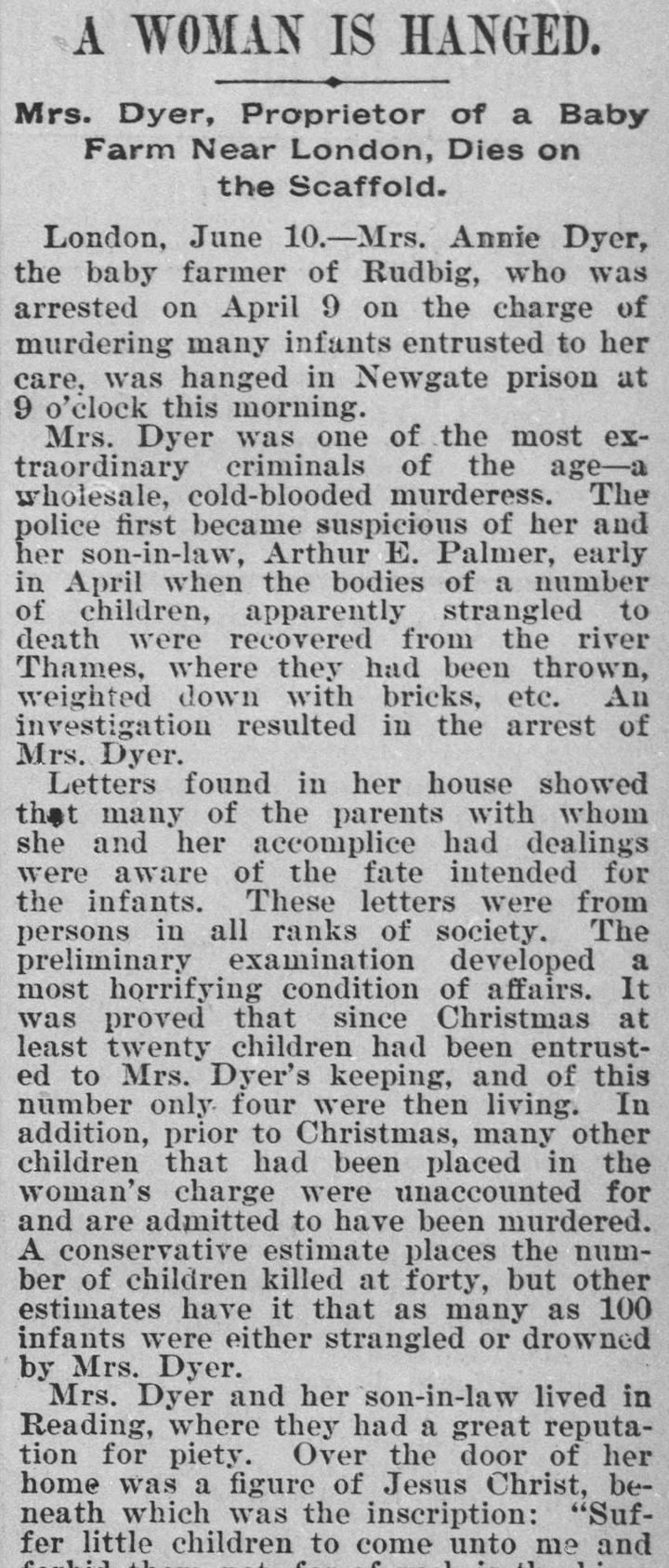
Mrs. Dyer, Proprietor of a Baby Farm Near London, Dies on the Scaffold. London, June 10.—Mrs. Annie Dyer, the baby farmer of Rudbig, who was arrested on April 9 on the charge of murdering many infants entrusted to her care, was hanged in Newgate prison at 9 o’clock this morning. Mrs. Dyer was one of the most ex- traordinary ecriminals of the age—a wholesale …
Source: Chronicling America: Historic American Newspapers, Library of Congress. Public domain.
Pictures


Afterwards
The case caused a national scandal and strengthened the campaign for regulation of adoption and child-minding. The Infant Life Protection Act 1897 tightened the registration of those who took in children for payment, though baby farming did not end, and the young National Society for the Prevention of Cruelty to Children gained public weight from the case.
Dyer was called the 'Ogress of Reading' in the press and in a street ballad. She is often described as one of the most prolific killers in British history, though only one murder was proved in court. Because she was active in 1888, she has occasionally been suggested as a Jack the Ripper suspect, a theory with no supporting evidence.
Questions readers ask
How many babies did Amelia Dyer kill?
She was convicted of one murder, that of Doris Marmon, and several other infants' bodies were recovered from the Thames in 1896. Her total over nearly thirty years is unknown; it is often put at well over a hundred, but that figure cannot be proved.
What was baby farming?
The Victorian practice of taking in infants, usually born outside marriage, in return for a weekly payment or a single lump sum. Some baby farmers cared for the children, but lump-sum arrangements gave an incentive to neglect or kill them.
How was Amelia Dyer caught?
A baby's body recovered from the Thames at Reading was wrapped in paper bearing a faint name and address. Reading police traced it to Dyer and arrested her using a young woman posing as a client.
When was Amelia Dyer hanged?
She was hanged at Newgate Prison in London on 10 June 1896, aged 58.
Sources and further reading
- Amelia Dyer (Wikipedia)
- Trial of Amelia Elizabeth Dyer, May 1896 (Old Bailey Proceedings Online, t18960518-451)
- Amelia Dyer (Wikidata)
- Wikidata Q660912 (life dates checked here)
Written by Sinister Crimes from the sources above; see our editorial standards. Last checked 1 November 2026.