

The case
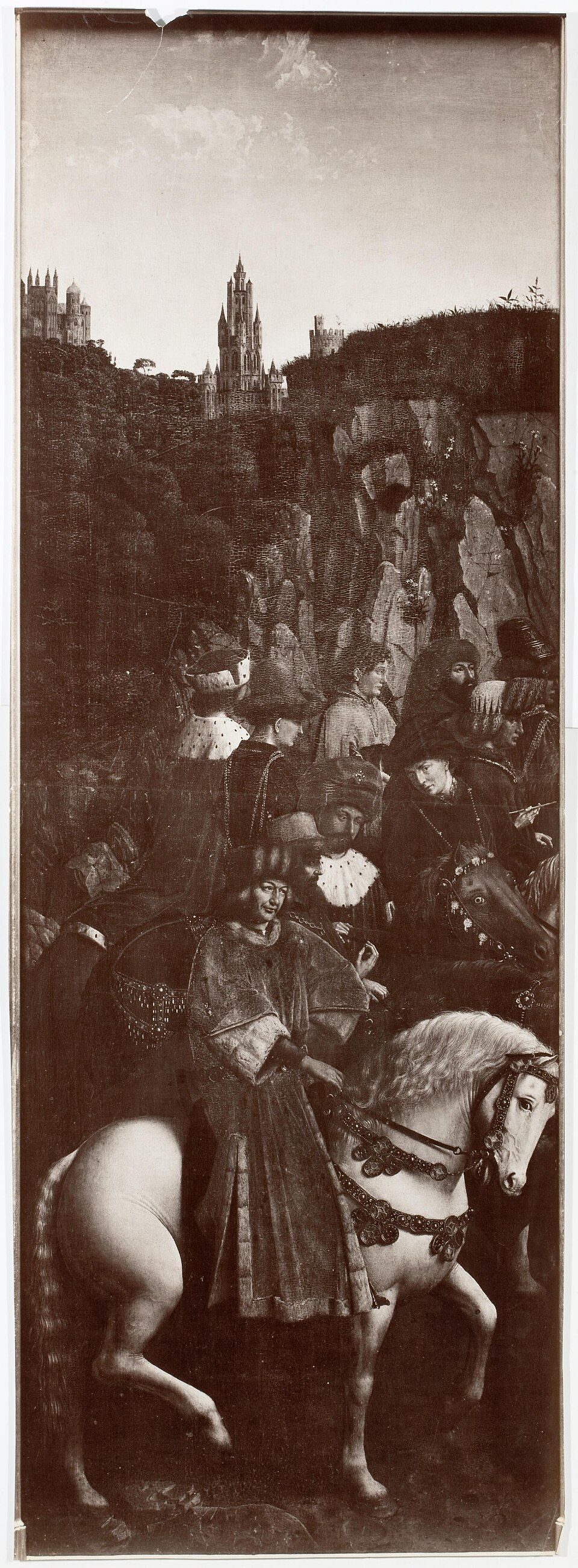
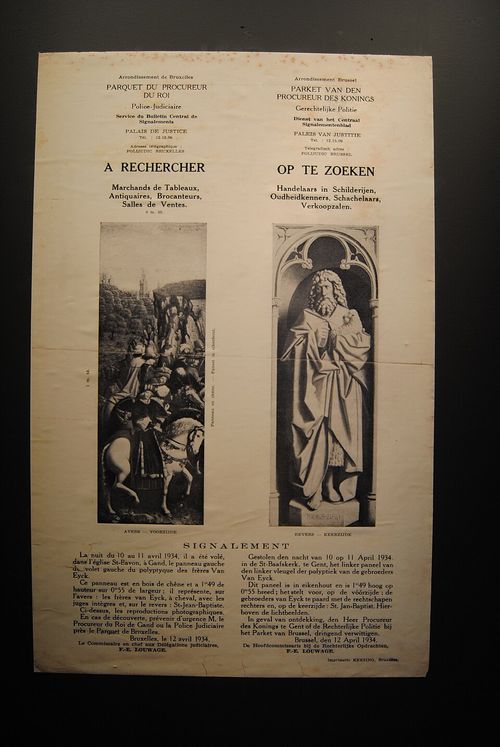
On the morning of 11 April 1934 Ghent discovered a gap in the most famous painting in Belgium. The lower left wing of Jan and Hubert van Eyck's Adoration of the Mystic Lamb, finished in 1432, had been taken out of its frame during the night. The thief had removed the panel cleanly, without harming its neighbours, and tucked a note into the empty space in French: 'Taken from Germany by the Treaty of Versailles.'
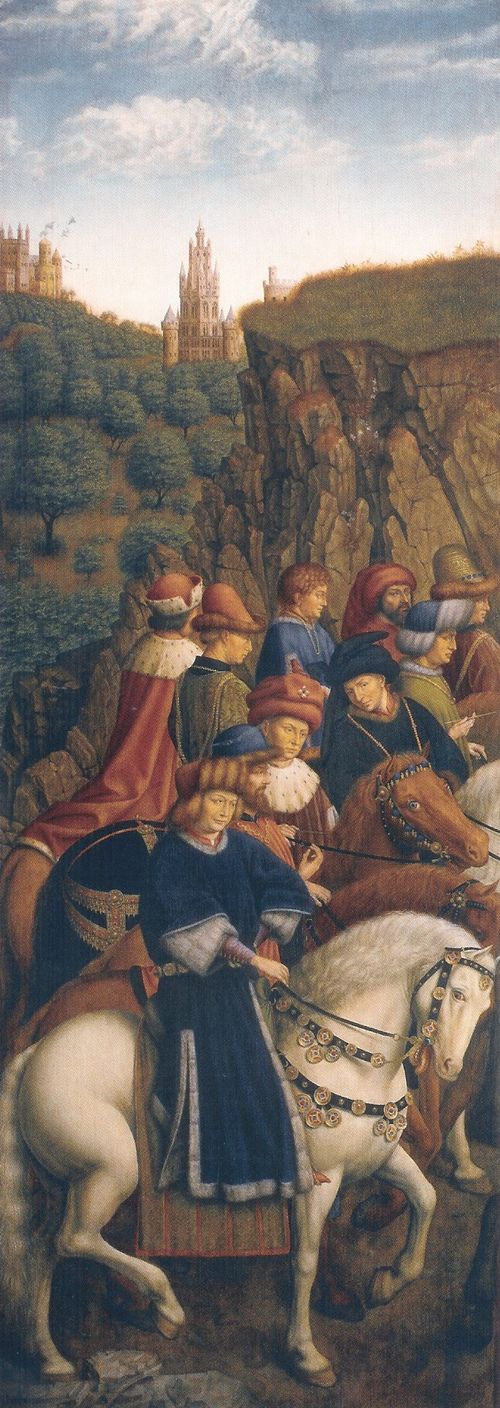
The panel was double-sided. Its front showed the Just Judges, a company of richly dressed riders approaching the Lamb; its back, seen when the altarpiece was closed, showed Saint John the Baptist painted in grey monochrome. The note was a deliberate jab. Several wings of the altarpiece had been sold to a Prussian collector in the nineteenth century, and the Treaty of Versailles had obliged Germany to return them in 1920 as reparation. Many Germans resented it, and the message seemed designed to point suspicion their way.
About three weeks later the Bishop of Ghent received the first of a series of anonymous letters signed 'D.U.A.', demanding one million Belgian francs. The government, which considered the painting a national treasure, refused to pay the full sum, but negotiations dragged on into October, with at least eleven letters passing between the extortionist and the authorities. To show good faith, the writer told the authorities how to collect a parcel from the left-luggage office at Brussels-North station. It held the Saint John the Baptist grisaille, the reverse half of the stolen panel. The Just Judges stayed hidden. At one stage a priest in Antwerp was used as a go-between and a part payment of 25,000 francs was handed over, but the talks broke down.
On 25 November 1934 Arsène Goedertier, a 57-year-old stockbroker from Wetteren and a former church sacristan, suffered a heart attack in Dendermonde. As he lay dying he told his lawyer that he alone knew where the Mystic Lamb was, and that the papers were in a drawer of his desk. He died before he could say more. In the desk the lawyer found carbon copies of the D.U.A. letters and an unsent final letter saying the panel was hidden where neither the writer nor anyone else could remove it without attracting public attention. The lawyer did not tell the police for about a month.
The investigators concluded that Goedertier was the extortionist and very probably the thief. No one was ever charged. Many writers have doubted that he could have done it alone. He was a small, middle-aged man who was said to see badly in the dark, and lifting a heavy oak panel down from a high altarpiece in an unlit cathedral and getting it out unseen looks like a job for more than one person, perhaps with help from inside the building. Who those helpers might have been has never been established.
The search has never really stopped. The cathedral has been X-rayed, walls and tombs have been opened, a car park floor in Ghent was dug up in 2008 on a tip, and amateur sleuths have pointed to dozens of hiding places, many of them based on readings of Goedertier's letters and sketches. The panel has not been found, and some believe it was destroyed long ago. In its place hangs a copy made by the restorer Jef Van der Veken, who gave one of the riders the face of King Leopold III so that no one would ever mistake it for the original.
Timeline
The Ghent Altarpiece is completed for the Vijd chapel of the church now known as Saint Bavo's Cathedral.
Under the Treaty of Versailles, Germany returns the wings of the altarpiece held in Berlin.
During the night of 10 to 11 April the Just Judges panel, with Saint John the Baptist on its reverse, is stolen from the cathedral.
The theft is discovered, along with a note referring to the Treaty of Versailles.
The Bishop of Ghent receives the first ransom letter, signed D.U.A., demanding one million Belgian francs.
As a sign of good faith, the extortionist leads the authorities to the Saint John the Baptist grisaille in the left-luggage office at Brussels-North station.
Correspondence between the extortionist and the authorities breaks off without agreement.
Arsène Goedertier dies in Dendermonde after a heart attack, telling his lawyer he alone knows where the panel is.
Goedertier's lawyer tells police about the deathbed words and the copies of the ransom letters.
Jef Van der Veken's copy of the Just Judges is installed in the altarpiece, by the most commonly cited date.
People in the case
-
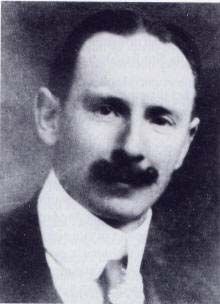
Arsène Goedertier Suspect
23 December 1876 – 25 November 1934
Stockbroker from Wetteren and former sacristan; the ransom letters were found in his desk after his death, and police concluded he was the thief. Never charged, as he died before suspicion fell on him.
-
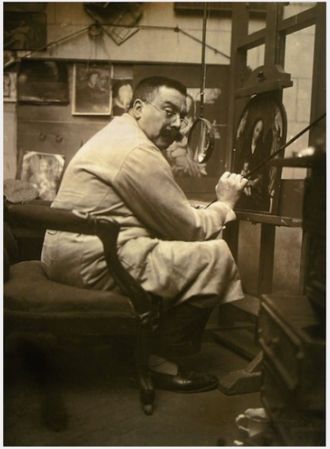
Jef Van der Veken Also involved
4 April 1872 – 1964
Belgian restorer and copyist who painted the replacement Just Judges panel now in the altarpiece.
-
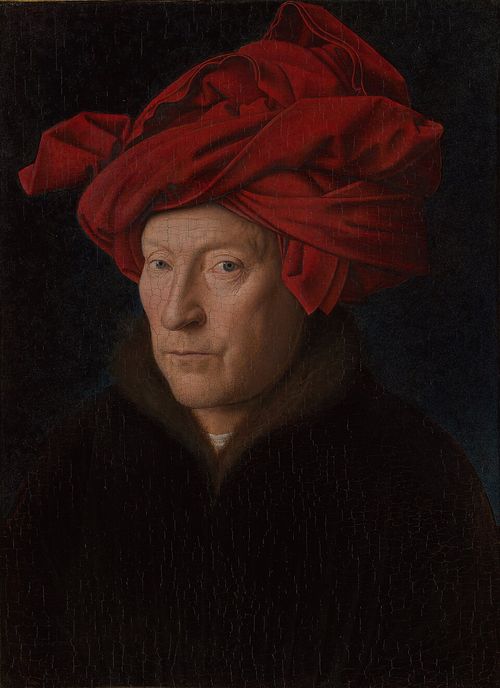
Jan van Eyck Also involved
? – 1441
Painter of the Ghent Altarpiece with his brother Hubert; the work was completed in 1432. The Just Judges may include portraits of the brothers.
Where it happened
- Saint Bavo's Cathedral, Ghent. Home of the Ghent Altarpiece, from which the panel was taken.
- Wetteren. Town where Goedertier lived; he had been sacristan of its church of Saint Gertrude.
- Dendermonde. Where Goedertier collapsed and died on 25 November 1934.
Outcome
Unsolved Unsolved
No one was charged. Police concluded that Arsène Goedertier, who died on 25 November 1934, was the author of the ransom letters and probably the thief, but his death ended any prosecution. The Saint John the Baptist half of the panel was returned in 1934; the Just Judges has never been recovered.
What the record settles, and what it doesn't
Established
- The Just Judges panel of the Ghent Altarpiece was stolen from Saint Bavo's Cathedral during the night of 10 to 11 April 1934.
- A note in French referring to the Treaty of Versailles was left in the empty frame.
- The Bishop of Ghent received ransom letters signed 'D.U.A.' demanding one million Belgian francs, and negotiations failed.
- The Saint John the Baptist grisaille from the back of the panel was returned through the left-luggage office at Brussels-North station.
- Copies of the ransom letters were found in the desk of Arsène Goedertier after his death on 25 November 1934.
- The Just Judges has never been found; a copy by Jef Van der Veken hangs in its place.
Disputed
- Whether Goedertier was the thief: police concluded he was, but many researchers think he could not physically have removed the panel alone and may have been only the extortionist, or a front for others.
- Who his accomplices were: theories range from a cathedral insider or a cleric to prominent Ghent families and politicians; none has been substantiated.
- Whether the papers in his desk were genuine: some have suggested they were planted after his death to make him a scapegoat, though most accounts treat them as his.
- Whether the panel survives: some believe it is hidden in a church or private collection in Flanders, others that it was destroyed decades ago.
- When the replacement was installed: some sources date Van der Veken's copy to 1941, others to 1945.
Pictures




Afterwards
The rest of the altarpiece had a dramatic war. Sent towards the Vatican for safety in 1940, it was stranded in France, seized on Hitler's orders in 1942, and stored in the Altaussee salt mine in Austria until Allied art officers recovered it in 1945. It came home without its Just Judges, and Van der Veken's copy has filled the gap ever since, the face of Leopold III hidden among the riders as a signature.
In Belgium the case became a national puzzle. Generations of amateur investigators have studied Goedertier's letters for coded clues, and every few years a new theory produces a dig, a radar survey or a broken-open wall. The Ghent police kept a file open on it for decades, and the missing panel has become as much a part of the altarpiece's fame as anything van Eyck painted.
Questions readers ask
Was the Just Judges panel ever found?
No. The Saint John the Baptist side of the panel was returned in 1934 as a goodwill gesture, but the Just Judges has never been recovered.
Who stole the Ghent Altarpiece panel?
Police concluded it was Arsène Goedertier, a stockbroker from Wetteren whose desk held copies of the ransom letters after his death in November 1934. He was never charged, and many researchers believe he had help.
Is the Just Judges panel in Ghent a copy?
Yes. The panel now in the altarpiece is a copy by the Belgian restorer Jef Van der Veken, who painted one of the riders with the face of King Leopold III.
Sources and further reading
- The Just Judges (Wikipedia)
- De rechtvaardige rechters (paneel) (Dutch Wikipedia)
- Arsène Goedertier (Dutch Wikipedia)
- The adventures of the Ghent Altarpiece (Visit Gent)
- Ghent Altarpiece (Wikipedia)
- Wikidata Q2157202 (life dates checked here)
Written by Sinister Crimes from the sources above; see our editorial standards. Last checked 1 November 2026.