

The case
The parcel that reached Max Mayer's office at 88 Hatton Garden on 16 July 1913 looked exactly as it should: brown paper, string, and his own 'MM' monogram pressed into the wax seals. Inside the box, where a necklace of 61 matched pink pearls should have been, there were lumps of sugar. Mayer, a London pearl dealer, had sent the necklace to Paris in the hope of a sale. When none came, his agent Henri Salomans wrapped it with great care and sent it back by registered post, as dealers routinely did. Somewhere on the way, someone had opened the parcel, emptied it, and sealed it up again with forged seals.
The necklace had taken about ten years to assemble, pearl by matched pearl, and had a reputation as the finest in the world. Mayer had insured it at Lloyd's for £135,000, and the loss became the largest jewellery claim the market had faced. Lloyd's assessors, Price and Gibbs, put up a £10,000 reward and hired Alfred Leach, a retired Hatton Garden police superintendent, to work alongside Chief Inspector Alfred Ward of Scotland Yard.
The answer came from the trade itself. In Antwerp, a London diamond dealer named Leiser Gutwirth dropped hints to a distant relative, the dealer Samuel Brandstatter, about a very large deal he had in hand. Brandstatter connected the hints with the reward notices and wrote back claiming to have a buyer, bringing in his cousin Myer Quadratstein to play the part. In London in mid-August the two men were taken to meet Gutwirth's associates: Simon Silverman, a diamond broker; James Lockett, a jeweller and seasoned burglar; and Joseph Grizzard, a dealer known to every detective in Hatton Garden as the city's most accomplished receiver of stolen jewels.
Grizzard liked theatre. At a tea shop in Holborn he asked Lockett for a match, and Lockett tossed a matchbox onto the table. Inside were three of the pearls. The visitors weighed them against the figures on the reward notice, then went to the Lloyd's assessors. Over the following days, at meetings watched by detectives, a Paris pearl merchant brought in as a further buyer paid for two pearls with marked notes. Grizzard grew uneasy and the meetings stalled, but on 2 September police arrested Grizzard, Lockett and Silverman at Chancery Lane Underground station and Gutwirth at his office. None of them had the necklace.
It turned up two weeks later in a gutter in Highbury. Augustus Horne, a piano-maker, picked up a small parcel with a matchbox inside full of what he took to be imitation pearls. He handed them in at a police station, where they were booked as glass beads before Mayer identified them. One pearl went astray on the way and, by Horne's later account, he found it in his pocket, failed to swap it for a drink, and threw it back in the gutter. Apart from that pearl and the two already bought by the trap, the necklace was complete. The thieves had evidently dumped it once they knew they were watched.
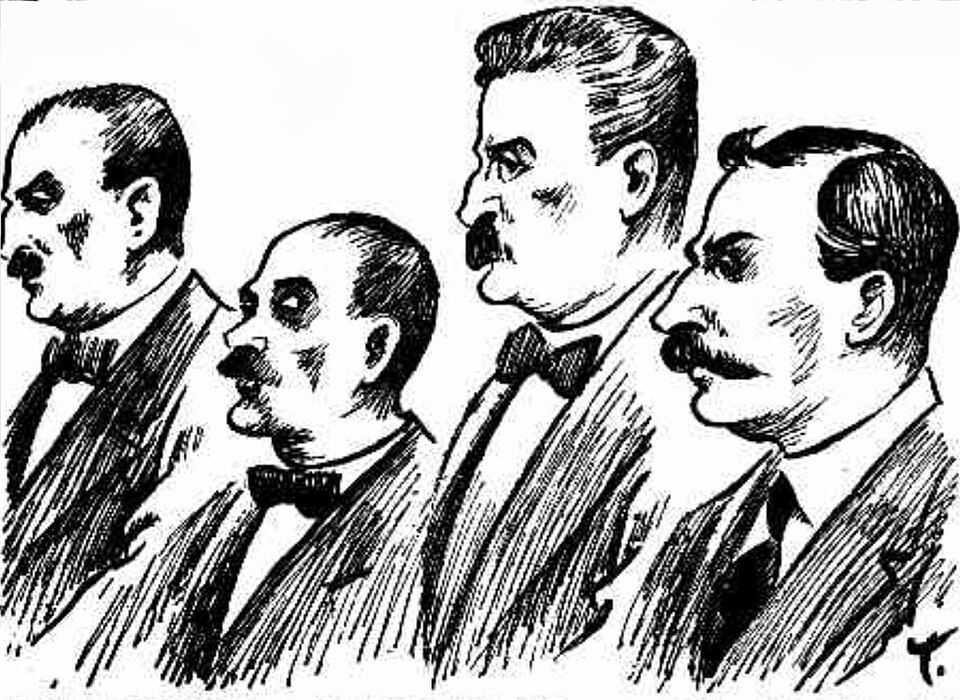
The four men were tried at the Old Bailey in November 1913, prosecuted by Richard Muir. The jury convicted them all. Grizzard and Lockett were sentenced to seven years' penal servitude, Silverman to five years, and Gutwirth to eighteen months' hard labour. A fifth man arrested with them, an elderly acquaintance named James McCarthy, was acquitted.
Who lost out
No one was harmed. The loss fell on Max Mayer, the Hatton Garden pearl dealer who owned the necklace, and on the Lloyd's underwriters who had insured it for £135,000; most of the pearls came back, and the underwriters paid out far less than they had feared.
Timeline
Mayer's agent in Paris, Henri Salomans, posts the unsold necklace back to London by registered mail.
The parcel reaches Mayer at 88 Hatton Garden with its seals apparently intact; the necklace has been replaced with sugar lumps.
Lloyd's assessors offer a £10,000 reward and engage the retired superintendent Alfred Leach alongside Scotland Yard.
Brandstatter and Quadratstein, posing as buyers, are introduced to Gutwirth, Silverman and Grizzard in London.
At a Holborn tea shop Grizzard produces three of the pearls in a matchbox; two pearls are later bought with marked notes.
Grizzard, Lockett and Silverman are arrested at Chancery Lane Underground station and Gutwirth at his office.
Augustus Horne finds the remaining pearls in a matchbox in a Highbury gutter and hands them to police.
At the Old Bailey all four are convicted; Grizzard and Lockett receive seven years, Silverman five years and Gutwirth eighteen months.
People in the case
-
Joseph Grizzard Perpetrator
1867 – ?
London jewel dealer and notorious receiver, known as 'Cammi'; organised the theft and was sentenced to seven years' penal servitude.
-
James Lockett Perpetrator
Jeweller and burglar, Grizzard's chief partner; sentenced to seven years' penal servitude.
-
Simon Silverman Perpetrator
Vienna-born diamond broker; sentenced to five years' penal servitude.
-
Leiser Gutwirth Perpetrator
Kraków-born dealer in precious stones, settled in London since 1893; his hints in Antwerp exposed the gang. Sentenced to eighteen months' hard labour.
-
Max Mayer Victim
Hatton Garden pearl dealer who owned the necklace and insured it at Lloyd's.
-
Alfred Ward Investigator
Scotland Yard chief inspector in charge of the case.
-
Augustus Horne Witness
Piano-maker who found the discarded pearls in a Highbury gutter and handed them to the police.
-
Richard Muir Prosecutor
1857 – 1924
Leading Crown prosecutor who conducted the case at the Old Bailey.
Where it happened
- Hatton Garden. London's jewellery quarter; Mayer's office was at No. 88 and the gang rented an office nearby.
- Chancery Lane Underground station. Where three of the gang were arrested on 2 September 1913.
- Highbury. District of north London where the discarded pearls were found in a gutter.
- Old Bailey. Central Criminal Court, where the gang was tried in November 1913.
Outcome
Convicted Convicted
Joseph Grizzard, James Lockett, Simon Silverman and Leiser Gutwirth were tried at the Old Bailey in November 1913 and convicted. Grizzard and Lockett were sentenced to seven years' penal servitude, Silverman to five years, and Gutwirth to eighteen months' hard labour. James McCarthy, arrested with them, was acquitted.
What the record settles, and what it doesn't
Established
- A necklace of 61 pearls belonging to the London dealer Max Mayer was stolen from a registered parcel posted from Paris and delivered to Hatton Garden on 16 July 1913.
- The parcel had been opened and resealed with forged copies of Mayer's seals, and the pearls replaced with sugar lumps.
- The necklace was insured at Lloyd's for £135,000, and the underwriters offered a £10,000 reward.
- Two dealers posing as buyers met the gang in London, and Grizzard showed them pearls from the necklace.
- Grizzard, Lockett, Silverman and Gutwirth were arrested on 2 September 1913 and convicted at the Old Bailey that November.
- Most of the pearls were found in a Highbury gutter by Augustus Horne about two weeks after the arrests.
Disputed
- How the parcel was intercepted: one account says the gang bribed the postman on Mayer's round and opened the parcel in an office they had rented in Hatton Garden; no postal worker was convicted, and the exact route of the switch was never fully set out in court.
- The stray pearl: a popular version has Horne giving one pearl to a child as a marble; contemporary press reports and the account of a detective on the case say instead that it fell into his pocket and he threw it away after failing to trade it for a drink.
- The value of the necklace: figures from £123,000 to £150,000 appear, depending on whether the source gives the purchase price, the insured sum or the asking price in Paris.
- The date of the verdict: sources agree on November 1913, but the exact day is not given consistently.
Afterwards
The pearls went back to Mayer, and Lloyd's rang the Lutine Bell, the traditional signal of news, to mark their recovery. Lloyd's paid out a reward, though far less than the full insured sum it had feared to lose. A full account of the case, built from the trial record, was published in 1929.
The case is remembered as Hatton Garden's first great theft, a century before the safe-deposit burglary of 2015 gave the street a second. It survives in the Metropolitan Police's Crime Museum, which holds three of the forged seals, and as a textbook example of a crime solved not by forensic work but by gossip in the diamond trade.
Questions readers ask
What was stolen in the Great Pearl Robbery?
A necklace of 61 matched pink pearls belonging to the London dealer Max Mayer, insured at Lloyd's for £135,000. It was taken from a registered parcel posted from Paris in July 1913.
Were the pearls recovered?
Almost all of them. Two were bought back during the police trap, and the rest were found in a matchbox in a Highbury gutter in September 1913, except for a single pearl that went astray.
Who was Joseph Grizzard?
A London jewel dealer, known as 'Cammi', with a long reputation as the leading receiver of stolen jewellery in Hatton Garden. He organised the theft and was sentenced to seven years' penal servitude.
Sources and further reading
- Great Pearl Robbery (Wikipedia)
- The Great Pearl Robbery (Lloyd's)
- History Feature (Insurance Museum)
- Wikidata Q118905772 (life dates checked here)
Written by Sinister Crimes from the sources above; see our editorial standards. Last checked 1 November 2026.