

The case
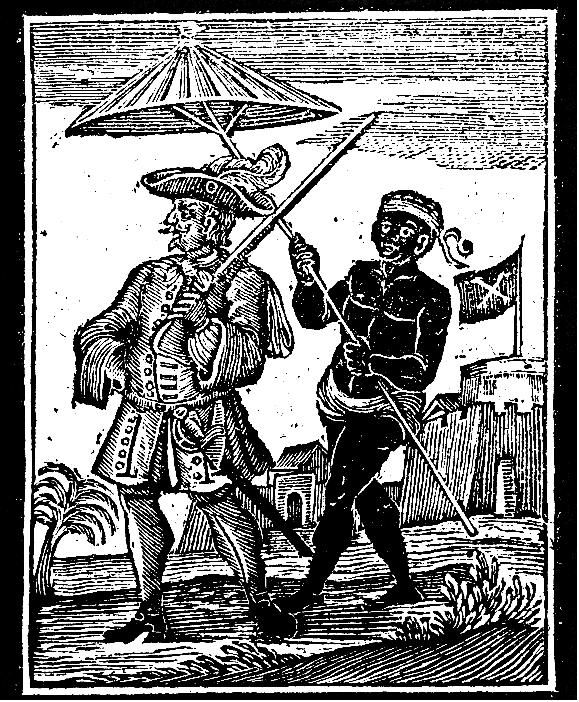
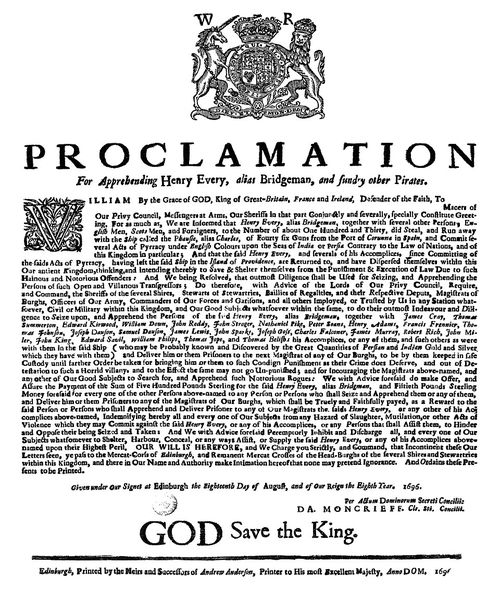
The last firm sighting of Henry Every is in Ireland in the summer of 1696, where he came ashore from a sloop with a few companions and a quantity of gold and jewels. After that he disappears. He was the most wanted man in the English-speaking world, with a reward of £1,000 on his head offered jointly by the Crown and the East India Company, and he was never found.
Every was a Devon seaman, probably born in 1659, with a background in the navy and the slave trade. In 1694 he was first mate of the Charles II, one of several English ships hired to serve Spain against French smugglers in the Caribbean. The squadron spent months idle at Corunna in northern Spain. The men's wages went unpaid and the promised Spanish commission did not arrive. On the night of 7 May 1694 Every and about two dozen others seized the ship while her captain lay ill, gave those who would not join them the chance to go ashore, and sailed out of the harbour.
They renamed her the Fancy and went south, raiding along the African coast and rounding the Cape into the Indian Ocean. At the island of Johanna in the Comoros in February 1695, Every wrote an open letter to English captains insisting he had harmed no English or Dutch ship and proposing a recognition signal. His real target lay further north: the annual fleet that carried pilgrims and trade between the Red Sea ports and Surat, the main port of the Mughal empire.
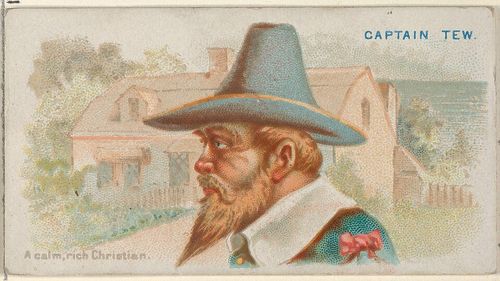
In August 1695 the Fancy joined several other pirate ships at the mouth of the Red Sea, among them Thomas Tew's Amity, and Every was chosen to lead them. The convoy slipped past in the dark, but the pirates gave chase. They first took the Fateh Muhammed, a large vessel belonging to a leading Surat merchant. Then, on 7 September, they caught the Ganj-i-Sawai, the emperor Aurangzeb's own ship, a huge vessel returning from Mocha with pilgrims, officials and treasure.
The Ganj-i-Sawai should have been able to defend herself. She carried dozens of guns and hundreds of armed men. But one of her own heavy guns exploded as the Fancy closed, killing many of the defenders and spreading fire and panic, and the pirates boarded and fought for two or three hours before she fell. What followed is described in Indian and East India Company sources as days of torture, rape and killing, as the pirates searched for valuables and assaulted women among the passengers. One of the pirates later spoke at his execution of barbarities he had committed. The loot ran to hundreds of thousands of pounds in gold, silver and jewels.
The consequences fell on other Englishmen. In Surat, crowds turned on the East India Company's people, and the Mughal governor confined them. Aurangzeb shut several Company trading posts and threatened to end English trade in India altogether. The Company agreed to compensate the losses, and in England the government declared Every and his crew enemies of all mankind and launched what has been called the first worldwide manhunt.
Every took the Fancy across to the Bahamas, where the governor of New Providence, Nicholas Trott, let in a captain calling himself Henry Bridgeman after a substantial bribe. The crew then scattered: some to the American colonies, others to Britain and Ireland. Two dozen were eventually caught. Every was not one of them.
The victims
The Ganj-i-Sawai, captained by Muhammad Ibrahim, carried several hundred passengers returning from the pilgrimage to Mecca and from trade at Mocha, along with her crew and guard. Contemporary Mughal and East India Company accounts describe pirates torturing captives to reveal hidden money and raping women aboard, and some women are said to have taken their own lives rather than submit. How many were killed is not recorded. The Fateh Muhammed, taken first, belonged to Abdul Ghaffar, said to be the wealthiest merchant in Surat. Beyond the ships, the English merchants and employees at Surat were imprisoned for months in the backlash.
Timeline
Every leads the mutiny aboard the Charles II at Corunna and the ship is renamed Fancy.
Every writes his open letter to English captains from Johanna in the Comoros.
Every joins Thomas Tew and other pirate captains at the mouth of the Red Sea.
The pirates capture the Ganj-i-Sawai after taking the Fateh Muhammed.
The Fancy reaches the Bahamas and Governor Nicholas Trott admits her crew.
Every lands in Ireland with a few companions and vanishes from the record.
Coxswain John Dann is arrested at Rochester, Kent.
Six of Every's crew are tried for piracy at the Old Bailey and acquitted.
The same men are retried for the mutiny and convicted.
Five of them are hanged at Execution Dock; the sixth is reprieved.
People in the case
-
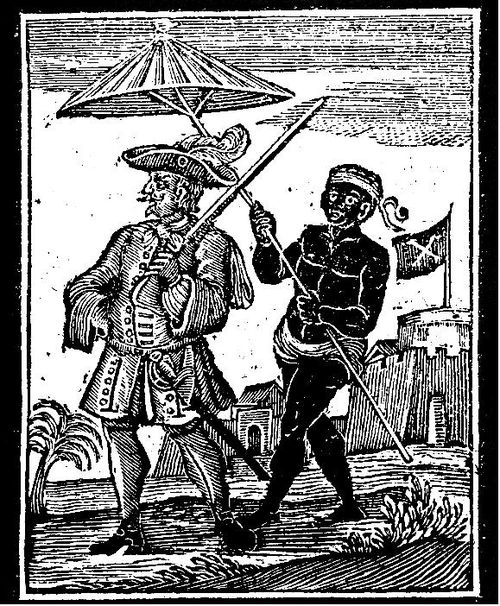
Henry Every Perpetrator
1659 – ?
English pirate, led the 1694 mutiny and the 1695 raid on the Mughal fleet; disappeared in 1696 and was never caught. Birth date of August 1659 is given in some sources.
-
Thomas Tew Accomplice
? – 1695
Rhode Island pirate whose sloop Amity joined Every's squadron; killed in a fight with a Mughal ship during the raid, his sloop falling behind the squadron.
-
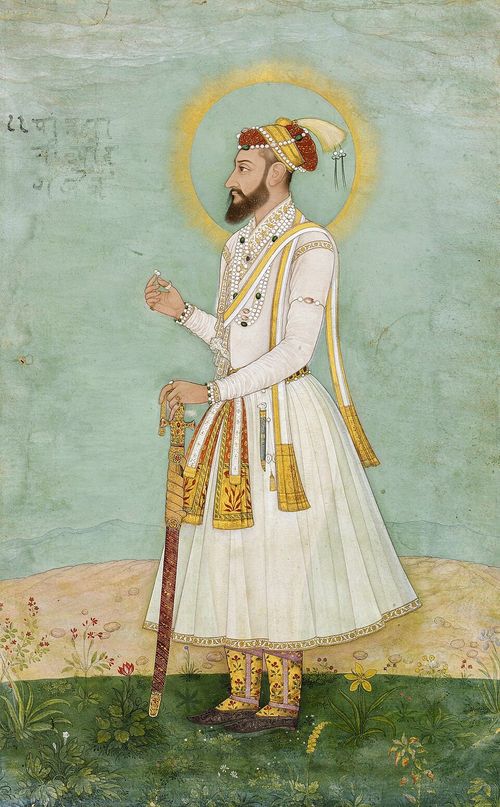
Aurangzeb Also involved
3 November 1618 – 3 March 1707
Mughal emperor who owned the Ganj-i-Sawai; retaliated against the East India Company.
-
Muhammad Ibrahim Victim
Captain of the Ganj-i-Sawai; blamed by the chronicler Khafi Khan for the ship's loss. Dates unknown.
-
Nicholas Trott Also involved
Governor of the Bahamas who accepted Every's bribe in 1696; not the South Carolina judge of the same name. Dates uncertain.
-
John Dann Witness
? – 1722
Every's coxswain; arrested at Rochester with gold sewn into his clothes and turned king's evidence.
-
Khafi Khan Also involved
1664 – 1732
Mughal historian in Surat whose chronicle describes the capture.
Where it happened
- Surat, India. Home port of the Mughal fleet; the Ganj-i-Sawai was taken at sea on her way back here.
- Bab-el-Mandeb strait. Mouth of the Red Sea, where the pirate squadron gathered to wait for the convoy.
- A Coruña, Spain. Harbour where the crew of the Charles II mutinied in May 1694.
- Nassau, New Providence. Where Governor Trott took the pirates' bribe in 1696.
- Execution Dock, Wapping. Where five of Every's crew were hanged in November 1696.
Outcome
Never caught Never caught
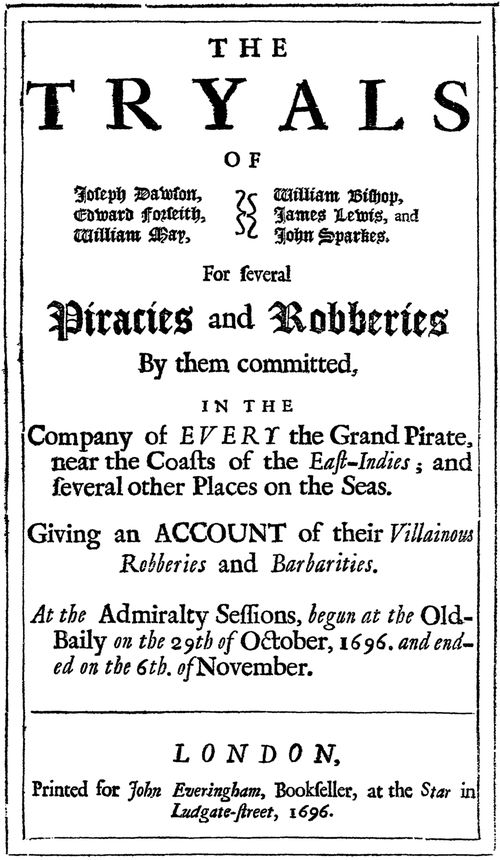
Every was never arrested or tried and his fate is unknown. Of his crew, 24 were rounded up in Britain; six were tried at the Old Bailey in October 1696, acquitted of piracy, then convicted of mutiny at a second trial and sentenced to death. Five were hanged at Execution Dock on 25 November 1696 and one reprieved. A few crew members tried in the American colonies were acquitted.
What the record settles, and what it doesn't
Established
- Every led a mutiny aboard the Charles II at Corunna on 7 May 1694 and renamed her the Fancy.
- On 7 September 1695 his squadron captured the Mughal emperor's ship Ganj-i-Sawai after taking the Fateh Muhammed.
- Passengers aboard the Ganj-i-Sawai were tortured and assaulted, according to Mughal and East India Company sources and a condemned pirate's own last words.
- The raid provoked Mughal reprisals against the East India Company and a large reward for Every's capture.
- Every reached the Bahamas in 1696 and then disappeared after landing in Ireland that summer.
- Six of his men were convicted at a second trial in London, and five were hanged on 25 November 1696.
Disputed
- The value of the plunder: the Mughal side put it at about £600,000, the East India Company at about £325,000, and each had reasons to inflate or reduce the figure.
- What became of Every: Johnson says he died poor in Devon after being cheated by Bristol merchants, a later reprint gives a death date in 1714, and other stories have him living rich under another name; none is supported by evidence.
- Whether a relative of the emperor was aboard and taken by Every, a story that grew in the retelling.
- How the pirates divided the loot: Johnson's tale of Every tricking his allies out of their shares is not borne out by more reliable sources.
- Every's birthplace and date, often given as Newton Ferrers, Devon, in August 1659, rest on limited evidence.
Pictures





Afterwards
The East India Company paid reparations and accepted the duty of escorting Mughal shipping, and English law hardened against piracy in the years that followed, including new courts for trying pirates in the colonies. The acquittal of Every's men at their first trial, despite open pressure on the jury, alarmed the government, and the second trial for mutiny was brought in a hurry to secure a conviction. Every's escape made him a hero of ballads and pamphlets: a fictional memoir of 1709 had him ruling a pirate kingdom in Madagascar, and a London play, The Successful Pyrate, followed in 1712. Coins thought to come from the Mughal raid have since been dug up in New England.
Questions readers ask
Was Henry Every ever caught?
No. He disappeared after landing in Ireland in 1696 and no reliable trace of him was ever found, despite a reward of £1,000.
What was the Ganj-i-Sawai?
The largest ship of the Mughal emperor Aurangzeb's fleet, used to carry pilgrims and trade between India and the Red Sea. Every's pirates captured her on 7 September 1695.
How much did Henry Every steal?
Estimates at the time ranged from about £325,000 to £600,000, making it one of the most valuable thefts by pirates on record.
What happened to Henry Every's crew?
They scattered. Of 24 caught in Britain, six were tried in London in 1696 and five hanged; a few tried in the American colonies were acquitted.
Sources and further reading
- Henry Every (Wikipedia)
- Capture of the Grand Mughal Fleet (Wikipedia)
- Ganj-i-Sawai (Wikipedia)
- Wikidata Q456882 (life dates checked here)
Written by Sinister Crimes from the sources above; see our editorial standards. Last checked 1 November 2026.