

The case
The first attempt that morning failed. At about ten past ten on Sunday 28 June 1914, as the motorcade carrying Archduke Franz Ferdinand and his wife Sophie drove along the Appel Quay beside the Miljacka river, a young printer named Nedeljko Čabrinović threw a bomb at their open car. It bounced off the folded hood and exploded under the vehicle behind, injuring officers and onlookers. Čabrinović swallowed a cyanide capsule that only made him sick and jumped into a river so shallow in the summer drought that he was hauled out almost at once.
Six young men had been posted along the route by Danilo Ilić, a Sarajevo schoolteacher turned revolutionary. All were subjects of Austria-Hungary, which had occupied Bosnia since 1878 and annexed it outright in 1908, and most were Bosnian Serb students belonging to the loose movement later called Young Bosnia. They wanted Habsburg rule ended and the South Slavs united in one state. Three of them, Gavrilo Princip, Čabrinović and Trifko Grabež, had come from Belgrade in May carrying pistols and bombs supplied by Major Vojislav Tankosić of the Serbian army, a member of the secret nationalist society known as the Black Hand. They crossed into Bosnia by a smuggling route run by Serbian frontier officers and agents of the Narodna Odbrana society.
After the bomb, the cars sped past the remaining conspirators, who did nothing. At the town hall Franz Ferdinand interrupted the mayor's welcome to protest that he had come on a visit and been greeted with bombs, then composed himself. The governor of Bosnia, General Oskar Potiorek, rejected a suggestion to wait for troops to line the streets. The couple decided to visit the wounded in hospital instead, and Potiorek ordered the route changed to run straight along the quay. Nobody told the drivers.
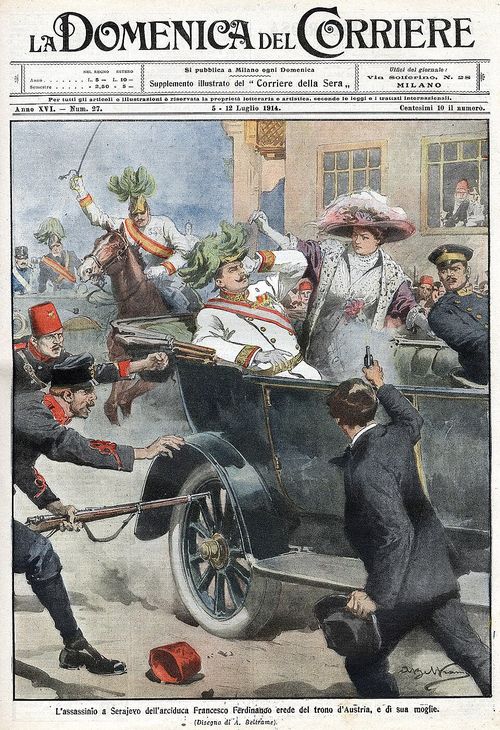
At the Latin Bridge, the lead cars turned right into a side street as the original programme had specified, and the archduke's driver, Leopold Lojka, followed. Potiorek shouted that he had taken the wrong road. Lojka braked and tried to reverse, and the car came to a halt a few feet from Princip, who had drifted to the corner near Schiller's delicatessen. Princip stepped forward and fired twice. One bullet struck Franz Ferdinand in the neck; the other hit Sophie in the abdomen. According to Count Harrach, who was standing on the running board, the archduke begged his wife not to die, for their children's sake. Both were dead within the hour.
Princip turned the pistol on himself but was seized before he could fire, and he and Čabrinović both survived their poison. Within days the police had most of the network. Austria-Hungary, convinced that Serbia stood behind the plot, sent Belgrade an ultimatum on 23 July and declared war on 28 July, exactly a month after the shooting. Within a week most of Europe was at war.
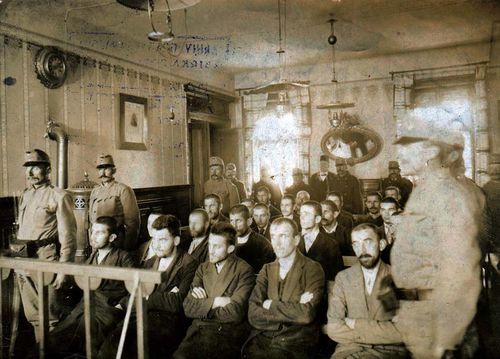
Twenty-five people were tried together in Sarajevo from 12 to 23 October 1914. The defendants included the gunmen and the peasants, teachers and minor officials who had carried their weapons from the border. Princip insisted that the plot was a private one and that Serbia bore no responsibility. The court disagreed and found that Serbian military circles had taken part. Austrian law forbade the execution of anyone under twenty at the time of the crime, and the court accepted that Princip, born in July 1894, was nineteen. He, Čabrinović and Grabež received the maximum twenty years. Ilić and two men who had helped move the weapons, Veljko Čubrilović and Miško Jovanović, were hanged on 3 February 1915. Two other death sentences were commuted, and nine defendants were acquitted.
The victims
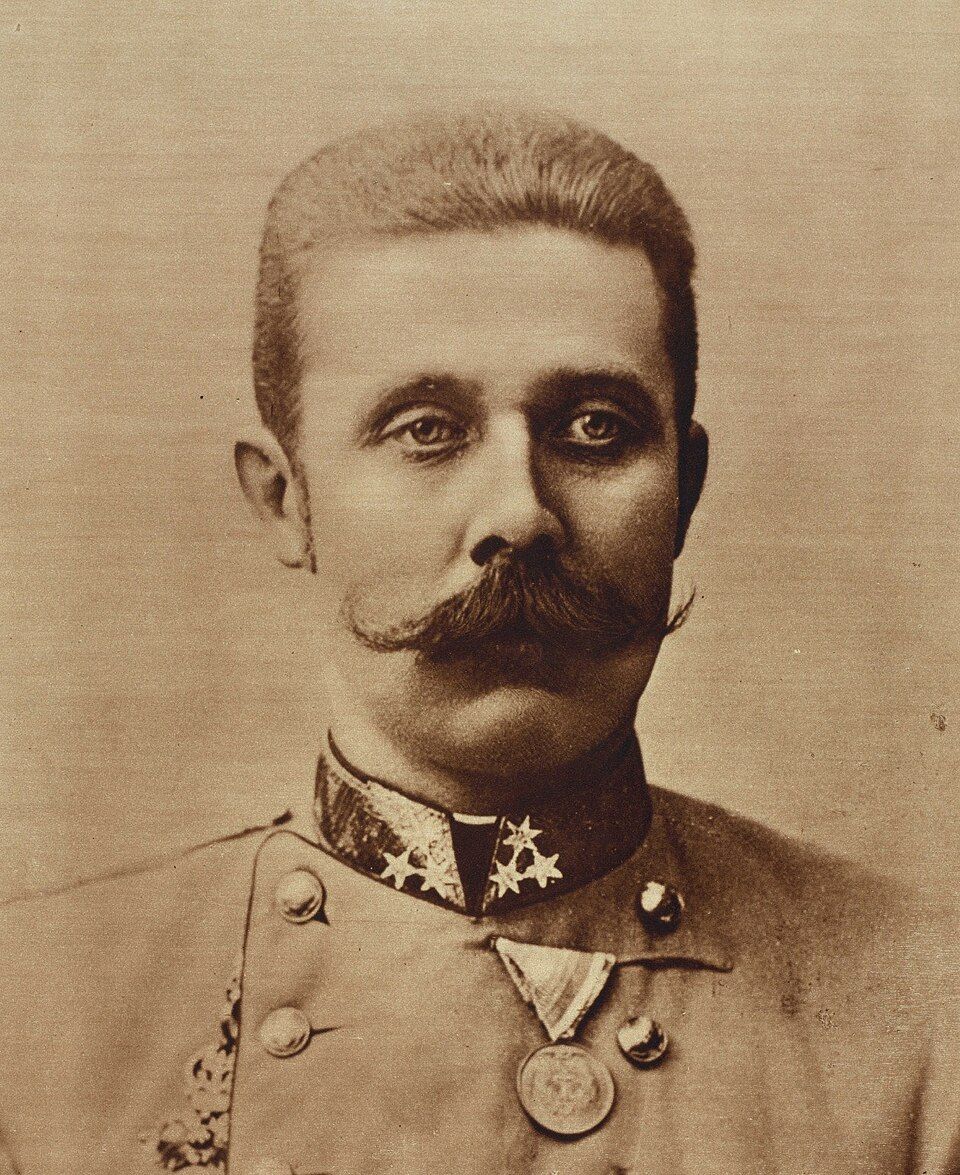
Franz Ferdinand was fifty, a nephew of Emperor Franz Joseph who had become heir after the suicide of Crown Prince Rudolf in 1889 and the death of his own father in 1896. He was a difficult, short-tempered man with a passion for hunting and collecting, who had travelled around the world in 1892 and 1893. Politically he was more interested than most in reforming the empire's treatment of its Slav peoples, which some Serb nationalists saw as a threat rather than a promise.
Sophie Chotek, born in Stuttgart in 1868 to a Bohemian diplomatic family, was a countess serving as a lady-in-waiting when the heir fell in love with her. Because she was not of royal rank, the emperor allowed the marriage in 1900 only on condition that their children could never inherit, and court protocol kept her from his side at most official occasions. A military inspection was one of the few settings where she could ride beside him in public, which is partly why she was in the car. The couple had three surviving children, born between 1901 and 1904, and they were killed on their fourteenth wedding anniversary.
Timeline
Austria-Hungary formally annexes Bosnia and Herzegovina, which it has occupied since 1878.
Princip, Čabrinović and Grabež leave Belgrade with pistols and bombs supplied by Major Tankosić.
The three reach Sarajevo after crossing the border by a covert route.
Čabrinović's bomb misses the archduke's car on the Appel Quay at about 10:10 a.m.
Shortly before 11 a.m., Princip shoots Franz Ferdinand and Sophie near the Latin Bridge; both die within the hour.
Austria-Hungary delivers an ultimatum to Serbia.
Austria-Hungary declares war on Serbia, beginning the First World War.
The trial of twenty-five defendants opens in Sarajevo.
Verdicts: Princip, Čabrinović and Grabež receive twenty years; five men are sentenced to death.
Danilo Ilić, Veljko Čubrilović and Miško Jovanović are hanged in Sarajevo.
Dimitrijević (Apis) is executed after the Salonika trial, held by Serbia on separate charges.
Princip dies of tuberculosis in the prison at Theresienstadt.
People in the case
-
Archduke Franz Ferdinand of Austria Victim
18 December 1863 – 28 June 1914
Heir presumptive to the Austro-Hungarian throne; shot by Princip near the Latin Bridge.
-
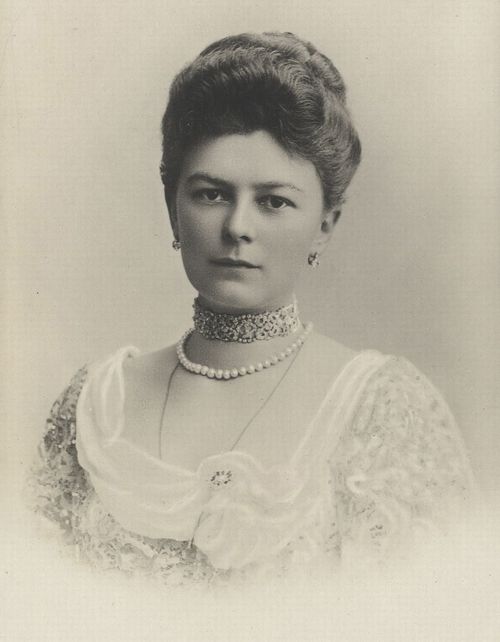
Sophie, Duchess of Hohenberg Victim
1 March 1868 – 28 June 1914
Franz Ferdinand's wife, born Countess Sophie Chotek; shot in the same car. Princip said he had meant the second shot for Governor Potiorek.
-
Gavrilo Princip Perpetrator
25 July 1894 – 28 April 1918
Bosnian Serb student who fired the fatal shots; nineteen at the time, so sentenced to twenty years rather than death. Died of tuberculosis in the fortress prison at Theresienstadt.
-
Nedeljko Čabrinović Accomplice
1 February 1895 – 23 January 1916
Printer who threw the bomb that missed; sentenced to twenty years and died of tuberculosis in prison.
-
Danilo Ilić Accomplice
1891 – 3 February 1915
Sarajevo organiser who recruited local conspirators and placed the assassins on the route. Hanged.
-
Trifko Grabež Accomplice
28 June 1895 – 21 October 1916
Came from Belgrade with Princip; did not act on the day. Sentenced to twenty years; died in prison.
-
Oskar Potiorek Also involved
20 November 1853 – 17 December 1933
Governor of Bosnia, riding in the car; responsible for security and for the route change that was never passed to the drivers.
-
Vojislav Tankosić Accomplice
28 September 1880 – 2 November 1915
Serbian army major and Black Hand member who supplied and trained the Belgrade three; killed in action in 1915.
-
Dragutin Dimitrijević Suspect
17 August 1876 – 24 June 1917
Known as Apis; head of Serbian military intelligence and leader of the Black Hand. Later claimed to have ordered the attack, but executed in 1917 after a separate Serbian trial.
-
Leopold Lojka Witness
17 September 1886 – 18 July 1926
Driver of the archduke's car, who took the wrong turn and stalled beside Princip.
Where it happened
- Latin Bridge and corner of Franz Joseph Street (now Museum of Sarajevo 1878–1918). Where the car stalled and Princip fired; the former Schiller delicatessen building is now a museum.
- Ćumurija Bridge, Appel Quay. Near where Čabrinović threw his bomb from the river side of the quay.
- Artstetten Castle, Lower Austria. Where Franz Ferdinand and Sophie are buried together, since she could not be laid in the Habsburg imperial crypt.
Outcome
Convicted Convicted; three hanged
A Sarajevo court convicted the conspirators on 28 October 1914 of murder and high treason. Princip, Čabrinović and Grabež, all under twenty, received twenty years; Vaso Čubrilović sixteen and Cvjetko Popović thirteen. Of five men sentenced to death, Danilo Ilić, Veljko Čubrilović and Miško Jovanović were hanged on 3 February 1915 and two had their sentences commuted. Princip, Čabrinović and Grabež all died in prison before the end of the war.
What the record settles, and what it doesn't
Established
- Gavrilo Princip shot and killed Archduke Franz Ferdinand and Sophie, Duchess of Hohenberg, in Sarajevo on 28 June 1914.
- Earlier the same morning Nedeljko Čabrinović threw a bomb that missed the couple's car and wounded others.
- The car was near Princip only because its driver took a wrong turn after a route change was not passed on.
- The assassins were Austro-Hungarian subjects from Bosnia; their weapons came from Serbian army officers linked to the Black Hand.
- Princip was spared the death penalty because he was under twenty and died in prison of tuberculosis in 1918.
- Three of the older conspirators were hanged in February 1915.
- The assassination led directly to the July Crisis and Austria-Hungary's declaration of war on Serbia on 28 July 1914.
Disputed
- How far the Serbian state was involved: the Sarajevo court found that Serbian military circles took part, and Apis later claimed responsibility, but his claim was made while facing execution, and an Austrian official reported in July 1914 that he had found no evidence of Serbian government involvement.
- What the Serbian prime minister, Nikola Pašić, knew in advance and whether he tried to warn Vienna; historians disagree on how specific any warning was.
- Princip's reputation is sharply divided: many Serbs see him as a liberator from imperial rule, while many Bosniaks and Croats regard him as a terrorist.
- Whether the killing made war inevitable: some historians stress Vienna's and Berlin's choices in July 1914, arguing the assassination was a pretext rather than a cause.
- The popular story that Princip was eating a sandwich when the car stopped has no contemporary source and appears to be a modern invention.
Pictures




Afterwards
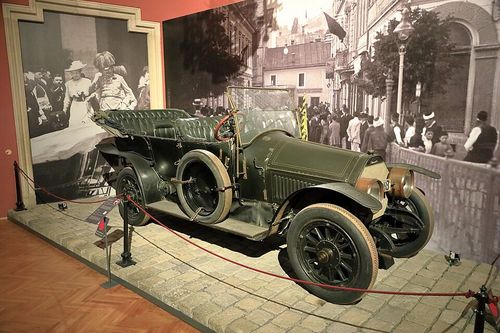
The bodies were taken by battleship to Trieste and by train to Vienna, where the court chamberlain arranged a deliberately modest funeral that reflected Sophie's lower rank. They were buried side by side at Artstetten. The car, the archduke's uniform and the pistols are in the Museum of Military History in Vienna. Anti-Serb rioting broke out in Sarajevo within hours of the killing.
The Black Hand's leaders were tried by Serbia itself at Salonika in 1917 on charges unrelated to Sarajevo; Apis and two others were shot, and a Serbian court annulled the verdicts in 1953. Under royal and then communist Yugoslavia Princip was honoured as a national hero, with his footprints set into the pavement at the corner. After the wars of the 1990s, how Sarajevo marks the spot became a contested question, and the former delicatessen now houses a museum of the Austro-Hungarian period.
Questions readers ask
Who killed Archduke Franz Ferdinand?
Gavrilo Princip, a nineteen-year-old Bosnian Serb student and member of the Young Bosnia movement, shot him and his wife Sophie in Sarajevo on 28 June 1914.
Why wasn't Gavrilo Princip executed?
Austro-Hungarian law did not allow the death penalty for anyone under twenty at the time of the crime, and the court accepted that Princip was nineteen. He was sentenced to twenty years and died of tuberculosis in prison in April 1918.
Did Serbia order the assassination?
The weapons and training came from Serbian army officers in the Black Hand, but whether the Serbian government knew or approved is still debated. Princip himself insisted the plot was private.
How did the assassination start the First World War?
Austria-Hungary blamed Serbia, sent an ultimatum on 23 July and declared war on 28 July. Alliance commitments drew Russia, Germany, France and Britain into the war within a week.
Sources and further reading
- Assassination of Archduke Franz Ferdinand (Wikipedia)
- Gavrilo Princip (Wikipedia)
- Sophie, Duchess of Hohenberg (Wikipedia)
- Wikidata Q192050 (life dates checked here)
Written by Sinister Crimes from the sources above; see our editorial standards. Last checked 1 November 2026.