

The case
The best-known story about Victor Lustig is also the least documented. As it is usually told, he arrived in Paris in 1925, read a newspaper piece about the cost of maintaining the Eiffel Tower, and saw an opening. Posing as a senior official of the Ministry of Posts and Telegraphs, on forged government stationery, he invited a handful of scrap-metal dealers to a confidential meeting at a grand hotel. The state, he told them, had decided to pull the tower down and sell its iron; because the decision would cause an uproar, it had to stay secret until the contract was signed.
In the classic version one dealer, named in later books as André Poisson, was eager to make his name in Paris business circles. Lustig played the corrupt functionary, hinted at his modest salary, accepted a bribe on top of the purchase money and left for Vienna. Poisson, too embarrassed to admit he had been fooled, supposedly never went to the police, and Lustig came back to try the trick again with a new group. This time, the story goes, a dealer alerted the authorities and Lustig fled to America.
No French police report, court file or contemporary Paris newspaper article describing the sale has been found by the writers who have looked. The account first appears in print in 1961, in The Man Who Sold the Eiffel Tower, a book built on the recollections of a Secret Service agent who helped catch Lustig in 1935 but witnessed nothing in Paris a decade earlier. Its dialogue is reconstructed and it gives no sources. Every later retelling, including the figure of about 70,000 francs, descends from it. The episode may be true, embroidered, or a story Lustig told about himself; the evidence does not allow a firmer answer.
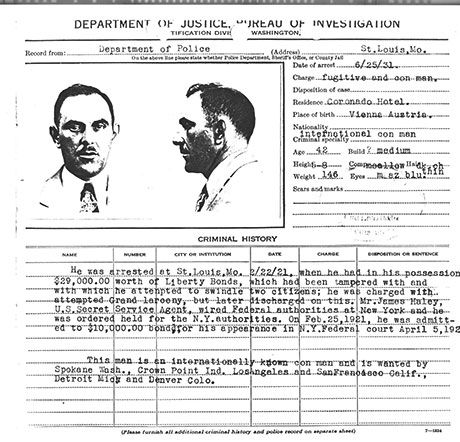
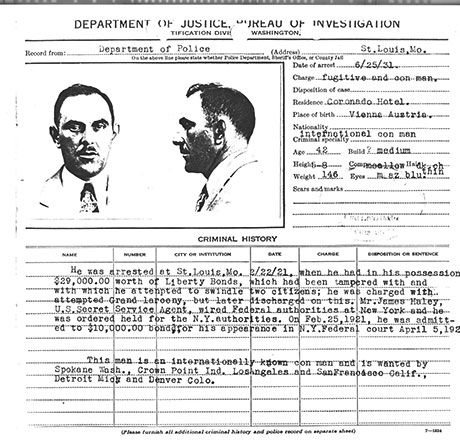
What the record does establish is a long career as a confidence man on both sides of the Atlantic. Lustig, who used many names including Robert V. Miller and styled himself "Count Lustig", was arrested repeatedly in the United States in the 1920s and early 1930s. A Bureau of Investigation identification card made after his arrest in St Louis in June 1931 describes him as a fugitive confidence man wanted in several cities. He was associated with the "money box", a mahogany case that he claimed could copy banknotes given a few hours; the demonstration worked because he had loaded a genuine note in advance.
His undoing was ordinary counterfeiting. From the early 1930s Lustig worked with two men from Nebraska who made plates and printed notes while he organised their distribution. The bills spread widely enough that the Secret Service made him a priority. In May 1935 he was arrested in New York. A key in his possession led agents to a locker at the Times Square subway station holding about $51,000 in counterfeit notes and the printing plates.
On 1 September 1935, the day before his trial was due to start, he escaped from the Federal House of Detention in Manhattan by feigning illness and climbing down a rope. He was recaptured in Pittsburgh about four weeks later. He pleaded guilty to the counterfeiting charges in December 1935 and was sentenced to fifteen years, with five more for the escape.
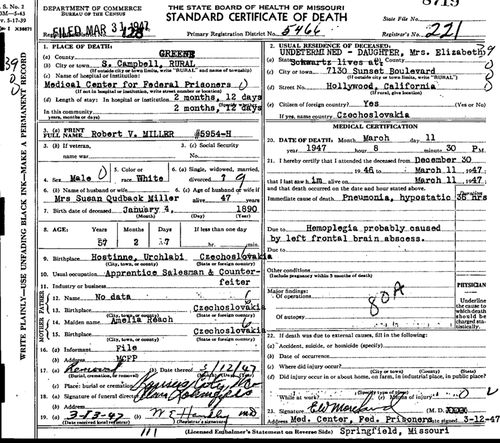
In April 1936 Lustig was taken to Alcatraz, where he was registered as prisoner 300. He spent about a decade on the island before being moved to the federal prison hospital at Springfield, Missouri. He died there of pneumonia on 11 March 1947, under the name Robert V. Miller. The clerk who filled in his death certificate gave his usual occupation as "apprentice salesman" and counterfeiter. He was never charged with anything concerning the Eiffel Tower.
Timeline
Lustig's recorded date of birth, in Hostinné, Bohemia, according to his prison records.
Lustig is said to sell the Eiffel Tower to a Paris scrap dealer; the story is first recorded in 1961.
Lustig is arrested in Chicago, travelling as Robert Miller with forged papers and a money box.
The Bureau of Investigation records him after an arrest in St Louis as a fugitive confidence man.
The Secret Service arrests Lustig in New York for counterfeiting; plates and about $51,000 in notes are found in a subway locker.
Lustig escapes from the Federal House of Detention in Manhattan.
He is recaptured in Pittsburgh.
He pleads guilty and is sentenced to fifteen years for counterfeiting and five for the escape.
Lustig arrives at Alcatraz as prisoner 300.
He dies of pneumonia at the Medical Center for Federal Prisoners in Springfield, Missouri.
The Man Who Sold the Eiffel Tower is published, the earliest known account of the sale.
People in the case
-
Victor Lustig Perpetrator
4 January 1890 – 11 March 1947
Confidence man and counterfeiter, convicted in 1935; his birth date and birthplace come from prison records he supplied himself, and other documents differ.
-
André Poisson Also involved
Scrap dealer named in the 1961 account as the buyer of the Eiffel Tower; no independent record of him has been identified.
-
Al Capone Also involved
17 January 1899 – 25 January 1947
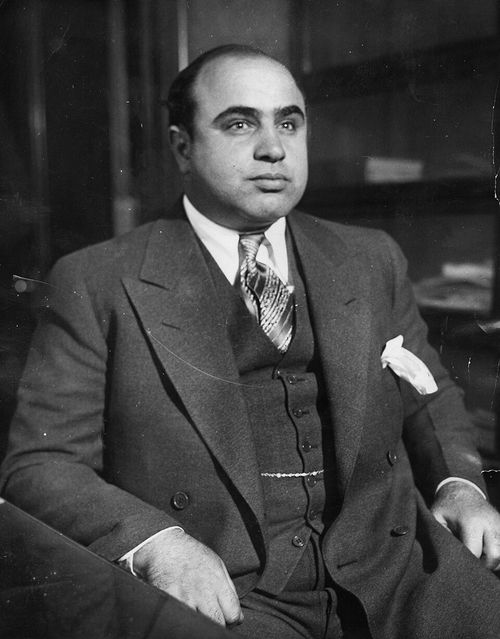
Chicago gangster; later accounts say Lustig conned him out of a small sum, an anecdote with no documentary support.
Where it happened
- Eiffel Tower. The monument Lustig is said to have sold for scrap in 1925.
- Hôtel de Crillon, Paris. Named in later retellings as the venue of the meeting with scrap dealers; not documented.
- Alcatraz Federal Penitentiary. Where Lustig was held from 1936.
- Medical Center for Federal Prisoners, Springfield. Prison hospital in Missouri where Lustig died in 1947.
Outcome
Convicted Convicted of counterfeiting
Arrested in New York in May 1935, Lustig escaped custody that September and was recaptured within a month. He pleaded guilty to counterfeiting in December 1935 and received fifteen years, plus five for the escape. He served his sentence at Alcatraz and died in federal custody in 1947. He was never prosecuted in France.
What the record settles, and what it doesn't
Established
- Victor Lustig was a confidence man who used many aliases, among them Robert V. Miller, and was arrested repeatedly in the United States.
- He was arrested in New York by the Secret Service in May 1935 for counterfeiting, and plates and counterfeit notes were recovered from a Times Square subway locker.
- He escaped from federal detention on 1 September 1935 and was recaptured in Pittsburgh later that month.
- He pleaded guilty and was sentenced to a total of twenty years.
- He was held at Alcatraz from 1936 and died at the federal prison hospital in Springfield, Missouri, on 11 March 1947.
- The earliest known account of the Eiffel Tower sale was published in 1961, fourteen years after his death.
Disputed
- Whether the Eiffel Tower sale happened at all: it is told as fact in most popular histories, but no French record or 1925 press report has been produced.
- Whether he sold the tower twice: the second attempt is part of the same single-source story.
- The amount paid, given variously in francs or dollars, and the identity of the buyer André Poisson, for whom no independent record has been found.
- Lustig's origins: prison papers give Hostinné in Bohemia and a date of 4 January 1890, but a 1931 identification card says he was born in Vienna, and a local search of Hostinné records found no trace of him.
- Anecdotes about conning Al Capone and a Texas sheriff are widely repeated but rest on no contemporary documentation.
- The 'Ten Commandments for Con Men' attributed to him have no verified origin with Lustig.
Pictures



Afterwards
Lustig's death went almost unnoticed; newspapers learned of it only in 1949, when his brother mentioned it in a New Jersey court. His fame came later and largely posthumously, through the 1961 book and the many retellings that followed. Since then "the man who sold the Eiffel Tower" has become one of the most repeated stories in the literature of fraud, often with dialogue and detail that no record supports. The documented Lustig, a counterfeiter who escaped from a Manhattan jail and ended his days in Alcatraz and a prison hospital, is less tidy but no less remarkable.
Questions readers ask
Did Victor Lustig really sell the Eiffel Tower?
Possibly, but it cannot be confirmed. No French police file or 1925 newspaper report has been found, and the story first appeared in a 1961 book based on a Secret Service agent's recollections.
What was Victor Lustig convicted of?
Counterfeiting US currency, after his arrest in New York in 1935, plus escaping from federal custody. He received twenty years in total.
Did Victor Lustig die in Alcatraz?
No. He was held at Alcatraz from 1936 but died at the Medical Center for Federal Prisoners in Springfield, Missouri, on 11 March 1947.
What was the Rumanian money box?
A wooden case Lustig claimed could duplicate banknotes. He preloaded it with real notes so the demonstration appeared to work, then sold it to the buyer.
Sources and further reading
- Victor Lustig (Wikipedia)
- Victor Lustig et la vente de la tour Eiffel (escroquerie.org)
- Who sold the Eiffel Tower? (Eiffel Tower official site)
- Wikidata Q347318 (life dates checked here)
Written by Sinister Crimes from the sources above; see our editorial standards. Last checked 1 November 2026.