

The case
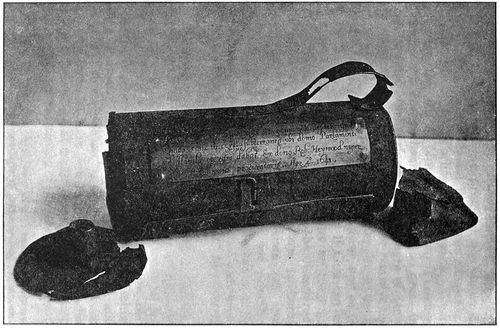
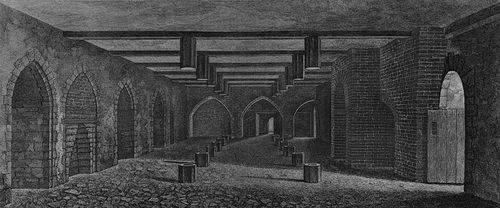
Around midnight on 4 November 1605, a search party led by Sir Thomas Knyvet entered a ground-floor storeroom directly beneath the chamber of the House of Lords. Behind a stack of firewood and coal they found thirty-six barrels of gunpowder, and beside them a tall man in a cloak, hat, boots and spurs, carrying a lantern, slow matches and a pocket watch. He said his name was John Johnson and that he was servant to Thomas Percy. The state opening of Parliament, at which King James I, his heir and most of the political nation would be present, was due to begin in a few hours.
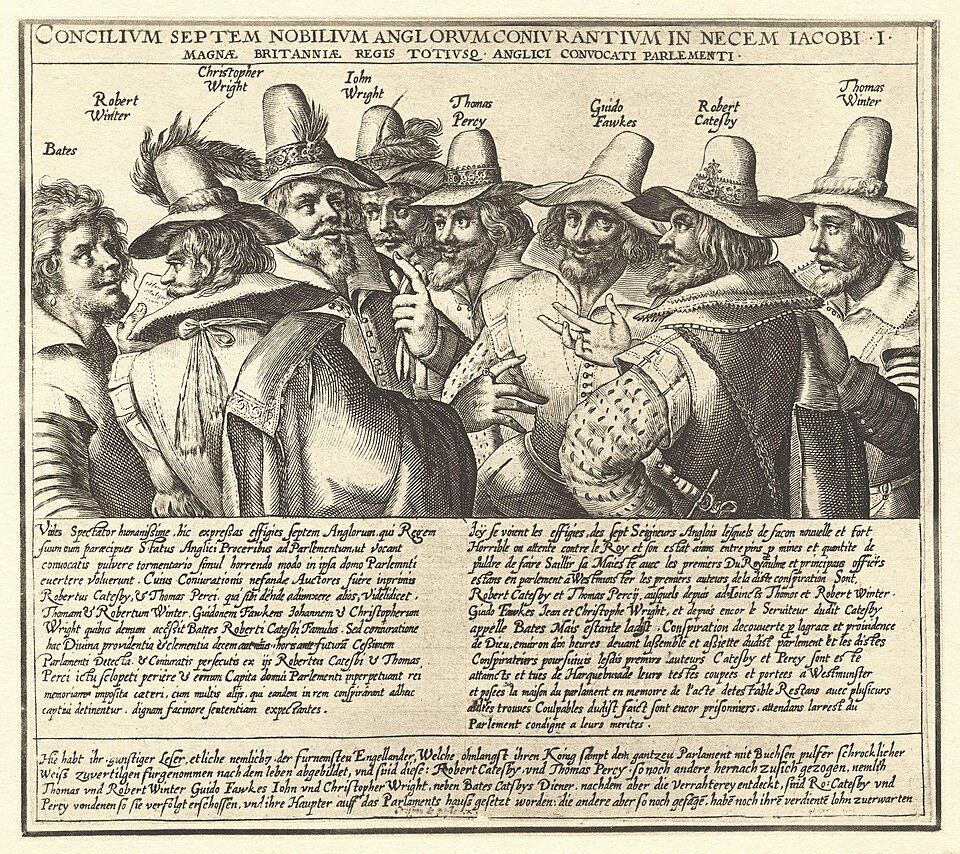
His real name was Guy Fawkes, a Yorkshireman who had spent a decade as a soldier in the Spanish army in Flanders. He was the expert, not the leader. The plot was the work of Robert Catesby, a charismatic Warwickshire gentleman who had already been fined heavily for his part in the Earl of Essex's rising of 1601. English Catholics had hoped that James, the son of Mary Queen of Scots, would ease the fines and penalties laid on those who refused to attend Protestant services. When he did not, Catesby resolved to kill the king and his government at one stroke, raise the Catholic Midlands, and put James's nine-year-old daughter Elizabeth on the throne.
The first five conspirators swore an oath of secrecy at an inn off the Strand in May 1604. Others joined over the following year until there were thirteen, most of them linked by blood, marriage or the Essex rising. Percy, who had a court post, leased a house beside Parliament, and in March 1605 the group took over the lease of the undercroft beneath the Lords. Repeated postponements of Parliament because of plague gave them months to stock it. The government later claimed they had first tried to tunnel under the building; no trace of a tunnel has ever been found.
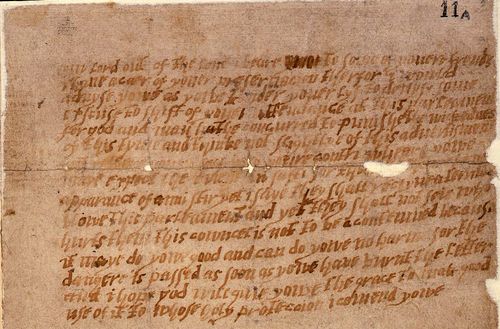
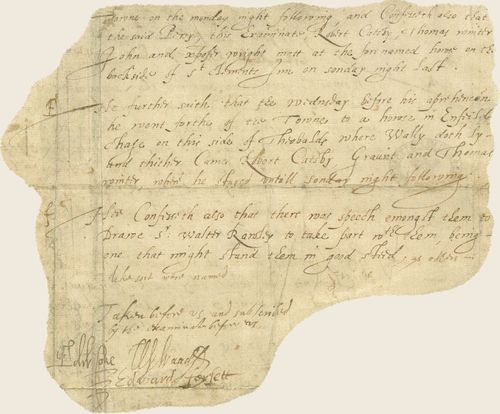
The plot leaked through the plotters' own consciences. Several were uneasy about killing Catholic peers who would be in the chamber. On 26 October an unsigned letter reached Lord Monteagle, a Catholic peer, at his house in Hoxton, advising him to stay away because Parliament would "receive a terrible blow" and "shall not see who hurts them". Monteagle took it straight to Robert Cecil, Earl of Salisbury, the king's chief minister. Salisbury waited until the king returned from hunting and let him draw the conclusion himself. The conspirators learned that the letter had been handed in, but went ahead anyway.
Fawkes was taken to the Tower, where James authorised torture by stages, and broke on 7 November. By then the others had fled to the Midlands, gathering a handful of followers and almost no support. At Holbeche House in Staffordshire, on the morning of 8 November, the sheriff of Worcestershire's men surrounded them. Damp powder drying by the fire had already flared up and burned several of them. In the shooting that followed, Catesby, Percy and the brothers John and Christopher Wright were killed. Francis Tresham, the last recruit and Monteagle's brother-in-law, died of illness in the Tower in December before he could be tried.
Eight surviving conspirators were tried for high treason in Westminster Hall on 27 January 1606, with the king watching unseen. Only Sir Everard Digby pleaded guilty. All eight were condemned to be hanged, drawn and quartered. Digby, Robert Wintour, John Grant and Thomas Bates died at St Paul's Churchyard on 30 January; Thomas Wintour, Ambrose Rookwood, Robert Keyes and Fawkes the next day in Old Palace Yard, opposite the building they had meant to destroy. Fawkes, weakened by torture, died when the drop broke his neck. Henry Garnet, superior of the English Jesuits, who had heard of the plot through another priest's confession, was tried separately and executed on 3 May 1606.
The victims
No one died in the explosion because there was none. Had the powder gone off, the dead would have included King James I, his wife Anne and their elder son Henry, along with the bishops, the peers and the Commons assembled for the opening of Parliament, many servants and onlookers, and a number of Catholic lords whom the plotters had agonised over but not warned. A 2005 reconstruction for television suggested that the charge would have levelled the chamber.
The heaviest cost fell on people who had no part in the plot. England's Catholics, most of them loyal, faced new penal laws and a compulsory oath of allegiance, and for two centuries the plot was used to argue that their faith made them traitors. The conspirators' families were ruined: Lady Digby's household was ransacked, the plotters' estates were confiscated, and servants and priests who had sheltered them were hunted down. Several men, including the carpenter Nicholas Owen who built the hiding places at Hindlip Hall, died under interrogation or on the scaffold.
Timeline
Elizabeth I dies and James VI of Scotland becomes James I of England.
Catesby, Thomas Wintour, John Wright, Percy and Fawkes swear an oath of secrecy at the Duck and Drake inn.
The conspirators take the lease of the undercroft beneath the House of Lords.
Plague postpones the opening of Parliament to 5 November.
Lord Monteagle receives an anonymous letter warning him to avoid Parliament and takes it to Salisbury.
Late at night Fawkes is arrested in the undercroft beside thirty-six barrels of gunpowder.
Londoners light bonfires to celebrate the king's escape; the other plotters ride for the Midlands.
Catesby, Percy and the Wright brothers are killed at Holbeche House; the others are taken.
Francis Tresham dies in the Tower.
Eight conspirators are tried and condemned in Westminster Hall.
Digby, Robert Wintour, Grant and Bates are executed at St Paul's Churchyard.
Thomas Wintour, Rookwood, Keyes and Fawkes are executed in Old Palace Yard, Westminster.
Henry Garnet is executed at St Paul's Churchyard.
People in the case
-
Robert Catesby Perpetrator
1573 – 8 November 1605
Leader and originator of the plot; killed in the shoot-out at Holbeche House. Birth year given as c. 1572 or 1573.
-
Guy Fawkes Perpetrator
13 April 1570 – 31 January 1606
Former soldier in the Spanish service who guarded the powder under the name John Johnson; executed in Old Palace Yard.
-
Thomas Percy Perpetrator
1560 – 8 November 1605
Kinsman and agent of the Earl of Northumberland; leased the house and undercroft. Killed at Holbeche House. Birth year approximate.
-
Thomas Wintour Perpetrator
? – 31 January 1606
One of the first plotters and the author of a detailed confession; born c. 1571. Executed with Fawkes.
-
Francis Tresham Suspect
1567 – 23 December 1605
Catesby's cousin and the last recruit; long suspected of writing the Monteagle letter. Died in the Tower before trial.
-
Sir Everard Digby Perpetrator
16 May 1578 – 30 January 1606
Wealthy young convert who was to lead the Midlands rising; the only defendant to plead guilty.
-
Henry Garnet Accused
July 1555 – 3 May 1606
Superior of the English Jesuits; executed for failing to reveal what he had learned of the plot under the seal of confession.
-
William Parker, 4th Baron Monteagle Witness
1575 – 1 July 1622
Catholic peer who received the anonymous warning letter and passed it to the government.
-
Robert Cecil, 1st Earl of Salisbury Investigator
1 June 1563 – 24 May 1612
Secretary of state who managed the discovery and the investigation.
-
James VI and I Victim
19 June 1566 – 27 March 1625
King of England and Scotland and the plot's principal target.
Where it happened
- Palace of Westminster (site of the old House of Lords). The undercroft where Fawkes was arrested lay beneath the medieval Lords chamber, destroyed by fire in 1834.
- Old Palace Yard, Westminster. Where Fawkes and three others were executed on 31 January 1606.
- Holbeche House, Staffordshire. Where the fugitives made their last stand on 8 November 1605.
Outcome
Executed Convicted; executed
Eight surviving conspirators were tried for high treason on 27 January 1606, convicted and executed by hanging, drawing and quartering on 30 and 31 January. Four others had been killed at Holbeche House and Tresham had died in custody. Henry Garnet was convicted separately on 28 March and executed on 3 May 1606; the Earl of Northumberland, Percy's patron, was fined £30,000 and imprisoned in the Tower until 1621 although no evidence tied him to the plot.
What the record settles, and what it doesn't
Established
- Fawkes was arrested late on 4 November 1605 guarding thirty-six barrels of gunpowder in the undercroft beneath the House of Lords.
- The plot was conceived and led by Robert Catesby, and its aim was to kill James I at the state opening of Parliament and start a Catholic rising.
- An anonymous letter to Lord Monteagle, delivered on 26 October, alerted the government.
- Catesby, Thomas Percy and John and Christopher Wright were killed by the sheriff's men at Holbeche House on 8 November.
- Eight conspirators, including Fawkes, were convicted of high treason and executed on 30 and 31 January 1606.
- Fawkes was tortured in the Tower on the king's written authority.
- Parliament made 5 November a day of thanksgiving in 1606, the origin of Bonfire Night.
Disputed
- Who wrote the Monteagle letter: Francis Tresham is the traditional suspect, but candidates also include Monteagle himself, Anne Vaux and Salisbury's own agents, and no attribution has been proved.
- Whether Salisbury knew of the plot earlier and let it ripen for political advantage: Catholic writers argued so from the 1600s onward, while most historians find no clear evidence and see him as an opportunist rather than an author.
- Whether the conspirators really tried to tunnel under Parliament: the story rests on confessions given in the Tower, and no tunnel has been found.
- How much Henry Garnet knew and whether he was rightly executed: the prosecution called him the plot's instigator, while his defenders say he learned of it only under the seal of confession and tried to dissuade Catesby.
- Whether the decayed powder would have exploded: some have argued it was spoiled, but a 2005 test using deliberately degraded powder suggested it would still have destroyed the chamber.
Pictures





Afterwards
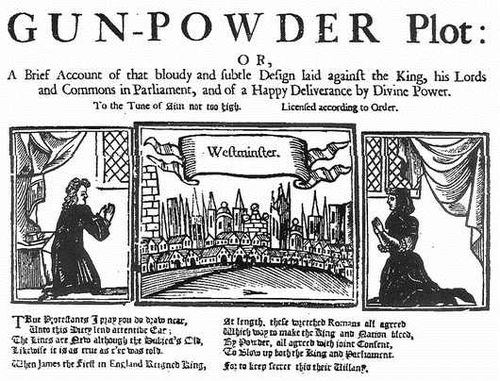
The plot gave the government a new national festival and Catholic England a long shadow. The Observance of 5th November Act required annual thanksgiving services until 1859, and the bonfires lit on the first night became a permanent custom; effigies, called guys, are still burned on 5 November across Britain. The Popish Recusants Act of 1606 imposed an oath of allegiance on Catholics, and full Catholic emancipation did not come until 1829.
The old House of Lords burned down in 1834, but the cellars of the Palace of Westminster are still searched before each state opening, a ritual dating from the Popish Plot scare of 1678. Fawkes's lantern is in the Ashmolean Museum in Oxford. Through a twentieth-century comic and film, his stylised face has become a worldwide emblem of protest, a strange fate for a man who wanted to install a Catholic monarch.
Questions readers ask
What was the Gunpowder Plot?
A plan by a group of English Catholics led by Robert Catesby to blow up the House of Lords during the state opening of Parliament on 5 November 1605, killing James I, and then to start a rising in the Midlands.
Was Guy Fawkes the leader of the Gunpowder Plot?
No. Robert Catesby led the plot. Fawkes, an experienced soldier, was in charge of the gunpowder and was the man caught with it, which is why his name became attached to it.
What happened to Guy Fawkes?
He was tortured in the Tower of London, tried for high treason on 27 January 1606 and executed in Old Palace Yard, Westminster, on 31 January 1606.
Why is Bonfire Night celebrated?
Bonfires were lit in London on 5 November 1605 to celebrate the king's escape, and in 1606 Parliament made the day an annual thanksgiving. The custom outlived the law.
Sources and further reading
- Gunpowder Plot (Wikipedia)
- Guy Fawkes (Wikipedia)
- Henry Garnet (Wikipedia)
- Wikidata Q45810 (life dates checked here)
Written by Sinister Crimes from the sources above; see our editorial standards. Last checked 1 November 2026.