

The case
The monks wanted to bar the doors. It was late afternoon on 29 December 1170, vespers had begun in the choir of Canterbury Cathedral, and four armed knights were coming through the cloister looking for the archbishop. Thomas Becket would not allow it. A church, he told them, was not to be turned into a fortress. So the doors stayed open, and the knights walked in calling for the traitor to the king.
Twenty years earlier the idea that Becket would die as the king's enemy would have seemed absurd. The son of a Norman merchant settled in London, he had risen through the household of Archbishop Theobald and in 1155 became Henry II's chancellor, the king's closest adviser and, by every account, his friend. He lived lavishly, raised the king's revenues, and even took the young prince Henry into his household. When Theobald died, Henry made Becket archbishop in 1162, expecting a loyal ally at the head of the English church.
Instead Becket resigned the chancellorship, took to a hair shirt, and became the church's most stubborn defender. The two men fell out over whether clergy accused of crimes could be tried in the king's courts, and over the written list of royal rights over the church known as the Constitutions of Clarendon, which Becket refused to seal. In October 1164 a royal council at Northampton condemned him for contempt and for his conduct as chancellor. He fled across the Channel that night and spent six years in France under the protection of Louis VII, trading excommunications and threats with the king while the pope tried to broker a peace.
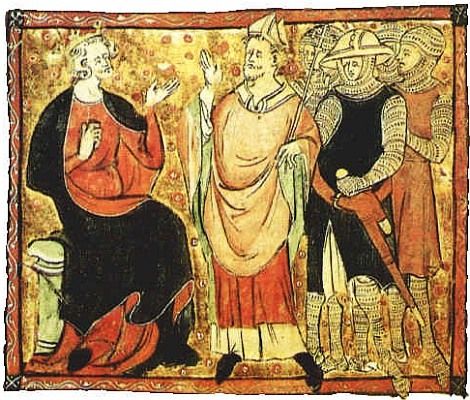
A settlement of sorts was reached in 1170 and Becket came home. But in June, while he was still abroad, the Archbishop of York and the bishops of London and Salisbury had crowned Henry's eldest son in Westminster Abbey, a right that belonged to Canterbury. Becket excommunicated them. The bishops took their complaint to Henry, who was keeping Christmas at Bures in Normandy, and the king flew into a rage. The famous line, "Will no one rid me of this turbulent priest?", is a much later invention; the monk Edward Grim, who was present at the murder, has Henry raging that he had nourished drones and traitors who let their lord be mocked by a low-born clerk. Whatever he said, four knights of his household took it as a command.
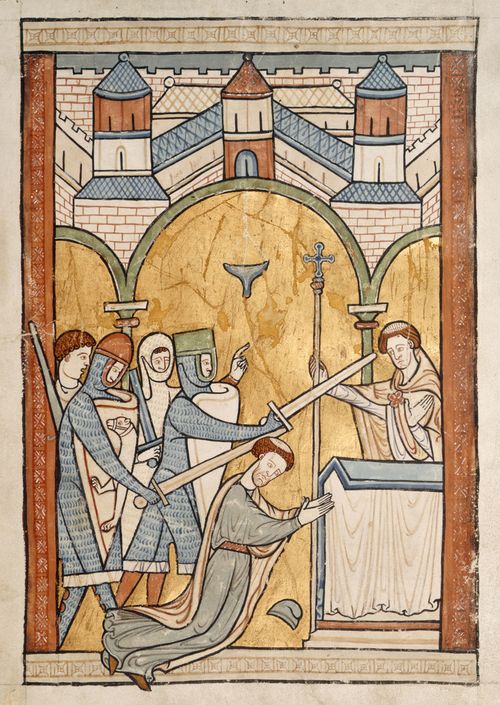
Reginald FitzUrse, Hugh de Morville, William de Tracy and Richard le Breton crossed the Channel, gathered at Saltwood Castle in Kent and rode to Canterbury. They first confronted Becket in his chamber and demanded that he lift the excommunications and answer to the king. He refused. They left to arm themselves and came back through the cloister into the cathedral. In the half-light near the steps to the choir they tried to drag him outside; he held on to a pillar. Then they struck him down with their swords. Grim, a visiting monk from Cambridge who had stayed at his side, put up his arm to protect him and was badly wounded. Becket died on the floor of the north-west transept, at about fifty years of age.
Nobody was ever brought to trial. The king, whatever his private feelings, did not arrest his own men, and the church dealt with them in its own way. The knights withdrew to Hugh de Morville's castle at Knaresborough. Pope Alexander III excommunicated them, and when they went to Rome to seek absolution he ordered them to serve fourteen years in the Holy Land. Henry swore he had never ordered the killing, and in July 1174 he walked barefoot to the tomb and submitted to being scourged by the monks.
The victims
Thomas Becket was born in Cheapside, London, on 21 December, probably in 1119 or 1120, to Gilbert and Matilda Beket, Normans who had done well in the city. His father's fortunes failed when he was young and he went to work as a clerk before finding a place with Archbishop Theobald, who sent him to study law at Bologna and Auxerre and on missions to Rome. Contemporaries describe him as tall, quick, a good talker and a lover of hunting and hawking, more administrator than scholar; his Latin was never polished.
What made him extraordinary was the transformation in 1162. The worldly chancellor became an archbishop who fasted, wore a hair shirt under his robes, and was willing to lose everything rather than concede what he saw as the rights of the church. Even sympathetic contemporaries found him proud and difficult. When the monks prepared his body for burial they found the hair shirt still on him, and within a few years of his death he was the most popular saint in England.
Timeline
Becket becomes Henry II's chancellor.
Becket is consecrated Archbishop of Canterbury, a day after being ordained priest.
Henry sets out the Constitutions of Clarendon; Becket refuses to seal them.
Condemned by a royal council at Northampton, Becket flees to France.
The Archbishop of York crowns Henry's eldest son at Westminster, infringing Canterbury's right.
Becket excommunicates the archbishop of York and the bishops of London and Salisbury, and soon returns to England.
At Bures in Normandy, Henry rages against Becket and four knights set off for England.
The four knights kill Becket in Canterbury Cathedral during vespers.
Pope Alexander III canonises Becket at Segni.
Henry II does public penance at Becket's tomb in Canterbury.
Becket's remains are moved to a new shrine in the Trinity Chapel.
Henry VIII has the shrine destroyed during the dissolution of the monasteries.
People in the case
-
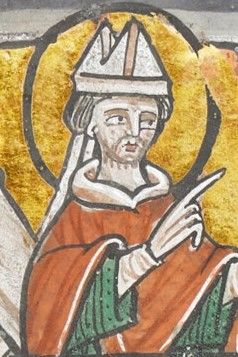
Thomas Becket Victim
21 December 1119 – 29 December 1170
Chancellor of England 1155 to 1162 and Archbishop of Canterbury from 1162; canonised in 1173. Birth year given as 1119 or 1120.
-
Henry II of England Also involved
5 March 1133 – 6 July 1189
King of England whose angry words sent the knights to Canterbury; did public penance at the tomb in 1174.
-
Reginald FitzUrse Perpetrator
Knight of the royal household, generally named as the leader of the four and the first to strike. Dates uncertain; often said to have died c. 1173.
-
Hugh de Morville Perpetrator
Lord of Westmorland; the four knights sheltered at his castle at Knaresborough after the murder. He joined the rebellion of 1173 to 1174 before going to Rome. Date of death uncertain.
-
William de Tracy Perpetrator
Somerset and Devon landholder, one of the four knights; dates of birth and death unknown.
-
Richard le Breton Perpetrator
One of the four knights; dates unknown.
-
Edward Grim Witness
? – 1189
Monk from Cambridge, wounded trying to shield Becket; wrote the best-known eyewitness account. Died c. 1189.
-
Pope Alexander III Judge
? – 30 August 1181
Excommunicated the four knights, imposed their penance and canonised Becket in 1173.
Where it happened
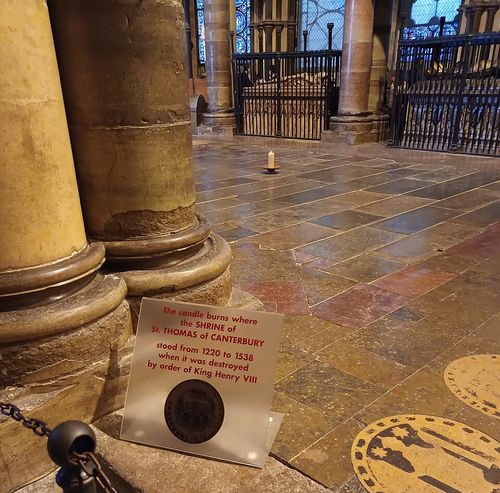
- Canterbury Cathedral. Becket was killed in the north-west transept, now called the Martyrdom; the site of his destroyed shrine in the Trinity Chapel is still marked.
- Knaresborough Castle, Yorkshire. Hugh de Morville's castle, where the four knights took refuge after the murder.
Outcome
Never caught No trial; excommunication and penance
The four knights were never tried by any secular court. Pope Alexander III excommunicated them, and when they sought absolution in Rome he ordered them to serve as knights in the Holy Land for fourteen years. Henry II was not charged with anything, but he did public penance at Becket's tomb on 12 July 1174.
What the record settles, and what it doesn't
Established
- Thomas Becket was killed in Canterbury Cathedral on 29 December 1170 by four knights of Henry II's household.
- The killers were Reginald FitzUrse, Hugh de Morville, William de Tracy and Richard le Breton.
- The murder followed Becket's excommunication of the bishops who had crowned Henry's eldest son in June 1170, and an outburst by the king at Bures.
- Edward Grim, who was present and was wounded, left a detailed eyewitness account.
- The knights were excommunicated and sent on penance to the Holy Land, but were never tried in a royal court.
- Becket was canonised by Pope Alexander III on 21 February 1173.
- Henry II did public penance at Becket's tomb in July 1174.
Disputed
- What Henry II actually said: the line "Will no one rid me of this turbulent priest?" dates from centuries later, and contemporary writers give several different versions of his outburst.
- Whether Henry meant the knights to kill Becket: the king always denied it, and many historians think they set out to arrest or intimidate him and the confrontation escalated, while others see the killing as a predictable result of Henry's words.
- Whether Becket sought martyrdom: admirers see a principled stand for the church's freedom; critics, then and now, see a proud man who chose confrontation when compromise was possible.
- What became of the knights: medieval writers say they ended their lives as penitents in the East and were buried at Jerusalem, while a local tradition places their graves in Somerset; the documentary record of their later lives is thin and the traditions conflict.
Pictures





Afterwards
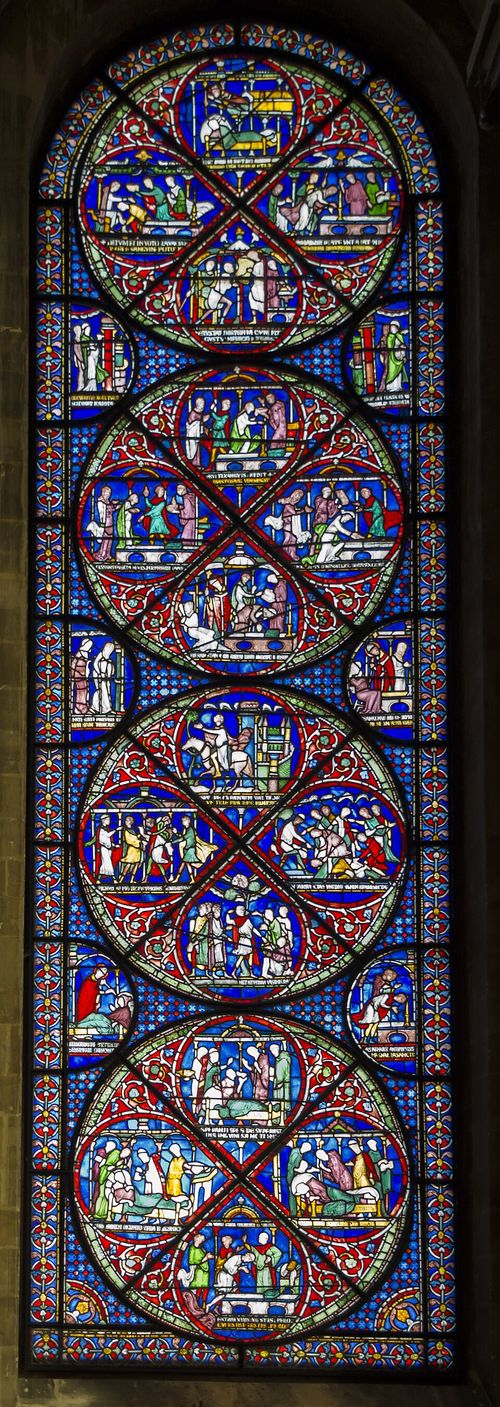
Miracles were reported at the tomb within days, and Canterbury became one of the great pilgrimage centres of Christendom. Pilgrims came from across Europe, chapels and churches were dedicated to him from Dublin to Sicily, and two centuries later Chaucer sent his storytellers on the road to "the hooly blisful martir". The cathedral's stained glass still shows the miracles credited to him. Henry's penance in 1174 coincided with the defeat of a rebellion against him, which contemporaries read as a sign that the saint had forgiven him.
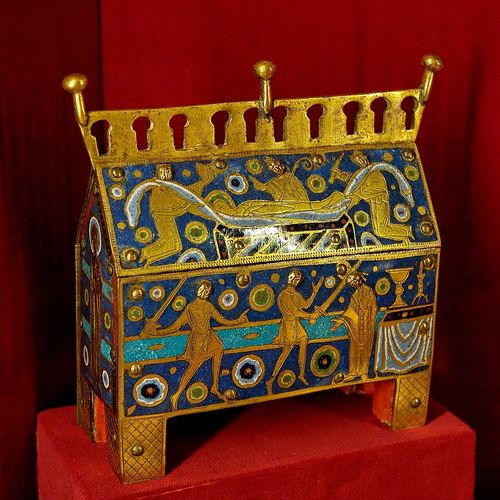
Henry VIII, at war with Rome and with the memory of a churchman who had defied a king, had the shrine stripped and destroyed in 1538 and ordered Becket's name erased from service books. The spot where he fell is still marked in the north-west transept. The story has been retold many times since, most famously in T. S. Eliot's play Murder in the Cathedral, first performed in 1935.
Questions readers ask
Who killed Thomas Becket?
Four knights of Henry II's household, Reginald FitzUrse, Hugh de Morville, William de Tracy and Richard le Breton, killed him in Canterbury Cathedral on 29 December 1170.
Did Henry II order Becket's murder?
Henry raged against Becket at Christmas 1170 and the knights acted on his words, but he always denied ordering a killing. He did public penance at Becket's tomb in 1174.
Did Henry II really say 'Will no one rid me of this turbulent priest?'
No contemporary source records those words, which first appear centuries later. Edward Grim, who was present at the murder, reports a different and longer complaint about traitors in the king's household.
What happened to Becket's murderers?
They were never tried. The pope excommunicated them and ordered them to serve fourteen years in the Holy Land as penance.
Sources and further reading
- Thomas Becket (Wikipedia)
- Edward Grim (Wikipedia)
- Reginald FitzUrse (Wikipedia)
- Wikidata Q192236 (life dates checked here)
Written by Sinister Crimes from the sources above; see our editorial standards. Last checked 1 November 2026.