

The case
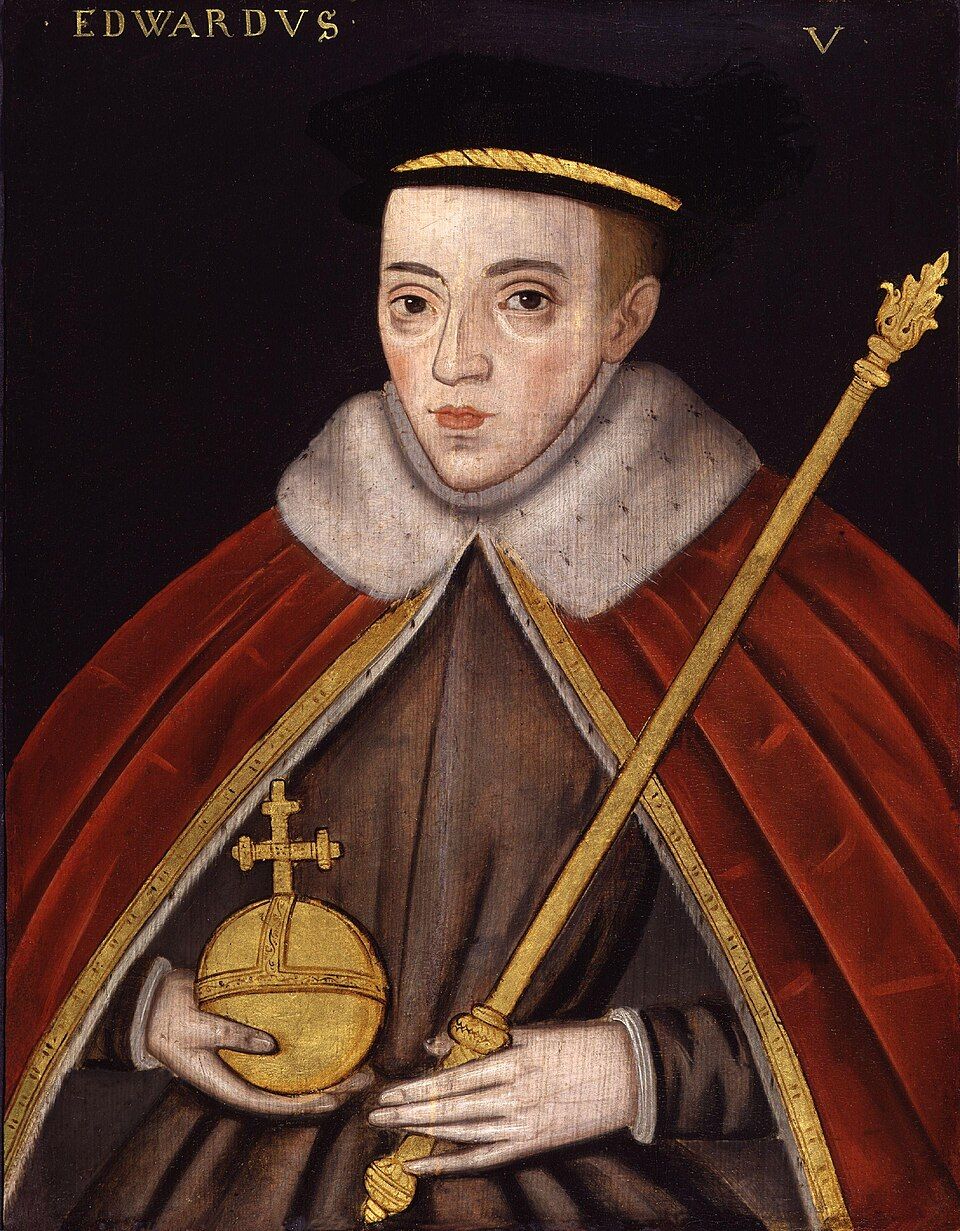
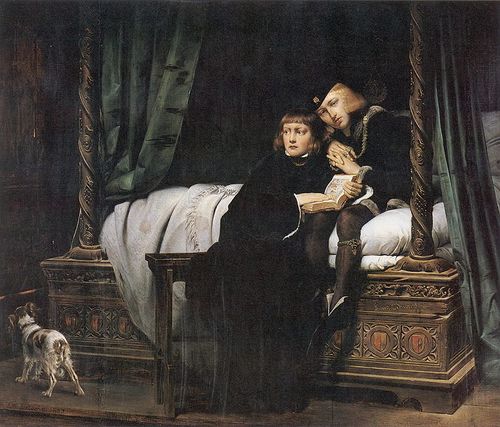
An Italian friar who was in London in the summer of 1483, Dominic Mancini, watched it happen. The boy king Edward V and his younger brother Richard were at first seen playing in the grounds of the Tower of London. Then they were withdrawn into the inner apartments and seen less and less often, until they were not seen at all. The doctor who attended the young king told Mancini that the boy made confession and did penance every day, because he believed death was facing him. Mancini's report, written before the end of that year and lost until it turned up in the municipal library at Lille in 1934, is the only account written while the princes' fate was still news.
Their father, Edward IV, had died suddenly on 9 April 1483. His heir, twelve years old, was being raised at Ludlow Castle under the eye of his mother's brother, Anthony Woodville, Earl Rivers. As the boy travelled toward London for his coronation, his father's brother Richard, Duke of Gloucester, met the party at Stony Stratford, arrested Rivers and the king's half-brother Sir Richard Grey, and took charge of the king himself. Rivers and Grey were later beheaded at Pontefract. The queen, Elizabeth Woodville, fled with her younger son and her daughters into sanctuary at Westminster Abbey.
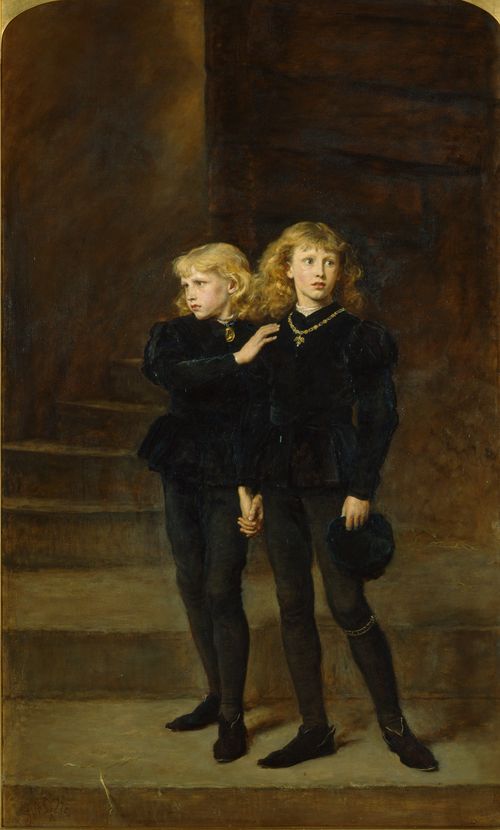
Gloucester was confirmed as Protector, and Edward was lodged in the Tower in May, then the customary place for a king to wait before his crowning. On 16 June the queen was persuaded to give up her younger son, nine-year-old Richard, Duke of York, to keep his brother company. Within days the coronation was postponed. A sermon at St Paul's Cross on 22 June argued that Edward IV's marriage had been invalid because of an earlier promise to marry another woman, so that his children were illegitimate. On 26 June Gloucester took the throne, and on 6 July he was crowned Richard III.
No record shows either boy alive after the summer of 1483. A plot to free them failed in July, and that autumn a rebellion against Richard, joined by his former ally the Duke of Buckingham, switched its allegiance to the exiled Henry Tudor, which suggests the rebels believed the princes were already dead. By January 1484 the chancellor of France was telling the French Estates General that Richard had murdered his nephews. Richard never displayed the boys to quash the rumour, and never ordered an inquiry.
The fullest version of the murder story was written about thirty years later by Thomas More. He said that Richard sent Sir James Tyrrell to the Tower, that two of Tyrrell's men smothered the boys in their beds, and that they were buried at the foot of a stair and later moved. More claimed Tyrrell confessed before his execution for treason in 1502, but no written confession has ever been found, More was a boy when the princes disappeared, and his account was written under the Tudors, whose claim rested on Richard's guilt. Shakespeare built his Richard III on More.
In July 1674 workmen at the Tower dug up a wooden chest under a staircase leading to the White Tower's chapel. It held the bones of two children. Charles II accepted them as the princes and had them placed in an urn in Westminster Abbey. In 1933 the urn was opened and an anatomist judged the bones consistent with boys of about the right ages, but the examination assumed what it set out to prove and could not determine sex or date. The bones have not been tested since, so even whether the two boys died in the Tower remains, strictly, unproven.
The victims
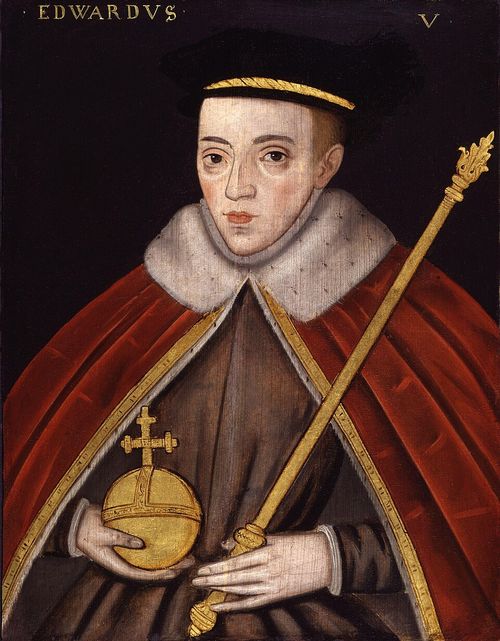
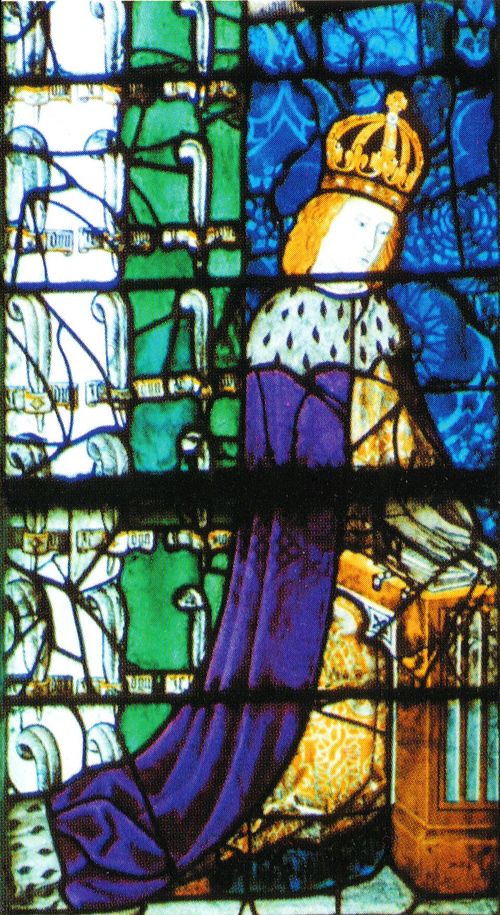
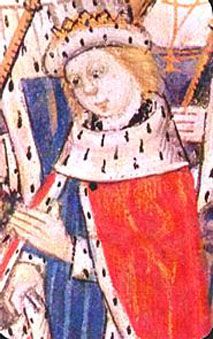
Edward was born on 2 November 1470 in sanctuary at Westminster, where his mother had fled while his father was driven from the throne. He was made Prince of Wales as a baby and from the age of three lived at Ludlow with his own household. His father's written instructions for his upbringing survive: Mass every morning, lessons, noble stories read at dinner, and exercise suitable for a prince. When his uncle arrested his escort at Stony Stratford, Mancini reports, the boy protested, to no effect. He was king for under three months and never crowned.
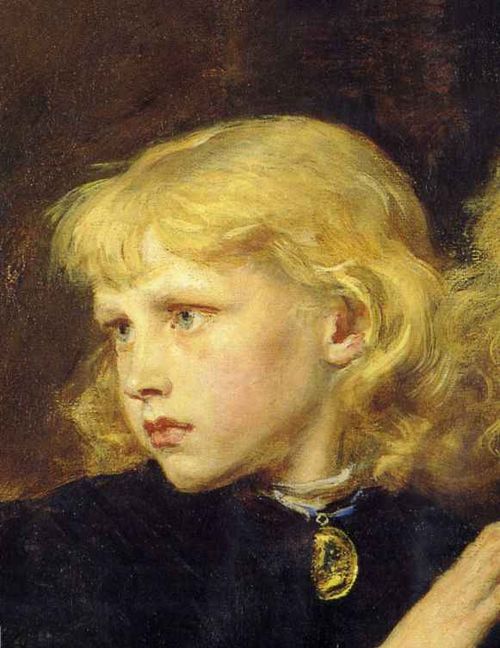
His brother Richard was born on 17 August 1473 and was made Duke of York as a small child. At four he was married in St Stephen's Chapel, Westminster, to the five-year-old Anne Mowbray, heiress to the dukedom of Norfolk; she died in 1481. He had spent the spring of 1483 in sanctuary with his mother and sisters before being handed over to join his brother. He was nine when he was last seen. Their sister Elizabeth later married Henry VII and became the mother of Henry VIII.
Timeline
Edward IV dies; his twelve-year-old son becomes Edward V.
At Stony Stratford, Gloucester takes custody of the young king and arrests his Woodville escort.
Edward V is lodged in the Tower of London ahead of his coronation.
His brother Richard is taken from sanctuary at Westminster to join him in the Tower.
A sermon at St Paul's Cross declares Edward IV's children illegitimate.
Gloucester is crowned Richard III.
An attempt to rescue the princes fails; after this summer there is no record of either boy alive.
Buckingham is executed after his rebellion collapses.
The French chancellor accuses Richard of murdering his nephews before the Estates General at Tours.
Richard III is killed at Bosworth and Henry Tudor becomes Henry VII.
Sir James Tyrrell is executed for treason; Thomas More later says he had confessed to the murders.
Workmen at the Tower find two children's skeletons under a staircase by the White Tower.
The bones in Westminster Abbey are examined and judged consistent with the princes' ages.
People in the case
-
Edward V Victim
2 November 1470 – ?
Elder son of Edward IV; proclaimed king on his father's death in April 1483, deposed in June and last seen that summer. Date and manner of death unknown.
-
Richard of Shrewsbury, Duke of York Victim
17 August 1473 – ?
Younger son of Edward IV; taken from sanctuary to the Tower on 16 June 1483 and not seen after that summer. Date and manner of death unknown.
-
Richard III Suspect
2 October 1452 – 22 August 1485
The princes' uncle, Protector and then king from June 1483; widely accused from late 1483 onward and regarded by most historians as the likeliest culprit. Killed at Bosworth.
-
Henry Stafford, 2nd Duke of Buckingham Suspect
4 September 1455 – 2 November 1483
Richard's chief ally in 1483, then a rebel against him; named as responsible by a few early sources. Executed at Salisbury.
-
Henry VII Suspect
28 January 1457 – 21 April 1509
Took the throne in 1485 and married the princes' sister Elizabeth; suggested as a suspect by some later writers, though he was abroad when the boys vanished.
-
Sir James Tyrrell Suspect
? – 6 May 1502
Servant of Richard III named by Thomas More as the organiser of the murder; executed for treason in 1502. Born c. 1455. No confession survives.
-
Elizabeth Woodville Also involved
1437 – 8 June 1492
The princes' mother; took sanctuary at Westminster and later backed Henry Tudor's cause. Birth year approximate.
-
Dominic Mancini Witness
Italian visitor whose report, written before the end of 1483, is the only contemporary narrative of the princes' last months. Dates uncertain.
-
Thomas More Also involved
7 February 1478 – 6 July 1535
Author of the History of King Richard III (c. 1513), the main source for the story of the smothering.
Where it happened
- White Tower, Tower of London. The princes were held in the Tower; bones were found beside the White Tower in 1674.
- Westminster Abbey. Where the queen took sanctuary in 1483 and where the 1674 bones are buried in the Henry VII Lady Chapel.
Outcome
Unsolved Unsolved
No one was ever charged with the princes' deaths. Henry VII's act of attainder against Richard III accused him in general terms of shedding infants' blood but did not name the princes. Tyrrell was executed in 1502 for unrelated treason, and his supposed confession is known only from Thomas More.
What the record settles, and what it doesn't
Established
- Edward V and his brother Richard, Duke of York, were lodged in the Tower of London in May and June 1483.
- Their uncle Richard, Duke of Gloucester, had them declared illegitimate and took the throne as Richard III in June 1483.
- No reliable record shows either boy alive after the summer of 1483.
- Rumours that they had been murdered, usually blaming Richard, were circulating in England and abroad by early 1484.
- Thomas More's account of their smothering on Tyrrell's orders was written about thirty years later and rests on a confession no one has seen.
- Two children's skeletons found at the Tower in 1674 were buried in Westminster Abbey as the princes, but their identity has never been proved.
Disputed
- Who was responsible: most historians consider Richard III the likeliest, since he had the motive and controlled the Tower; others point to the Duke of Buckingham, and a minority have suggested Henry VII or Margaret Beaufort, for whom the evidence is weaker.
- Whether the boys were murdered at all: some writers argue one or both survived, pointing to Henry VII's caution and to Perkin Warbeck, who claimed to be Prince Richard; most historians reject survival theories.
- When they died: dates proposed range from summer 1483 to after Henry VII's accession in 1485.
- Whether the 1674 bones are the princes: the location partly fits More's story, but the stair above them was built later, other children's bones have been found in the Tower, and the 1933 examination did not establish sex or date.
- How far Thomas More's account can be trusted, given that it was written under the Tudors and drew on a confession that does not survive.
Pictures





Afterwards
The princes' disappearance shadowed Richard's short reign and helped Henry Tudor rally support; after Bosworth, Henry married their sister Elizabeth of York and repealed the act that had declared her and her brothers illegitimate. Two pretenders exploited the mystery. Lambert Simnel was crowned in Dublin in 1487, and Perkin Warbeck, claiming to be Prince Richard, troubled Henry for most of the 1490s until his capture and execution in 1499.
The Tudor version, carried by More and Shakespeare, made Richard the archetypal wicked uncle, and a counter-movement defending him has been active since the eighteenth century. The 2012 discovery of Richard III's own skeleton under a car park in Leicester renewed calls to test the bones in Westminster Abbey and an unidentified pair of children's coffins in the royal vault at Windsor. Permission has never been given, and the urn remains sealed beneath Christopher Wren's memorial.
Questions readers ask
What happened to the Princes in the Tower?
Edward V and his brother Richard were lodged in the Tower of London in 1483 and were never reliably seen after that summer. They are generally assumed to have been killed, but there is no direct evidence of when, how or by whom.
Did Richard III kill the princes?
He is the most widely suspected, because he took their throne, controlled the Tower and was accused within months. But no conclusive evidence has been found, and some historians point to other suspects or doubt that the boys were murdered.
Have the princes' bodies been found?
Two children's skeletons found at the Tower in 1674 were buried in Westminster Abbey as the princes. They were examined in 1933 but have never been DNA tested, so their identity is unproven.
How old were the Princes in the Tower?
When their father died in April 1483, Edward was twelve and Richard nine.
Sources and further reading
- Princes in the Tower (Wikipedia)
- Edward V (Wikipedia)
- Richard of Shrewsbury, Duke of York (Wikipedia)
- Wikidata Q648580 (life dates checked here)
Written by Sinister Crimes from the sources above; see our editorial standards. Last checked 1 November 2026.