

The case
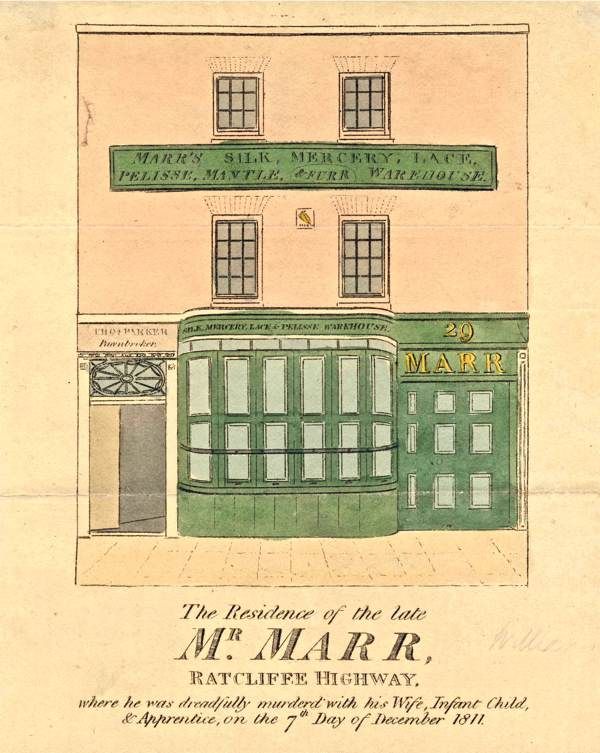
A little before midnight on Saturday 7 December 1811, Timothy Marr sent his servant Margaret Jewell out to buy oysters. Marr kept a linen draper's and hosier's shop at 29 Ratcliff Highway, the busy, rough road running east from the Tower through the docks and sailors' lodgings of Wapping. Saturday was pay day and his late customers had just gone. The oyster shop was shut, so was the baker's where Jewell meant to settle a bill, and when she came back after twenty minutes the house was dark and locked. She knocked, heard a step on the stairs and the baby cry, and then nothing.
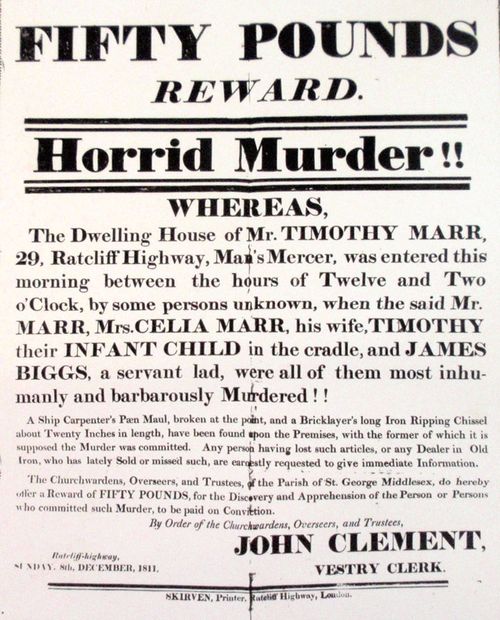
Her hammering brought the night watchman and woke a neighbour, a pawnbroker named John Murray, who climbed over his back wall and went in. Inside he found Marr, his wife Celia, their apprentice James Gowan and their fourteen-week-old son Timothy, all killed. Nothing appeared to have been taken; there was money in the till and more upstairs. In a bedroom the Thames River Police found a heavy shipwright's maul, bloodied, which was assumed to be the weapon.
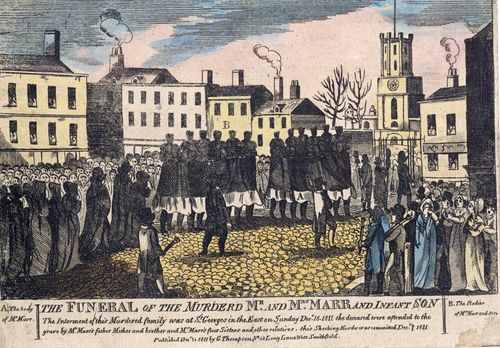
London had no police force in the modern sense. The inquiry fell to parish constables, watchmen, the river police and the Bow Street Runners, and suspects were taken up on hearsay and released. The four Marrs were buried together at St George in the East on 15 December. Four days later someone cleaned the maul and noticed initials, read as "I P" or "J P", punched faintly into the handle.
That same night, 19 December, the killer struck again, half a mile away at the King's Arms in New Gravel Lane. John Williamson, the publican, his wife Elizabeth and their servant Bridget Harrington were killed. Their lodger John Turner escaped by knotting sheets together and climbing down from an upper window, shouting murder, and the Williamsons' fourteen-year-old granddaughter Catherine Stillwell was found asleep and unharmed upstairs. Turner said he had glimpsed a tall man in a long coat bending over Mrs Williamson's body.
Within days the magistrates had a suspect: John Williams, a seaman of about 27 who lodged at the Pear Tree in nearby Cinnamon Street and had been drinking at the King's Arms that evening. He was examined at the Shadwell police office on 23 December and sent to Coldbath Fields prison. The next day the Pear Tree's landlord identified the maul as one belonging to a sailor called John Petersen, whose tools were stored in the house. A laundress spoke of a torn and bloodied shirt. Williams said he had been in a brawl over cards.
He never had the chance to answer in court. On the morning of 28 December he was found hanged in his cell. The magistrates treated the suicide as a confession and declared him the murderer of both households, and the Home Secretary agreed. On 31 December his body was drawn through Wapping on an open cart, past the Marr shop and the King's Arms, and buried at the crossroads near St George's turnpike with a stake driven through it. The evidence against him had never been tested before a jury.
The victims
Timothy Marr was in his twenties, a former seaman with the East India Company who had saved enough to open his own shop on the Highway that spring. He and his wife Celia had a son, also Timothy, born on 29 August and baptised at St George in the East. James Gowan was their apprentice. The family had been in the house barely eight months.
John Williamson, 56, had kept the King's Arms for fifteen years and ran a quiet house; he and his wife Elizabeth, about 60, liked to close early. Bridget Anna Harrington, in her late fifties, worked for them as a servant. Their granddaughter Catherine, who slept through the attack, was the only member of the household left.
Timeline
Timothy, Celia and baby Timothy Marr and apprentice James Gowan are killed at 29 Ratcliff Highway shortly before midnight.
A coroner's jury sits on the Marr deaths.
The Marrs and their apprentice are buried at St George in the East.
Initials are noticed on the maul; that night John and Elizabeth Williamson and Bridget Harrington are killed at the King's Arms.
John Williams is examined at the Shadwell police office and committed to Coldbath Fields prison.
The landlord of the Pear Tree identifies the maul as a lodger's tool kept at the house.
Williams is found hanged in his cell; the magistrates declare him guilty.
Williams's body is paraded through Wapping and buried at a crossroads near St George's turnpike.
People in the case
-
Timothy Marr Victim
? – 7 December 1811
Linen draper at 29 Ratcliff Highway; his age was reported as 24 or 27.
-
Celia Marr Victim
? – 7 December 1811
Timothy Marr's wife, still recovering from childbirth.
-
Timothy Marr (infant) Victim
29 August 1811 – 7 December 1811
The Marrs' son, fourteen weeks old.
-
James Gowan Victim
? – 7 December 1811
Apprentice in the Marr shop.
-
John Williamson Victim
? – 19 December 1811
Publican of the King's Arms, New Gravel Lane, aged 56.
-
Elizabeth Williamson Victim
? – 19 December 1811
John Williamson's wife, aged about 60.
-
Bridget Anna Harrington Victim
? – 19 December 1811
Servant at the King's Arms, in her late fifties.
-
John Williams Accused
? – 28 December 1811
Seaman, aged about 27, also called John Murphy; died in custody before trial and was declared guilty by the magistrates.
-
Margaret Jewell Witness
The Marrs' servant, who was out on an errand during the first attack.
-
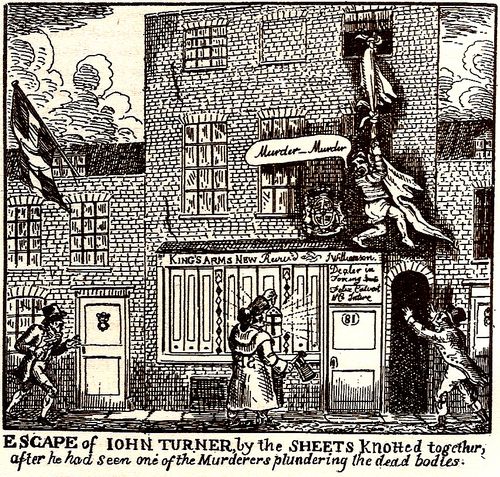
John Turner Witness
Lodger at the King's Arms who escaped by a rope of sheets.
Where it happened
- Site of 29 Ratcliff Highway (now The Highway). The Marr shop stood on the south side between Cannon Street Road and Artichoke Hill.
- New Gravel Lane (now Garnet Street). Site of the King's Arms, where the Williamsons and their servant were killed.
- St George in the East. Hawksmoor's church, where the Marr family were buried.
- Junction of Cannon Street Road and Cable Street. Approximate site of Williams's crossroads burial.
Outcome
Disputed verdict Accused died before trial
John Williams hanged himself in Coldbath Fields prison on 28 December 1811 before he could be tried. The Shadwell magistrates continued their hearing, took his suicide as proof of guilt and named him as the sole killer of both households. No one else was ever charged.
What the record settles, and what it doesn't
Established
- Four people in the Marr household were killed at 29 Ratcliff Highway shortly before midnight on 7 December 1811.
- Three people were killed at the King's Arms in New Gravel Lane on 19 December 1811, while a lodger escaped and a granddaughter survived unharmed.
- A shipwright's maul found at the Marr house was traced to a sailor's tool chest kept at the Pear Tree, where John Williams lodged.
- Williams was examined by magistrates and held at Coldbath Fields, where he was found hanged on 28 December 1811.
- The magistrates declared him guilty without a trial, and his body was paraded through Wapping and buried at a crossroads with a stake through it.
Disputed
- Whether Williams was the killer: the magistrates were satisfied, but the evidence was circumstantial, his build did not match Turner's tall man, and his alibi was never checked, so several historians have argued that the case was closed to calm the public.
- Whether one man acted alone: witnesses spoke of two men running from the scenes, and other suspects, including a carpenter who worked at the Marr shop and a former shipmate of Williams, were detained and released.
- Whether Williams's death was suicide: prisoners and a warder said he had been in good spirits the day before, which led to speculation that he was killed.
- The motive: some accounts claim Williams and Marr had sailed together and fallen out, but no clear reason for the second attack was ever found.
- The size of the crowd at the procession: figures range from about 10,000 to an often-quoted 180,000.
Pictures



Afterwards
The murders caused a panic across London and exposed how improvised the policing of the capital still was: the inquiry had depended on parish watchmen, separate magistrates' offices and competing rewards that encouraged informers. A single Metropolitan Police force was not created until 1829.
Thomas De Quincey made the killings a centrepiece of his ironic essay "On Murder Considered as One of the Fine Arts", which kept them in literary memory for two centuries. In the 1880s workmen digging a trench at the crossroads where Cannon Street Road meets Cable Street uncovered a skeleton with a stake through it, believed to be Williams. The Highway has since been rebuilt beyond recognition, but St George in the East still stands.
Questions readers ask
Who committed the Ratcliff Highway murders?
Magistrates named John Williams, a seaman who lodged nearby, after he hanged himself in prison before trial. Because he was never tried and the evidence was circumstantial, many writers doubt he was guilty or that he acted alone.
How many people were killed in the Ratcliff Highway murders?
Seven: four in the Marr household on 7 December 1811 and three at the King's Arms on 19 December 1811.
Why was John Williams buried at a crossroads?
Suicides could not then be buried in consecrated ground, and crossroads burial with a stake was an old custom for them. The parade and burial were also meant to show a frightened public that the supposed killer was dead.
Sources and further reading
- Ratcliff Highway murders (Wikipedia)
- The Ratcliffe Highway Murders of December 1811 (Thames Police Museum)
- Wikidata Q7295511 (life dates checked here)
Written by Sinister Crimes from the sources above; see our editorial standards. Last checked 1 November 2026.