

The case
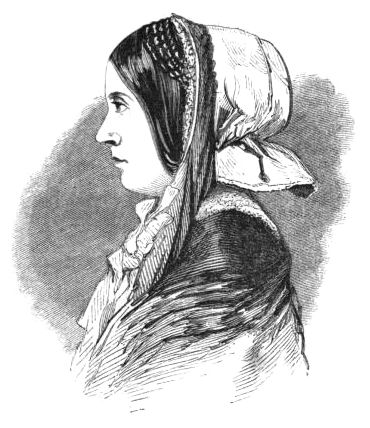
When the police searched Pierre Emile L'Angelier's lodgings in Glasgow after his death on 23 March 1857, they found a great many letters, most of them from the same correspondent, Madeleine Hamilton Smith, the 22-year-old eldest daughter of the architect James Smith, and many were written in a frankness that Victorian readers found almost impossible to credit. A post-mortem had already found a large quantity of arsenic in L'Angelier's stomach. Eight days after he died, she was arrested.
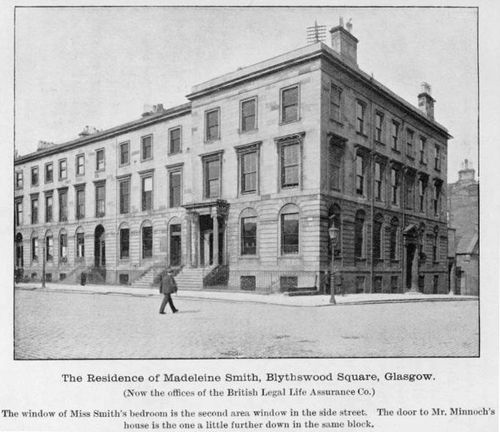
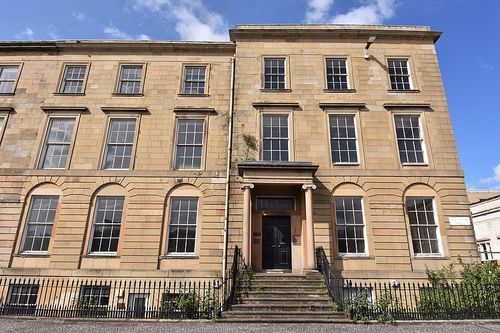
The two had met in 1855. He was a clerk in a seed merchant's warehouse, about ten years older than her, born in the Channel Islands to French parents and without money or connections. She lived with her family at 7 Blythswood Square, in the most respectable part of the city. Her parents knew nothing of him. The couple met at her basement bedroom window and wrote to each other constantly, and by 1856 they were lovers and talked of marriage.
Late that year her parents found her a suitable match, a prosperous merchant named William Harper Minnoch who lived in the same building. Early in 1857 she accepted him and tried to end the affair with L'Angelier, asking him to give back her letters. He refused, and made clear that he would show them to her father rather than let her go. Her next letters turned warm again.
L'Angelier was taken violently ill on the night of 19 February and again on 22 February, and recovered both times. Madeleine Smith bought arsenic from Glasgow druggists on 21 February, 6 March and 18 March, signing the poison register in her own name and saying it was for rats. On the evening of 22 March, L'Angelier came back early from a holiday at Bridge of Allan, telling his landlady he had received a letter calling him back, and went out late. A letter from her asking him to come was later found in his waistcoat pocket. He came home after two in the morning in agony and died some hours later.
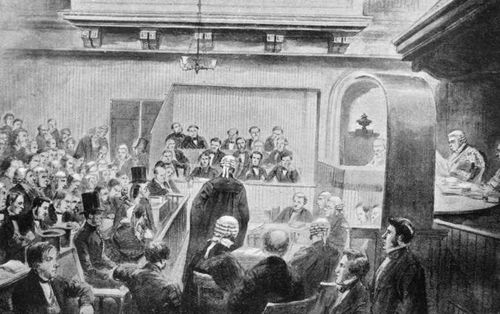
Her trial at the High Court of Justiciary in Edinburgh ran from 30 June to 9 July 1857 and became the sensation of the year. The Lord Advocate, James Moncreiff, prosecuted in person. Her counsel, John Inglis, built the defence on a gap in the evidence: no witness could place the two together on any of the nights he fell ill, and nobody could show that she had seen him on 22 March at all. He suggested that L'Angelier, who had talked of suicide before, might have taken the poison himself, and pointed out that the arsenic she bought had been coloured with soot or indigo, as the law required, while none was seen in the dead man's stomach.
The Lord Justice-Clerk, Lord Hope, summed up in terms many thought leaned towards her. The jury was out for about half an hour. She was found not guilty on the charge connected with L'Angelier's first illness, which had come two days before her first recorded purchase of arsenic, and the murder charge was found not proven, the verdict Scots law allows when a jury is unconvinced of either guilt or innocence. She was released the same day.
Madeleine Smith left Scotland. In London in 1861 she married George Wardle, a designer who later managed William Morris's firm, and moved in artistic and socialist circles. The couple separated in 1889. She later went to the United States, married again and died in New York in April 1928, at the age of 93.
The victims
Pierre Emile L'Angelier was in his early thirties when he died, a Channel Islander of French family who had worked in nurseries and in Edinburgh before settling in Glasgow as a packing clerk with a firm of seedsmen. Acquaintances described him as vain and eager to rise in society, and also as warm, talkative and devoted. He had been jilted once before and had spoken of suicide.
He kept everything Madeleine Smith wrote to him, and the letters became the centre of the case against her. In death he was cast by her defence as a social climber and blackmailer, and by the prosecution as a seduced man who was killed to keep a scandal quiet. He was buried in the Ramshorn Cemetery on Ingram Street, Glasgow.
Timeline
Madeleine Hamilton Smith is born in Glasgow.
She meets Pierre Emile L'Angelier, and they begin a secret correspondence.
She accepts a proposal from William Harper Minnoch.
She asks L'Angelier to return her letters; he refuses and threatens to show them to her father.
L'Angelier suffers the first of two bouts of violent illness that month.
Madeleine Smith makes the first of three recorded purchases of arsenic.
L'Angelier dies at his lodgings in the early morning; arsenic is found at the post-mortem.
Madeleine Smith is arrested after her letters are found among his belongings.
Her trial opens before the High Court of Justiciary in Edinburgh.
The jury returns not guilty on one charge and not proven on the charge of murder, and she is freed.
She marries George Wardle in London.
She and Wardle separate; she later moves to the United States.
She dies in New York at the age of 93.
People in the case
-
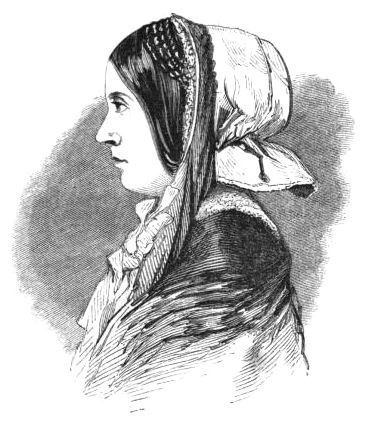
Madeleine Smith Accused
29 March 1835 – 12 April 1928
Eldest daughter of the Glasgow architect James Smith. Charged with murder; the jury returned not proven. Later known as Lena Wardle and Lena Sheehy.
-
Pierre Emile L'Angelier Victim
? – 23 March 1857
Packing clerk from the Channel Islands, born c. 1823; her secret lover, who died of arsenic poisoning.
-
William Harper Minnoch Witness
Glasgow merchant to whom she was engaged in early 1857; gave evidence at the trial.
-
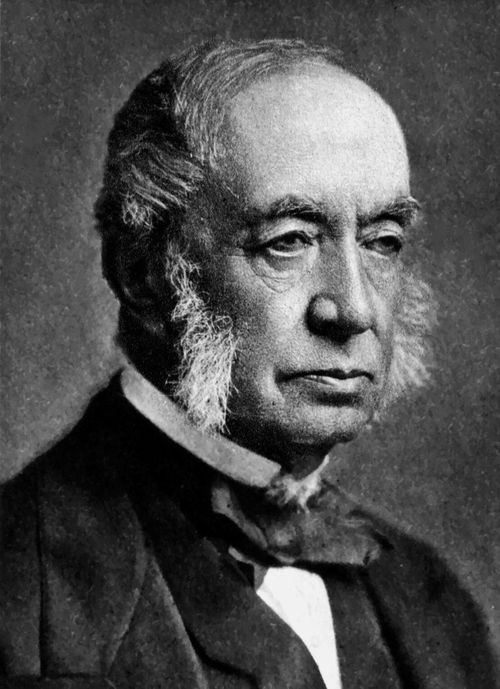
John Inglis Defence
21 August 1810 – 20 August 1891
Dean of the Faculty of Advocates; led her defence and later became Lord Justice-General as Lord Glencorse.
-
James Moncreiff Prosecutor
29 November 1811 – 27 April 1895
Lord Advocate, who prosecuted the case himself.
-
John Hope, Lord Hope Judge
26 May 1794 – 14 June 1858
Lord Justice-Clerk, who presided at the trial.
-
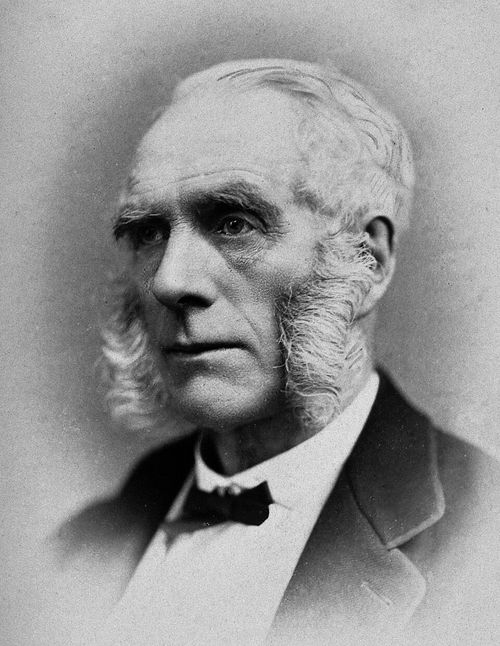
Andrew Douglas Maclagan Witness
17 April 1812 – 5 April 1900
Edinburgh medical jurist who gave toxicological evidence that L'Angelier died of arsenic.
-
James Smith Also involved
1808 – 1863
Her father, a leading Glasgow architect; the family left Glasgow after the trial.
Where it happened
- 7 Blythswood Square, Glasgow. The Smith family home, where she met L'Angelier at her basement window.
- Parliament House, Edinburgh. Seat of the High Court of Justiciary, where she was tried in June and July 1857.
- Ramshorn Cemetery, Ingram Street, Glasgow. Where L'Angelier was buried.
Outcome
Acquitted Not proven
Madeleine Smith was tried before the High Court of Justiciary in Edinburgh from 30 June to 9 July 1857 on charges of administering poison and of murder. The jury found her not guilty on the charge relating to L'Angelier's first illness and returned a verdict of not proven on the murder charge. Under Scots law not proven is an acquittal, and she could not be tried again.
What the record settles, and what it doesn't
Established
- Pierre Emile L'Angelier died of arsenic poisoning in Glasgow on 23 March 1857.
- Madeleine Smith and L'Angelier had a long secret relationship, recorded in letters found in his lodgings.
- She had become engaged to William Harper Minnoch and had asked L'Angelier to return her letters, which he refused to do.
- She bought arsenic from Glasgow druggists more than once in the weeks before his death and signed for it in her own name.
- No witness placed the two together on the night of his death or on the nights of his earlier illnesses.
- The jury found the murder charge not proven on 9 July 1857, and she was freed.
Disputed
- Whether she poisoned him: most later writers have thought her guilty, while others accept the defence's suggestion of suicide or accidental self-poisoning.
- Whether the couple met on the night of 22 March; the defence's case depended on there being no proof that they did.
- Why no trace of the soot or indigo colouring was seen in L'Angelier's stomach, if the arsenic was hers.
- Whether some letters were matched to the right envelopes; the dating of one undated letter by an illegible postmark was argued over at the trial.
- The exact date of her death: most sources give 12 April 1928, but some catalogue records give 28 April. A minority of writers have doubted that the Lena Sheehy who died in New York was Madeleine Smith at all.
Pictures




Afterwards
The Smith family sold their Glasgow house and country villa and withdrew to Bridge of Allan and then Polmont, where her father died in 1863. Madeleine reinvented herself in London as Lena Wardle, wife of a designer at Morris & Co., and was involved for a time with the Fabian Society. After her marriage ended she went to the United States, where she married William Sheehy, who died in 1926. She was buried at Mount Hope Cemetery in Hastings-on-Hudson, New York.
The case became a model for later fiction about sexual secrecy and poison. Wilkie Collins drew on the not proven verdict for The Law and the Lady (1875), and David Lean filmed the story as Madeleine (1950). Her letters survive, and some are held by Glasgow Libraries and the Morgan Library in New York.
Questions readers ask
What does 'not proven' mean in Madeleine Smith's case?
Not proven is a verdict available to Scottish juries alongside guilty and not guilty. It counts as an acquittal, so Madeleine Smith walked free and could not be retried, but it signalled that the jury was not satisfied she was innocent.
Did Madeleine Smith poison L'Angelier?
No court found that she did. She had motive and had bought arsenic, but the prosecution could not prove she met him before he fell ill. Many historians believe she was guilty; others think suicide remains possible.
What happened to Madeleine Smith after the trial?
She moved to London, married the designer George Wardle in 1861 and lived in artistic and socialist circles. After separating from him she went to America, remarried and died in New York in 1928.
Who was Pierre Emile L'Angelier?
He was a clerk in a Glasgow seed merchant's warehouse, born in the Channel Islands to a French family. He was Madeleine Smith's secret lover from 1855 and kept the letters that later formed the core of the case against her.
Sources and further reading
- Madeleine Smith (Wikipedia)
- A complete report of the trial of Miss Madeline Smith (1857), Internet Archive
- Madeleine Wardle, Lost Lives (Bill Greenwell)
- Wikidata Q1883279 (life dates checked here)
Written by Sinister Crimes from the sources above; see our editorial standards. Last checked 1 November 2026.