

The case
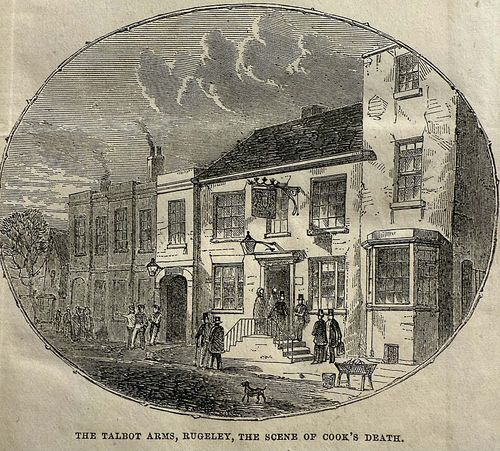
On the morning of 26 November 1855, in a room at the Talbot Arms in Rugeley, two young medical men began a post-mortem examination on the body of John Parsons Cook while a crowd looked on. One of the onlookers was Cook's friend and doctor, William Palmer. During the examination he jostled the man doing the work, and he tried to make off with the jar holding the stomach and its contents. He later offered a post-boy money to upset the jars on the way to the railway. The samples that reached the toxicologist in London were of poor quality, and a second examination had to be made. It was the sort of thing that made a whole county suspicious of its local surgeon.
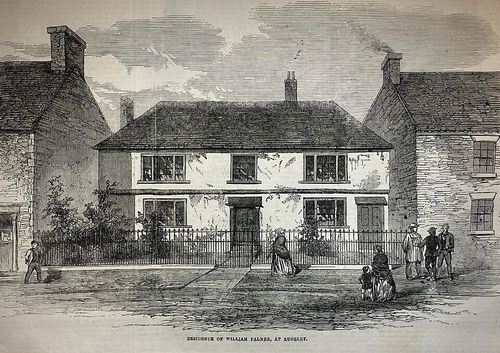
Palmer was born in Rugeley in 1824, the son of a prosperous timber merchant and sawyer, and qualified as a doctor in London in 1846. He set up practice in his home town but cared more for racing than medicine, keeping horses and betting heavily. He married Ann Thornton in 1847. Over the next eight years a striking number of people around him died: his mother-in-law, who had come to stay; a racing acquaintance who had lent him money; four of his five children, all in infancy; his wife Ann in 1854, on whose life he had a policy for £13,000; and his brother Walter in 1855, whose life he had also insured heavily. By then he owed huge sums to moneylenders on bills bearing his mother's forged signature, and the insurance company was refusing to pay on Walter's death.
In mid-November 1855 Palmer and Cook went to the races at Shrewsbury. Cook's horse Polestar won, and he collected a good sum; Palmer lost. That evening at the Raven in Shrewsbury Cook drank brandy and water and complained that it burned his throat, and was violently sick in the night. He told friends he believed Palmer had dosed him.
Back in Rugeley, Cook took a room at the Talbot Arms, across the road from Palmer's house, and Palmer took charge of his care. Cook was repeatedly sick. On Monday 19 November Palmer went to London and settled Cook's betting accounts, applying the money to his own debts. That evening, back in Rugeley, he obtained three grains of strychnine from a local surgery, and around midnight Cook was seized with convulsions. The next morning Palmer bought more strychnine at another shop. That night Cook took two pills from him, and in the early hours of 21 November 1855 he died in convulsions. Palmer produced papers claiming Cook owed him money, and an elderly local doctor certified apoplexy.
Cook's stepfather, William Stevens, was not satisfied and demanded an inquest. The analyst Alfred Swaine Taylor found antimony but no strychnine, yet told the coroner he believed Cook had been poisoned. Palmer, meanwhile, tried to influence the coroner with gifts, and the local postmaster opened letters for him. On 15 December the inquest jury named Palmer as the killer, and he was arrested. The bodies of his wife and brother were exhumed; Ann's contained antimony.
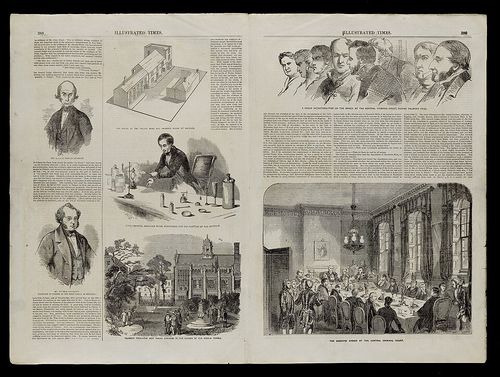
Feeling in Staffordshire ran so high that Parliament passed a special Act in April 1856 allowing the trial to move to the Central Criminal Court in London. It opened on 14 May before Lord Chief Justice Campbell. The Attorney General, Sir Alexander Cockburn, led the prosecution; Serjeant Shee defended. The medical evidence was fiercely contested: the defence called witnesses who said strychnine, if given, should have been found, while the Crown argued that Cook's symptoms could only be strychnine. On 27 May the jury convicted him. William Palmer was hanged in public outside Stafford gaol on 14 June 1856.
Who lost out
John Parsons Cook was in his late twenties, a young man who had trained for the law but, having inherited about £12,000, gave it up for the turf. He owned racehorses and was well liked at race meetings, a cheerful and rather delicate young man who trusted Palmer as a friend and as his doctor. His stepfather's persistence after his death was what brought the case to court.
The others whose deaths came to be laid at Palmer's door were never the subject of a trial. They included his wife Ann, who was twenty-seven and the mother of his surviving son; his brother Walter, an alcoholic whom he had insured; his mother-in-law Ann Thornton; the racing man Leonard Bladen; and four of his infant children. Inquest juries returned verdicts of wilful murder against him in the cases of Ann and Walter, but those indictments were dropped after his conviction for Cook's death.
Timeline
William Palmer is born in Rugeley, Staffordshire.
He qualifies as a doctor in London and returns to Staffordshire.
He marries Ann Thornton at Abbots Bromley.
His mother-in-law dies while staying in his house.
Ann Palmer dies; Palmer collects on a large policy on her life.
Walter Palmer dies; the insurer refuses to pay and sends investigators.
At Shrewsbury races Cook wins on Polestar and falls ill that night.
Palmer settles Cook's bets in London and that evening obtains strychnine in Rugeley.
John Parsons Cook dies in the early hours at the Talbot Arms, Rugeley.
A post-mortem is held, during which Palmer interferes with the samples.
The inquest jury returns a verdict of wilful murder against Palmer, and he is arrested.
An Act allowing the trial to be moved to London receives royal assent.
Palmer's trial opens at the Central Criminal Court.
He is found guilty of murdering Cook and sentenced to death.
Palmer is hanged in public outside Stafford gaol.
People in the case
-
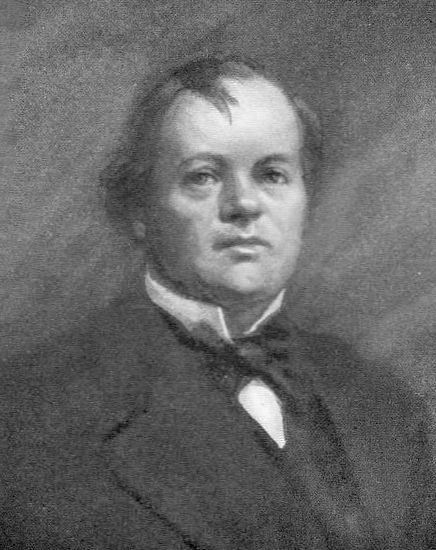
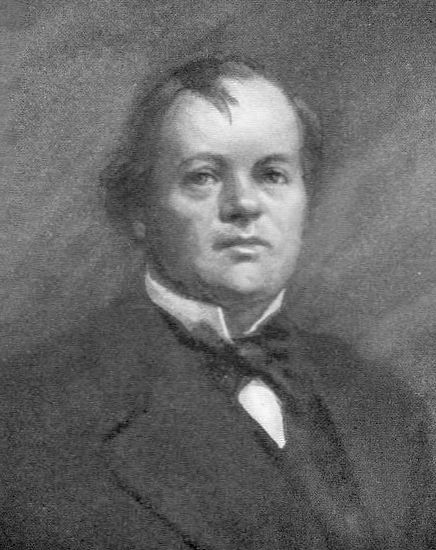
William Palmer Perpetrator
6 August 1824 – 14 June 1856
Rugeley surgeon and racehorse owner, convicted of poisoning John Parsons Cook and hanged at Stafford.
-
John Parsons Cook Victim
? – 21 November 1855
Young racing man and Palmer's friend; died at the Talbot Arms, Rugeley.
-
Ann Palmer Victim
1827 – 29 September 1854
Palmer's wife, born Ann Thornton; her death was put down to cholera, but antimony was found after exhumation. Not tried.
-
Walter Palmer Victim
? – 16 August 1855
Palmer's brother, heavily insured by him; the insurer refused to pay. Not tried.
-
William Stevens Witness
Cook's stepfather, who insisted on an inquest.
-
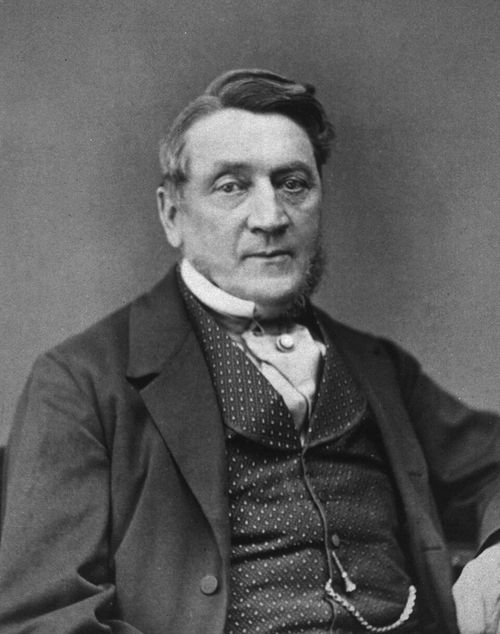
Alfred Swaine Taylor Investigator
11 December 1806 – 27 May 1880
Leading toxicologist who analysed the remains and gave evidence for the Crown.
-
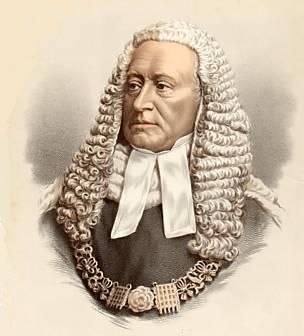
Sir Alexander Cockburn Prosecutor
24 September 1802 – 20 November 1880
Attorney General; led the prosecution.
-
William Shee Defence
24 June 1804 – 1868
Serjeant-at-law who led the defence and was rebuked for telling the jury he personally believed Palmer innocent.
-
John Campbell, 1st Baron Campbell Judge
15 September 1779 – 23 June 1861
Lord Chief Justice, who presided and summed up strongly against Palmer.
Where it happened
- Rugeley, Staffordshire. Market town where Palmer practised and where Cook died at the Talbot Arms, opposite Palmer's house.
- Old Bailey (Central Criminal Court), London. Where Palmer was tried in May 1856 under a special Act of Parliament.
- Stafford gaol. Where Palmer was held and publicly hanged; now HM Prison Stafford.
Outcome
Executed Executed
Palmer was tried at the Central Criminal Court for the murder of John Parsons Cook from 14 to 27 May 1856, the venue having been moved from Stafford by special Act of Parliament. The jury found him guilty and Lord Campbell sentenced him to death. Indictments for the murders of his wife and brother were not proceeded with, and he was hanged at Stafford on 14 June 1856.
What the record settles, and what it doesn't
Established
- John Parsons Cook died at the Talbot Arms, Rugeley, on 21 November 1855 while under Palmer's care.
- Palmer obtained strychnine in Rugeley on the two days before Cook's death, and the sales were not recorded in the poisons books.
- Palmer was deeply in debt to moneylenders, had forged his mother's signature on bills, and took control of Cook's winnings.
- He interfered with the post-mortem and tried to influence the coroner.
- His wife and brother had died while heavily insured for his benefit, and antimony was found in his wife's exhumed body.
- He was convicted of Cook's murder on 27 May 1856 and hanged at Stafford on 14 June 1856.
Disputed
- Whether Cook died of strychnine: no strychnine was found in his remains, and medical witnesses at the trial disagreed sharply about whether his symptoms proved it.
- Whether the trial was fair: Lord Campbell's summing up was strongly against Palmer, and some writers since, including Robert Graves in a novel, have argued that the case was not proved.
- How many people Palmer killed: suspicions extend to his mother-in-law, Leonard Bladen, his brother and four infant children, but only Cook's death was tried.
- The size of the policy on Walter's life, given as £13,000 or £14,000 in different accounts.
Pictures




Afterwards
The case made Palmer the most notorious poisoner of the century; a waxwork of him stood in Madame Tussaud's Chamber of Horrors for more than a century, and Conan Doyle had Sherlock Holmes cite him as proof that a doctor gone wrong is the most dangerous of criminals. The Central Criminal Court Act 1856, passed for his trial and often called Palmer's Act, gave the courts a lasting power to move a trial away from local prejudice.
The trial also put the young science of toxicology on public display, with leading experts contradicting each other in court. Palmer's surviving son, William Brookes Palmer, lived until 1926. Rugeley, legend has it, asked to change its name because of the scandal, a story that is almost certainly apocryphal.
Questions readers ask
Who did William Palmer poison?
He was convicted only of murdering his friend John Parsons Cook with strychnine in 1855. He was also suspected in the deaths of his wife, his brother, his mother-in-law, a racing acquaintance and several of his infant children.
Why was William Palmer tried in London?
Local feeling in Staffordshire was so strong that a fair trial there seemed impossible. Parliament passed the Central Criminal Court Act 1856 so the case could be heard at the Old Bailey.
Was strychnine found in John Cook's body?
No. Alfred Swaine Taylor found antimony but no strychnine, and the Crown relied on Cook's symptoms, Palmer's purchase of strychnine and his conduct. This gap was the heart of the defence case.
When was William Palmer hanged?
On 14 June 1856, in public outside Stafford gaol, before a crowd estimated at around 30,000.
Sources and further reading
- William Palmer (murderer) (Wikipedia)
- Palmer, William (1824-1856), Dictionary of National Biography (Wikisource)
- The Times report of the trial of William Palmer (Cornell Law Library)
- Wikidata Q563618 (life dates checked here)
Written by Sinister Crimes from the sources above; see our editorial standards. Last checked 1 November 2026.